
The endless “and then…” story isn’t a sign of a vivid imagination, but a broken narrative engine that lacks structure.
- Replace the weak “and then” link with a causality chain: something happens BECAUSE of a reason, BUT a problem occurs, THEREFORE a resolution is reached.
- A story only has momentum if the hero faces a real problem with high stakes, not just a minor inconvenience.
Recommendation: Treat storytelling like a craft, not a phase, by teaching your child the fundamental structural tools used by professional screenwriters.
You know the scene. Your child, eyes wide with excitement, starts a story. “There was a dragon, and then he flew to a castle, and then he met a knight, and then they found a treasure chest, and then…” The story spools out, a long, winding road of events with no destination in sight. As a parent, you praise the creativity, but as a listener, you’re lost. The common advice is to just encourage them or ask “what happens next?”, but this often pours more fuel on the rambling fire. We read them books, hoping they’ll absorb the structure by osmosis, but that’s like expecting someone to build a car just by looking at one.
The issue isn’t a lack of imagination; it’s a lack of engineering. A story is not a list. It is a narrative engine, a machine where every piece connects to the next with purpose, driven by conflict and moving toward a specific destination. If your child’s stories feel like a series of disconnected events, it’s because the foundational bolts of structure are missing. But what if the solution wasn’t just more encouragement, but more craft? What if you could give your child the blueprint used by every screenwriter in Hollywood?
This is where we shift our perspective. We stop being just a patient audience and become a story editor, a co-director. This guide will walk you through the essential screenwriting tools to fix your child’s narrative engine. We will diagnose the “And Then” trap and replace it with a powerful causality chain. We’ll learn how to forge characters that feel real because they have clear wants and needs. We will explore how to find the right medium for their unique style, inject high stakes to make any story compelling, and use games to break through creative blocks. Finally, we’ll turn these skills into daily habits, transforming everyday conversations into powerful storytelling practice and adding the final polish with poetic language. Let’s build a better story, together.
To navigate this process, here is a breakdown of the key structural elements we will cover, from the core mechanics to the final artistic touches.
Contents: A Screenwriter’s Guide to Children’s Storytelling
- The “And Then” Trap: Why Kids Can’t Edit Their Own Stories?
- Heroes and Villains: How to Create Characters That Feel Real?
- Podcast or Book: Which Medium Fits Your Child’s Storytelling Style?
- The Boring Story: Why Every Hero Needs a Big Problem?
- Story Dice: How to Gamify the Plot when They Are Stuck?
- Mental Movies: How to Teach Your Child to Picture the Story?
- Beyond “Fine”: 3 Questions That Replace “How Was School?”
- Metaphor and Rhyme: How to Teach Poetry Without Being Boring?
The “And Then” Trap: Why Kids Can’t Edit Their Own Stories?
The “And Then” trap is the default mode for a young storyteller. It’s a simple, linear accumulation of events without connection or consequence. A happens, and then B happens, and then C happens. The story moves forward chronologically, but it has no dramatic momentum. This isn’t a flaw in creativity; it’s the absence of a fundamental tool: causality. Teaching this skill is more than just about telling better stories. Research from 2024 demonstrates that children who learn structured storytelling show 30% higher scores in problem-solving tasks. They learn to think not just about what happens next, but *why* it happens.
To break this cycle, we need to replace “And Then” with a screenwriting powerhouse: the “Because, But, Therefore” (BBT) framework. This simple structure forces a chain of cause and effect, building a narrative engine that runs on its own logic. It transforms a list into a plot. Here’s how it works:
- BECAUSE: This establishes the initial situation and the reason for it. (The knight went to the cave because he heard a dragon was inside.)
- BUT: This introduces the conflict, the problem, the twist. It’s the engine’s spark. (But when he got there, the dragon was a baby who was crying.)
- THEREFORE: This is the resolution or the next logical action that results from the conflict. (Therefore, the knight put down his sword and decided to help the baby dragon find its mother.)
By guiding your child through this structure, you are teaching them to be their own first editor. You are giving them the tools to see their story not as a straight line, but as a series of connected, meaningful events. This simple shift is the first and most crucial step in building a story that has a beginning, a middle, and a satisfying end.
Heroes and Villains: How to Create Characters That Feel Real?
A story structure is just a skeleton. To bring it to life, it needs a heart: a character we care about. Often, a child’s heroes are just avatars for action—they do things, but we don’t know why. They want the treasure, they fight the monster, but their motivations are paper-thin. A compelling character, whether a hero or a villain, feels real because they have an internal dimension. The most powerful tool for this comes from professional animation studios and screenwriters: differentiating between a character’s Want and their Need.
The Want is the character’s external, conscious goal. It’s the plot-driver. It’s what they *think* will solve their problems. (e.g., A lonely princess *wants* to win the grand tournament to prove she is strong). The Need is their internal, often unconscious, flaw or lesson they must learn to truly grow. (e.g., The lonely princess *needs* to learn to trust others and make a friend). A great story happens when the pursuit of the Want forces the character to confront their Need. The tension between these two goals creates a compelling character arc.
This paragraph introduces the illustration of a child drawing a character’s emotional journey, a key part of understanding their arc.

As this drawing of an emotional arc suggests, a character’s journey is rarely a straight line. You can help your child map this out. Ask: “What does your hero want more than anything?” and then, “But what do they *really* need to learn to be happy?” This simple exercise elevates a flat character into a three-dimensional being whose journey we are invested in.
Pixar’s Framework: The Power of Potential Failure
Professional storytellers know that a hero’s objective must be at risk. The likelihood of something going wrong is what makes a story suspenseful. When you tell a suspenseful story, your audience will have a heightened focus and a strong motivation to continue listening. They are desperate to know if the hero succeeds in getting what they want, but are even more invested in seeing if they get what they *need*.
Podcast or Book: Which Medium Fits Your Child’s Storytelling Style?
Once your child has the basic tools of structure and character, the next question is: what’s the best way to get the story out? We often default to writing, but not every child is a natural writer. Forcing a “storyteller” into a single medium is like giving a painter only a chisel. A child’s natural learning style often dictates the best storytelling format for them. Recognizing this can unlock a new level of creativity and engagement, and the benefits are tangible. Studies show that children using varied storytelling mediums experience a 25% improvement in their vocabulary development.
Instead of insisting on a written story, consider your child’s innate tendencies. Are they a visual thinker, an orator who processes ideas by speaking, or a kinetic builder who needs to engage physically? As outlined by educational resources like LWTears, matching the medium to the learning style is key. The following table breaks down some options.
| Learning Style | Best Medium | Key Benefits | Suggested Tools |
|---|---|---|---|
| Visualizer | Digital Comics/Drawing | Thinks in pictures, needs visual scaffolding | Pixton, Paper & Pencils |
| Orator | Podcast/Audio Recording | Thinks out loud, verbal processing | Voice recorder, storytelling apps |
| Kinetic Builder | Stop-Motion/Acting | Needs physical manipulation | LEGO, toys, video tools |
For the Visualizer, who sees the story in their head, drawing a comic strip or storyboarding scenes can be more effective than writing paragraphs. For the Orator, who can talk for hours, a simple voice recorder app turns them into a podcast creator, allowing them to perform different voices and add sound effects. For the Kinetic Builder, who needs to touch and move things, using LEGOs or action figures to act out scenes for a stop-motion video brings their story to life in a tangible way. By offering these alternatives, you’re not just finding a new hobby; you’re validating their unique creative process and giving them the best possible stage for their narrative.
The Boring Story: Why Every Hero Needs a Big Problem?
So your child has a character and a basic plot structure. But the story still falls flat. “The knight helped the baby dragon find its mom. The end.” It’s nice, but it’s not exciting. Why? Because the narrative engine is running on low-grade fuel. The story is missing one critical ingredient: stakes. A story becomes compelling not just when a problem exists, but when the outcome of that problem truly *matters*. The hero must have something significant to lose.
A common mistake for young storytellers is creating inconveniences, not problems. An inconvenience is frustrating but easily solved (e.g., the hero’s shoelace is untied). A problem with high stakes has serious consequences for failure (e.g., the hero must tie a rope bridge together before it collapses over a canyon). Teaching your child to think in terms of stakes is teaching them to create narrative tension. This is the invisible force that keeps an audience hooked, desperate to know what happens next.
The journey itself becomes a visual metaphor for the challenges and obstacles that create a compelling narrative.
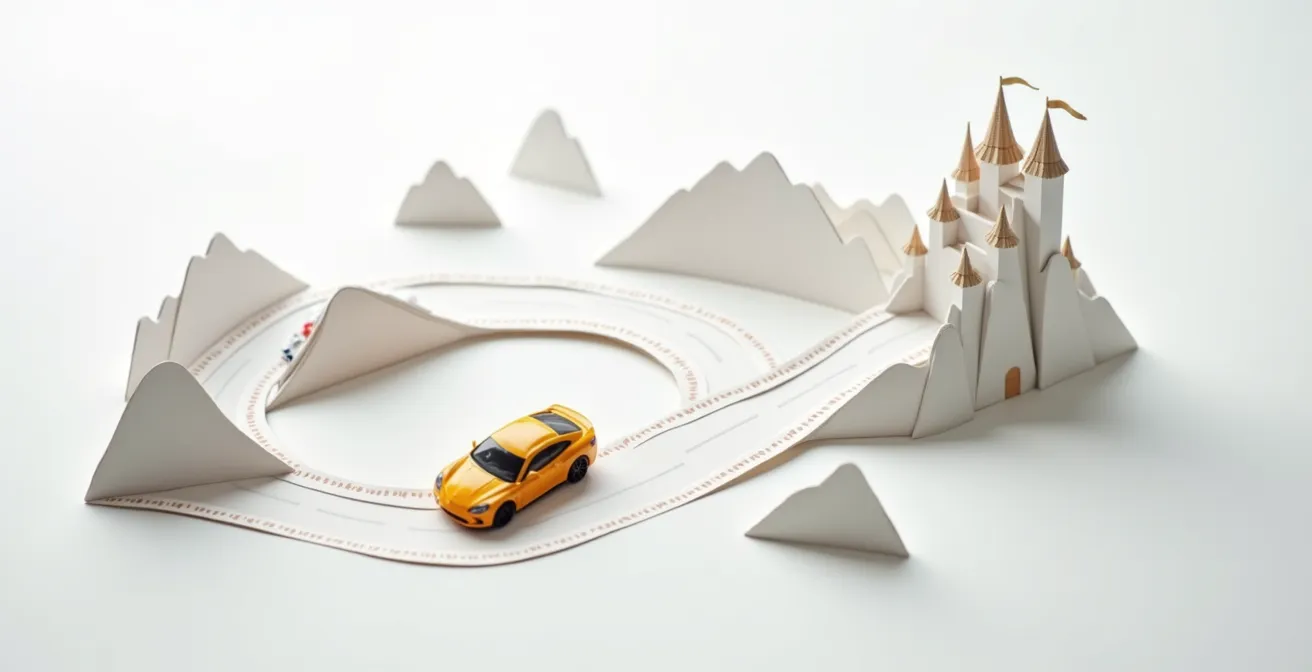
Think of the story as a journey on a winding road, as shown above. The hills are the obstacles, and the destination is the goal. A flat, straight road is a boring trip. The twists, turns, and steep climbs are what make it an adventure. The higher the climb, the more satisfying it is to reach the top.
Technique: Differentiating Stakes
A key exercise is to help your child differentiate between small problems and big problems. It’s the difference between the hero missing the bus versus the hero missing the last spaceship off a doomed planet. Ask them, “What is the worst thing that could happen if your hero fails?” If the answer is “not much,” you know you need to raise the stakes. This teaches the importance of scale and urgency, the two components that fuel a truly exciting plot.
Story Dice: How to Gamify the Plot when They Are Stuck?
Even the most seasoned screenwriter hits a wall. For a child, this moment of being “stuck” can feel like total failure. They have a character and a problem, but they have no idea what should happen next. This is the perfect moment to move from instruction to play. Story dice—cubes with simple images on each face—are a brilliant tool for this, but they work best when used not as a random story generator, but as a problem-solving device within a structured framework. The goal isn’t to generate a whole plot, but to inject a single, unexpected element that forces a creative solution.
This kind of playful constraint is fantastic for building mental agility. In fact, educational research confirms that cognitive flexibility is a crucial skill for development, and games like story dice are an excellent way to practice it. Instead of just rolling the dice and asking “what happens?”, you can create mini-games with specific narrative goals. This turns a frustrating block into an exciting challenge.
Here are a few constraint-based activities to try:
- The Escape Room: The hero is trapped! Roll three dice. “Your hero must use a key, a storm, and a boat to escape the locked room. How do they do it?”
- The Plot Twist: Create custom dice with concepts like “a secret is revealed,” “an enemy becomes a friend,” or “a trusted tool breaks.” When the story lags, roll the plot twist die and incorporate the result.
- The Revision Roll: After the first draft of the story is told, roll one die. “Okay, now we have to add a ‘ghost’ to the story. Where does it fit?”
- The Story Chain: In a group, one person starts the story. The next person rolls a die and has to add one sentence to the story incorporating their image.
By gamifying the process, you remove the pressure of “getting it right” and re-engage the child’s natural love of play. You’re teaching them that a plot problem isn’t a dead end; it’s just an opportunity to roll the dice.
Mental Movies: How to Teach Your Child to Picture the Story?
Many rambling stories suffer from a lack of scenery. The characters exist in a white void, performing actions without a tangible world around them. The child sees it all in their head, but they lack the vocabulary to “paint the picture” for their audience. To fix this, we can borrow a technique from film directing: teaching them to create “mental movies.” This means moving beyond just *what* happens and focusing on *how* it looks, sounds, and feels. It’s about training them to be the Director of Photography for their own imagination.
The first step is to get them thinking like a camera operator. Instead of just saying, “The hero was sad,” ask, “If this were a movie, where would the camera be? Is it a close-up on the hero’s face, showing a single tear? Or is it a wide shot, showing them sitting all alone in a huge, empty room?” This simple question forces them to translate an abstract emotion into a concrete visual. It encourages them to *show*, not just *tell*.
Technique: Sensory BINGO
To create a truly immersive scene, a storyteller needs to engage more than just the sense of sight. A great tool for this is “Sensory BINGO.” Create a simple card with the five senses: Sight, Sound, Smell, Touch, and Taste. As your child tells a story about a particular scene—like a walk through a spooky forest—have them try to “check off” each sense. What does the moss on the trees *feel* like? What is the *smell* of the damp earth? What is the *sound* of the wind whistling through the branches? This simple game encourages them to build a rich, multi-sensory world for their characters to inhabit.
Mastering this “director’s eye” is a skill that can be audited and improved. By thinking in terms of camera shots and sensory details, a child learns to construct scenes that are not just described, but experienced by the listener.
Your Story’s Cinematography Audit: Turning Words into Scenes
- Shot Inventory: List all the “shots” described in the scene. Is it all wide shots, or are there close-ups for emotion and detail?
- Sensory Data: Inventory all the sensory details used. Have they only described what can be seen, or have they included sounds, smells, or textures?
- Camera Logic: Does the perspective shift logically, or does it jump around confusingly? Is the “camera” guiding the audience’s attention effectively?
- Impact Shot: Identify the single most powerful image in the scene. Is it clearly described and emotionally resonant?
- Reshoot Plan: Identify where to add a new “shot.” Could a close-up on a character’s trembling hands increase tension? Could a wide shot establish the scale of the challenge?
Beyond “Fine”: 3 Questions That Replace “How Was School?”
The dreaded question: “How was school today?” The inevitable answer: “Fine.” This daily exchange is a missed opportunity. It’s a conversation-stopper, not a starter. But what if you could use this daily check-in to practice the very storytelling skills we’ve been discussing? By replacing that one generic question with three specific, structure-oriented ones, you can turn a mundane routine into a daily screenwriting workshop. You’re not just asking about their day; you’re asking them to find the story within it.
This isn’t just about conversation. Daily practice is incredibly effective for cognitive development. Research indicates that daily storytelling practice sharpens a child’s memory and their attention to detail, as they learn to scan their day for noteworthy events. Instead of asking “How was school?”, try these three questions, each designed to target a different pillar of narrative structure.
- Question 1 (The Structurer): “Tell me the Beginning, Middle, and End of your recess today.” This question explicitly asks them to impose the three-act structure on a real-life event. They have to identify a starting point (e.g., “We went outside”), a main event (e.g., “We played tag”), and a conclusion (e.g., “The bell rang and we went inside”). It’s a direct application of the core framework.
- Question 2 (The Plot-Spotter): “What was a small problem someone had today, and what happened?” This question trains them to look for conflict and resolution, the engine of any plot. It could be as simple as “Someone’s pencil broke, so they had to go sharpen it.” They are learning to identify the “But” and “Therefore” in their own lives.
- Question 3 (The Character Analyst): “Who was the ‘hero’ of your day today, and what heroic thing did they do?” This question teaches them to think about character and action. The “hero” could be a friend who shared a snack or a teacher who explained something clearly. It reframes their day in terms of character-driven events.
By weaving these questions into your daily routine, you make storytelling a natural, effortless habit. You’re teaching them that stories aren’t just in books or movies; they are everywhere, waiting to be structured and told.
Key Takeaways
- A story is a ‘narrative engine’, not a list. It requires structure, conflict, and causality to function.
- Replace the phrase ‘and then’ with the ‘Because, But, Therefore’ framework to create a logical chain of events.
- A compelling story needs high stakes. Differentiate between a minor inconvenience and a real problem with significant consequences.
Metaphor and Rhyme: How to Teach Poetry Without Being Boring?
Once the structural foundation of the narrative engine is solid, it’s time to add the finishing touches—the custom paint job, the polished chrome. This is where you move from prose to poetry, introducing tools like metaphor and rhyme. For many kids, the word “poetry” can sound boring or intimidating. But in reality, these are simply advanced tools for making language more powerful, memorable, and fun. You don’t need to teach them to write a sonnet; you just need to show them how to make their words do more work.
Metaphor is simply describing one thing by calling it something else. It’s a way to create a powerful image in the listener’s mind. Instead of “the knight was brave,” you could say “the knight was a lion in battle.” Rhyme, when used sparingly, can make a key moment or a character’s catchphrase stick in the memory. Think of it as adding a musical quality to the language. These aren’t just frivolous decorations; they are tools that enhance comprehension and vocabulary. A comprehensive 2023 study found that narrative abilities, honed by such poetic tools, positively influence a child’s listening comprehension and vocabulary.
Technique: Word Painting
A simple and fun exercise is “word painting.” Start with a very simple, boring sentence, like “The man walked.” Now, challenge your child to “repaint” the sentence with more vivid and specific words. The goal is to replace the generic verb (“walked”) and noun (“man”) to create a completely different picture. “The giant stomped.” “The spy crept.” “The old man shuffled.” This single exercise teaches them the power of word choice and how a single strong verb can tell a whole story on its own, making their prose more engaging and dynamic.
By introducing these tools as fun games rather than stuffy literary rules, you give your child the final pieces of the storyteller’s toolkit. You empower them not just to build a functional story, but to make it beautiful. They learn that the way words are chosen and arranged is just as important as the plot itself, completing their transformation from a rambling narrator to a true storyteller.
Now that you have the complete screenwriter’s toolkit, start by implementing just one of these techniques. The next time a story begins, don’t just be an audience; be a co-director and help your child build a story that doesn’t just start, but truly soars.