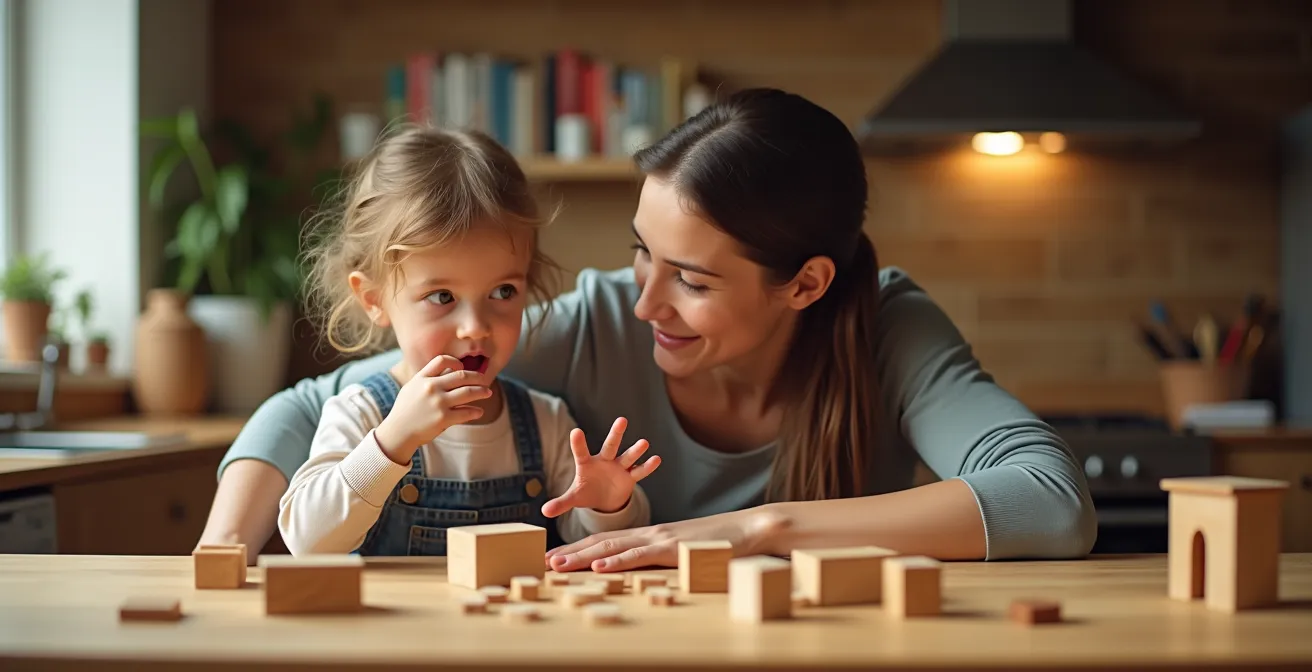
The endless stream of “why?” from a child can feel exhausting. But what if the solution isn’t to have all the answers, but to change your role entirely? This guide reframes the parent from a reactive answer-provider to a proactive “inquiry architect.” You will learn to transform your child’s natural curiosity into a powerful learning engine by providing them with the frameworks and tools to discover their own answers through projects, experiments, and critical thinking.
Every parent knows the sound. It starts as a gentle hum and quickly crescendos into a daily symphony: “Why is the sky blue? How do birds fly? Why can’t I have ice cream for breakfast?” For generations, the go-to, exasperated response has been a simple, conversation-ending phrase: “Because I said so.” It’s a tool of efficiency, a moment of reprieve in a busy day. But in a world overflowing with information, this answer is no longer just insufficient; it’s a missed opportunity of immense proportions.
The common advice is to be patient, to engage, and perhaps to look up the answer together on Google. While well-intentioned, these actions treat curiosity as a series of pop quizzes to be passed. They don’t build the underlying skills a child needs to navigate a complex world. The real challenge isn’t just answering the “what,” but teaching the “how”—how to question, how to investigate, and how to learn for oneself. What if the true key to unlocking your child’s potential lies not in giving them the fish, but in teaching them how to build the fishing rod, map the lake, and understand the ecosystem?
This is a fundamental shift in mindset. It’s about moving from being an encyclopedia to being an inquiry architect. Your role is not to dispense facts, but to design small, engaging systems of discovery. This guide will provide you with practical frameworks to do just that. We will explore how to turn a simple question into a real experiment, why building something creates deeper knowledge than reading a textbook, how to teach your child to ask “Google-proof” questions, and how to equip them with the critical thinking skills to evaluate information and learn from their own failures.
This article will guide you through a series of practical strategies and mindset shifts to help you build this new foundation. Below is a summary of the key areas we will explore, each designed to empower you and your child on this journey of shared discovery.
Summary: Fostering a Child’s Innate Curiosity
- Baking Soda Volcanoes: Why They Fail the Science Fair Criteria?
- Textbooks vs. Projects: Why Building Something Sticks Longer Than Reading?
- The Google-Proof Question: How to Ask Things That Require Thinking?
- Fake News for Kids: How to Spot Bad Sources for a Project?
- The Lab Notebook: Why Writing Down Failures Is the Best Part?
- How to Build a Birdfeeder That Actually Survives Squirrels?
- The Boredom Complaint: How to Ask for Advanced Work Respectfully?
- Fact vs. Opinion: How to Teach Media Literacy to a 10-Year-Old?
Baking Soda Volcanoes: Why They Fail the Science Fair Criteria?
The baking soda volcano is a rite of passage, a bubbling, fizzing spectacle of kitchen chemistry. It’s fun, it’s messy, and it’s a classic. However, as a science project, it’s often just a demonstration, not an experiment. A demonstration shows a principle (an acid and a base react), while an experiment tests a hypothesis. The difference is subtle but profound. It’s the difference between watching a magic trick and learning how it’s done. To truly build a young scientist’s mind, we must guide them from demonstration to investigation.
The goal is to introduce variables and measurement. Instead of just making the volcano erupt, the question becomes: “What ratio of vinegar to baking soda produces the highest eruption?” This transforms a simple demo into a genuine scientific inquiry. It requires forming a hypothesis, measuring results, recording data, and analyzing outcomes. This shift is crucial because educational research shows that projects with statistical analysis have a 40% higher success rate at science fairs, not because they are more complex, but because they demonstrate a true understanding of the scientific method.
Imagine your child carefully measuring different amounts of vinegar, timing the eruption, and plotting the results on a graph. They are no longer just a spectator; they are a scientist. They are learning that science isn’t about knowing the answer beforehand, but about designing a fair test to find it. This process builds resilience and analytical skills far more effectively than any colorful explosion.
Case Study: From Catapult to Volcano
A student who wanted to test a catapult’s reliability didn’t just launch things for fun. They measured the distance the projectiles traveled over many launches, created a histogram of the results, and used statistical analysis to assess the catapult’s consistency. This same methodology can be applied to a volcano project. By testing different vinegar-to-soda ratios and systematically measuring the eruption height, a child can analyze the data and draw a conclusion based on evidence, transforming a simple demo into a prize-worthy experiment.
Textbooks vs. Projects: Why Building Something Sticks Longer Than Reading?
We’ve all experienced it: cramming for a test by reading a chapter over and over, only to forget the information a week later. Now, compare that to the time you spent assembling a piece of furniture or building a model. You likely remember the steps, the challenges, and the feeling of accomplishment far more vividly. This isn’t just a feeling; it’s a well-documented cognitive bias known as the “IKEA Effect.”
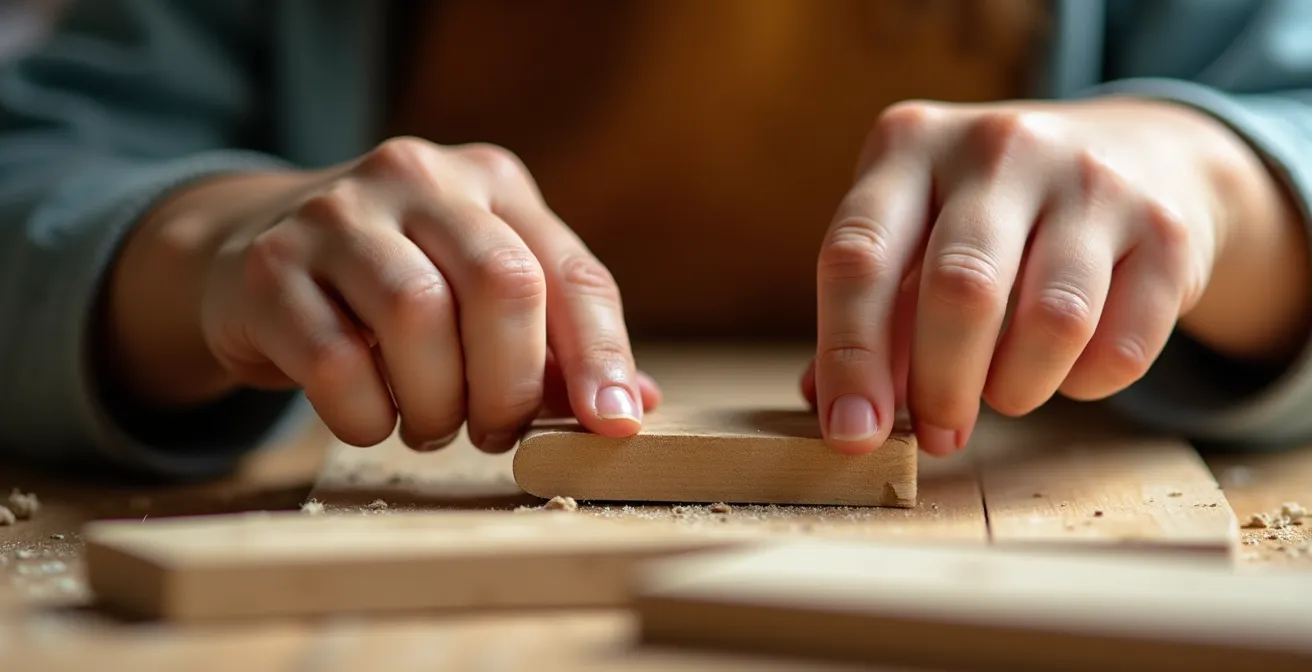
The IKEA Effect describes our tendency to place a disproportionately high value on things we partially or fully create ourselves. Psychological research on the IKEA effect shows a 63% premium in perceived value when participants build items themselves. This sense of ownership and investment translates directly to learning. When a child builds a model of the solar system, they aren’t just memorizing the order of the planets; they are grappling with scale, distance, and physical relationships. The effort they invest imbues the knowledge with personal meaning, making it “stick” in their memory far more effectively than a flat diagram in a book.
As the researchers who coined the term put it, this is a clear case of effort justification. The struggle and the problem-solving involved in the creation process are what make the end product—and the knowledge gained—so valuable to us. As an inquiry architect, your role is to create opportunities for this kind of “labor that leads to love.”
When labor leads to love.
– Norton, Mochon & Ariely, Journal of Consumer Psychology
The Google-Proof Question: How to Ask Things That Require Thinking?
In the age of instant information, any question that starts with “What is…” or “Who was…” can be answered in seconds by a search engine or a smart speaker. While this is incredibly efficient, it can inadvertently train children to be excellent fact-retrievers but poor thinkers. The most valuable skill we can teach them is how to engage with questions that Google *can’t* answer—questions that require analysis, evaluation, and creation.
An inquiry architect doesn’t just ask questions; they design them to climb a ladder of cognitive demand. The classic framework for this is Bloom’s Taxonomy, which categorizes thinking skills into different levels, from basic recall to higher-order creation. Asking “What happened in the story?” is a level-one recall question. Asking “Can you design a better ending for the story?” is a level-six creative question that demands a far deeper level of engagement. Your goal is to gently guide conversations up this ladder.
For example, instead of asking “What is a habitat?” (a Googleable question), you might ask, “If we were to design a perfect habitat for a ladybug in our backyard, what three things would we absolutely need to include and why?” This question requires application, analysis, and a touch of creativity. It sparks a project, not just a search query. The following table provides a simple guide for parents to craft questions that move beyond simple recall.
| Level | Type | Example Question | Cognitive Demand |
|---|---|---|---|
| Remember | Recall Facts | What happened? | Low |
| Understand | Explain | Why do you think that happened? | Medium-Low |
| Apply | Use Knowledge | How would you solve this differently? | Medium |
| Analyze | Compare/Contrast | How is X similar to Y? | Medium-High |
| Evaluate | Judge/Critique | What evidence supports your idea? | High |
| Create | Design/Invent | Can you design a better solution? | Highest |
Fake News for Kids: How to Spot Bad Sources for a Project?
Once your child starts investigating their own questions, they will inevitably venture online. The internet is the world’s largest library, but it’s one where the books are not vetted, and anyone can add a page. Teaching a 10-year-old to distinguish credible information from misinformation is no longer an optional skill; it is a fundamental component of modern literacy. The instinct is to give them a list of “good” websites, but this is a temporary fix. A more durable solution is to give them a mental framework for evaluating *any* source they encounter.
Professional fact-checkers don’t have a magical list of trusted sites. Instead, they use a technique called “lateral reading.” Instead of reading an article vertically from top to bottom, they immediately open new tabs to investigate the source itself. What do other, more established sources say about this website or author? This simple habit is incredibly effective; media literacy research shows that fact-checkers use lateral reading in over 90% of verification cases. We can teach a simplified version of this to our children.
A great, kid-friendly framework is the SIFT method. It provides four simple, memorable steps that empower a child to become a responsible digital citizen. It moves them from being passive consumers of information to active, critical investigators. Instead of asking “Is this true?”, they learn to ask “Who is telling me this, and why should I believe them?”
Your Action Plan: The SIFT Method for Kids
- STOP: Before you share or believe a piece of information, just pause. Take a breath and ask yourself what you really know about the website or person who posted it.
- INVESTIGATE the source: Don’t stay on the page. Open a new browser tab and search for the name of the website, the organization, or the author. See what independent, reliable sources (like Wikipedia, news organizations, or universities) say about them.
- FIND better coverage: See if you can find other, more trusted sources reporting the same story. If a major news event is only being reported by one unknown blog, that’s a red flag.
- TRACE claims to the original source: Many articles report on another report or study. Click on the links and try to get back to the original information to see if it’s being represented accurately.
The Lab Notebook: Why Writing Down Failures Is the Best Part?
In our success-oriented culture, failure is often seen as an endpoint, a sign to give up. But in science and engineering, failure is simply data. An experiment that “fails” to produce the expected result is often more valuable than one that succeeds, because it reveals a flaw in our understanding. The single most important tool for capturing the value of failure is the lab notebook. It is not a diary for perfect results; it’s a log of the entire messy, beautiful process of discovery.
Encourage your child to document everything: their initial question, their hypothesis, their procedure, their sketches, and—most importantly—their observations, especially when things go wrong. Did the plant wilt? Did the bridge collapse? Did the circuit short out? Write it down! This act of documentation transforms a mistake from a moment of frustration into a “productive failure.” It becomes a puzzle to solve: “Why did that happen?”
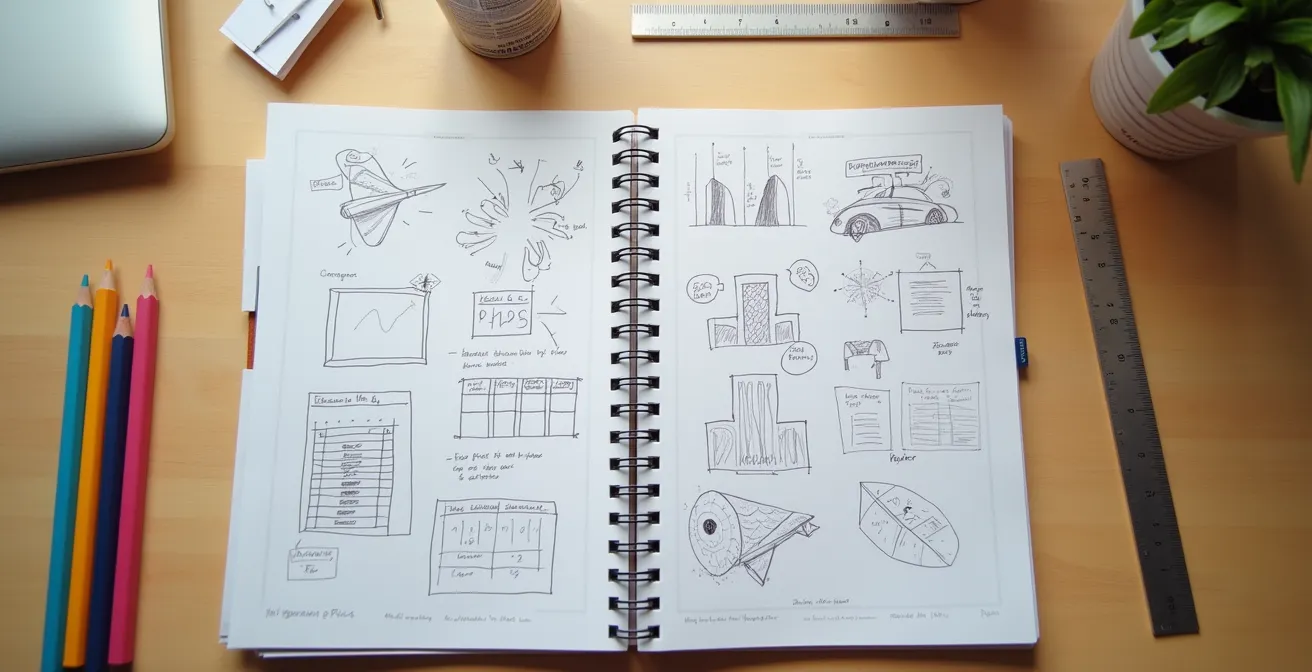
A simple, powerful structure for a lab notebook entry can be framed around three questions. This provides a “knowledge scaffold” that guides a child from hypothesis to analysis, making their thinking visible and forcing them to confront the gap between their expectations and reality. This is where true learning happens.
| Question Type | Purpose | Example Entry |
|---|---|---|
| What do I THINK will happen? | Hypothesis Formation | ‘I think the plant with more water will grow taller’ |
| What ACTUALLY happened? | Observation & Data | ‘The overwatered plant turned yellow and wilted’ |
| What’s DIFFERENT? | Analysis & Learning | ‘Too much water prevented oxygen from reaching roots’ |
Making Errors Count: Quantifying Failure
A key concept in science is understanding and calculating experimental error. To do this, you subtract the known or theoretical value from your measured experimental value, then divide by the known value. Teaching a child this simple formula helps them quantify their “failures.” It reframes an error not as a mistake, but as a measurable deviation that can be analyzed and understood. It’s a powerful lesson that failure is just data, not defeat.
How to Build a Birdfeeder That Actually Survives Squirrels?
The “why” questions don’t always have to be grand and cosmic. Sometimes, they are intensely practical: “Why do the squirrels keep eating all the birdseed?” This everyday problem is a perfect opportunity to introduce the engineering design process. Unlike the scientific method, which seeks to understand the world, the engineering process seeks to solve a problem within a set of constraints. Building a squirrel-proof birdfeeder is a classic and deeply engaging engineering challenge for a child.
The process provides a structured way to tackle the problem, moving from abstract ideas to a tangible, tested solution. It encourages research (how high can a squirrel jump?), brainstorming (what if it spins?), prototyping (let’s build a model with cardboard), and, crucially, iteration. The first version will almost certainly fail. The squirrel will triumph. This is not a cause for despair; it’s Step 5: Test. The real engineering begins in Step 6: Analyze Failure Points. Where did the squirrel get its grip? How did it bypass the baffle? This analysis directly informs the redesign for version 2.0.
This iterative cycle of build-test-fail-redesign teaches resilience, problem-solving, and the valuable lesson that the first idea is rarely the best one. It’s a microcosm of all innovation.
- Define the Problem: Squirrels are eating all the bird food.
- Research: Study squirrel behavior. A quick search reveals they can jump 4-5 feet horizontally and up to 10 feet vertically from a standstill.
- Brainstorm Solutions: Sketch ideas for baffles, weight-activated perches, or spinning mechanisms.
- Build a Prototype: Start simple, using recycled materials like plastic bottles and plates.
- Test: Set up the feeder and observe. Document how squirrels defeat the design.
- Analyze Failure Points: Where did the design fail? Did the squirrel climb the pole, jump from a branch, or simply knock it over?
- Redesign: Use the failure analysis to improve the design and build version 2.0.
Case Study: The Middle School Engineer
A middle school student took on the squirrel challenge for their regional STEM competition. They didn’t just build a feeder; they spent two weeks systematically documenting squirrel behavior in their yard, noting jump angles and grip strength. This research informed their final design: a counterweight system that would close the feeding ports whenever anything heavier than a cardinal landed on the perch. Their rigorous process, which embraced failure as a source of data, led them to win the competition.
The Boredom Complaint: How to Ask for Advanced Work Respectfully?
Sooner or later, a curious and engaged child may come home with a familiar complaint: “I’m bored in class.” This statement is often a sign that they have mastered the current material and are ready for a new challenge. However, the way they approach their teacher can make all the difference. Simply asking for “more work” or “harder problems” can sometimes be misinterpreted. The key is to guide your child to ask for deeper work, not just a higher volume of it.
This is a crucial moment for you as an inquiry architect. You can coach your child on how to frame their request respectfully and constructively. Instead of presenting their boredom as a problem for the teacher to solve, they can present it as an opportunity for them to explore. This shifts the dynamic from complaint to collaboration. A request to “explore how this math concept applies to building bridges” is far more compelling than “Can I have another worksheet?”
It shows initiative, curiosity, and a genuine desire to learn, rather than a simple need to be kept busy. This approach respects the teacher’s time while demonstrating that the student is a self-motivated learner. The following table contrasts these two approaches, providing concrete language you can practice with your child.
| Volume Approach (Less Effective) | Depth Approach (More Effective) |
|---|---|
| ‘Can I have more math problems?’ | ‘Could I explore how this math applies to architecture?’ |
| ‘I need extra worksheets’ | ‘Can I create a teaching video for younger students?’ |
| ‘Give me harder problems’ | ‘May I research the history behind this concept?’ |
| ‘I finished early’ | ‘I’d like to investigate alternative solutions’ |
Key Takeaways
- Transform from an “answer-giver” to an “inquiry architect” by providing learning frameworks.
- Hands-on projects create deeper, longer-lasting knowledge than passive reading due to the IKEA Effect.
- Teach children to ask “Google-proof” questions that require analysis and creativity, not just fact-retrieval.
- Embrace “productive failure” by documenting mistakes in a lab notebook, turning errors into valuable data.
Fact vs. Opinion: How to Teach Media Literacy to a 10-Year-Old?
In our modern media landscape, the line between what is true and what someone believes to be true is often blurred. A foundational skill for any young researcher is the ability to distinguish between a fact, an opinion, and an informed opinion. This isn’t an abstract philosophical debate; it’s a practical tool for critical thinking that can be taught with simple, everyday examples.
A fact is a statement that can be proven true or false with evidence. “The Earth orbits the Sun.” An opinion is a personal belief or preference. “Chocolate ice cream is the best.” A third, more nuanced category is the informed opinion, which is a judgment made by an expert based on facts. “Based on the X-rays and symptoms, the doctor concluded the patient has pneumonia.” Teaching children to sort information into these three buckets is a powerful first step in media literacy.
A simple and effective activity is to take a news article, an advertisement, or even a social media post and use highlighters to categorize the statements. You can use green for facts, yellow for opinions, and blue for informed opinions. This makes the abstract concepts tangible. In a classroom setting, teachers have found that this kind of active practice yields significant results. One study noted that students who practiced identifying opinion-clue adjectives (like ‘best’, ‘worst’, ‘amazing’) became 75% better at spotting biased content within just four weeks of regular practice. This skill is about recognizing that not all information carries the same weight.
- FACT: Can be proven true or false with evidence (e.g., “Water freezes at 0 degrees Celsius”).
- OPINION: A personal belief or preference that cannot be proven (e.g., “Blue is the best color”).
- INFORMED OPINION: An expert’s judgment based on facts and evidence (e.g., “A film critic deems a movie a masterpiece based on its script, acting, and cinematography”).
By shifting your perspective from a source of answers to an architect of inquiry, you give your child a gift far more valuable than any single fact: the confidence and the competence to build their own understanding of the world, one curious question at a time.