In summary:
- A child’s “clumsiness” is often a visual processing issue, not a lack of athleticism. It’s a solvable problem in the eye-brain-body feedback loop.
- Start with slow-moving objects like balloons or scarves to build tracking skills and confidence before moving to faster balls.
- Incorporate specific, low-pressure games that train visual tracking, balance, and peripheral awareness, like rhythm games or balance board exercises.
- Optimize the environment by ensuring good, diffuse lighting to eliminate shadows and glare that can disrupt visual processing.
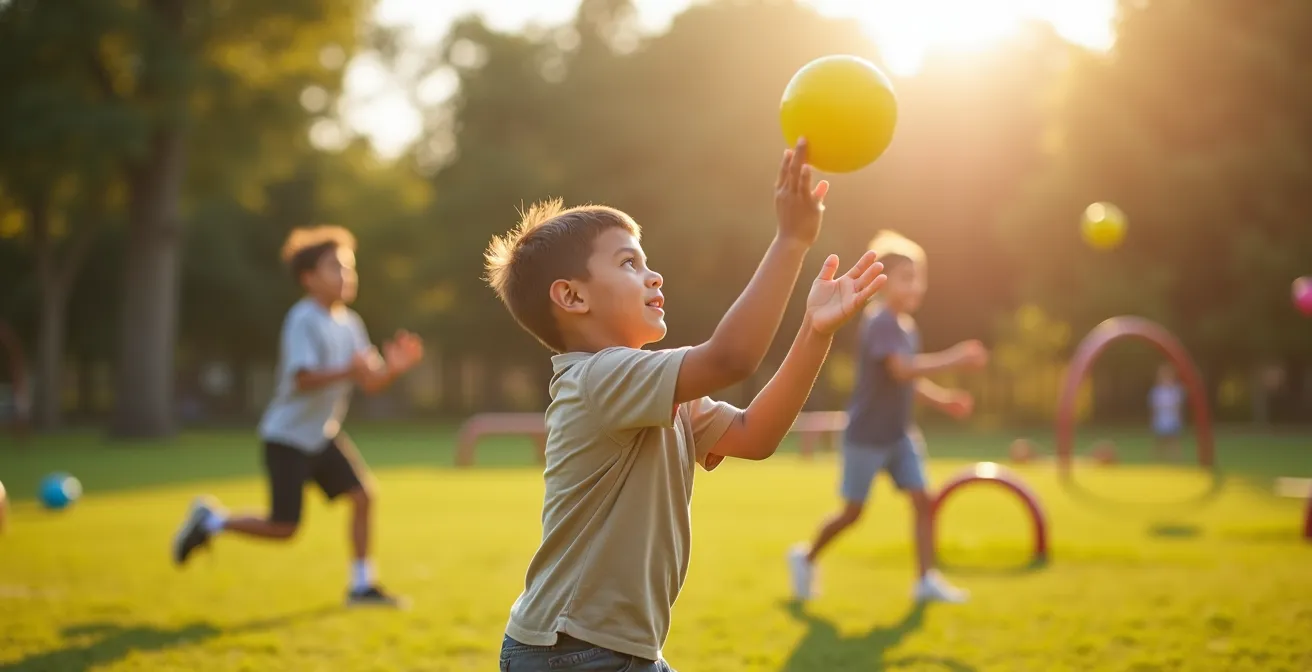
Does the sound of a dodgeball game make you wince, not for yourself, but for your child? If you’re a parent who watches your kid consistently get hit in the face by a slowly thrown ball, you’re not alone. The common advice is often frustratingly simple: “just practice more” or “sign them up for a team.” But for a child who isn’t naturally athletic, this can lead to more frustration and a drop in confidence.
What if the problem isn’t a lack of effort or athletic ability? What if the core issue is how their brain processes what their eyes are seeing? As a vision therapist, I help parents and children reframe this challenge. We shift the focus from “catching the ball” to strengthening the fundamental communication pathway—the feedback loop between the eyes, the brain, and the body. Poor reaction time is rarely about slow muscles; it’s about an inefficient visual processing system.
This guide will walk you through a training-focused approach. We’ll explore why issues like skipping lines while reading are connected to this and how simple, supportive exercises can fundamentally rewire this connection. We will look at everything from indoor games to bike riding, showing you how to build the foundational skills that boost both coordination and confidence.
To help you navigate this supportive, training-focused approach, this article is broken down into key areas. Each section addresses a common question or scenario, providing practical exercises to build your child’s visual processing skills and, ultimately, their confidence.
Summary: A Vision Therapist’s Guide to Building Reaction Skills
- Why Skipping Lines in Reading Is Actually a Coordination Issue?
- Balloon Keep-Up: The Best Indoor Game for Eye Tracking?
- FPS Games: Do They Really Improve Real-World Hand-Eye Skills?
- Feet Need Eyes Too: Why Tripping Often Signals a Vision Issue?
- How to Boost Gross Motor Confidence in a “Clumsy” 6-Year-Old?
- Why You Should Keep Reading to Your Child Even After They Can Read?
- How to Teach Bike Riding in Under 2 Hours?
- Shadows and Glare: How Poor Lighting Ruins Coordination Practice?
Why Skipping Lines in Reading Is Actually a Coordination Issue?
It may seem unrelated, but if your child frequently loses their place while reading, skipping lines or words, it’s a strong clue about their overall coordination. This isn’t a sign of carelessness; it’s a challenge in visual tracking. The ability to move the eyes smoothly and accurately from one word to the next, and then make a precise jump down to the next line, uses the exact same foundational skills required to track a moving ball. Both tasks require the eyes to send accurate location data to the brain, which then predicts the object’s (or word’s) next position.
When this system is inefficient, the eyes make jerky, inaccurate movements (called saccades). For a child, this visual processing challenge is significant; research shows that children aged 5-6 need up to 4 times longer than adults to respond to complex visual tasks. This is why reading practice can be a surprisingly effective tool for sports coordination. Instead of just focusing on the ball, try these exercises that link vision with balance, strengthening the entire sensory integration system:
- Wall Sits & Reading: Have your child hold a wall sit for 30 seconds before reading to activate postural muscles, which provides a stable base for the eyes to work from.
- Balance Board Tracking: While standing on a balance board, have them track a simple object (like your finger) moving side-to-side. This trains the vestibular (balance) system to cooperate with the visual system.
- Exercise Ball Reading: Small intervals of reading (2-5 minutes) while sitting on a large exercise ball engages core muscles and helps stabilize the “jumpy” eyes that cause them to lose their place.
Balloon Keep-Up: The Best Indoor Game for Eye Tracking?
For a child who flinches at the sight of a ball, asking them to “play catch” is counterproductive. Their brain is already associating the activity with failure and discomfort. The solution is to change the object. A balloon is the perfect training tool because it moves slowly, unpredictably, and hangs in the air, giving your child’s visual system ample time to process, predict, and react.
The goal of “Balloon Keep-Up” isn’t to hit it hard, but to gently tap it to keep it from touching the floor. This simple game trains several critical skills at once: visual tracking as they follow the balloon’s path, depth perception as they judge its distance, and hand-eye coordination as they time their tap. It’s a low-stakes, high-reward activity that builds success and rewires the brain for positive interaction with moving objects.
The Slower-is-Better Method
This approach is widely used in occupational therapy. Therapists often find that for children who struggle with catching, the key is to start with objects that move slowly enough for their developing visual systems to follow. Items like lightweight scarves, which drift gently through the air, provide the necessary time for a child’s brain to track the object, coordinate a plan, and execute the reach—turning a stressful task into a manageable one.
The intense focus a child develops while trying to keep a balloon afloat is a powerful form of visual training in action. It’s pure, unadulterated practice in the eye-brain-body feedback loop.
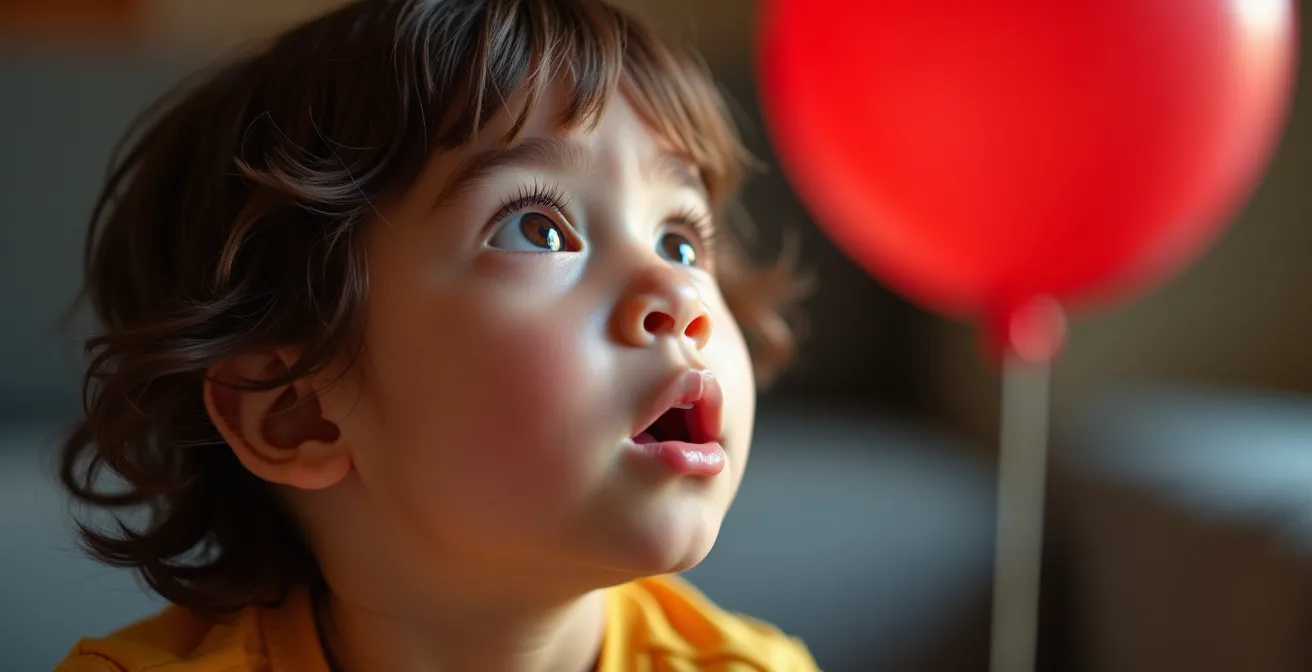
As you can see, the child’s entire being is focused on the object. This level of concentration is what helps forge stronger neural pathways between what they see and how they move. It replaces the anxiety of a fast-moving ball with the engaging physics of a simple balloon.
FPS Games: Do They Really Improve Real-World Hand-Eye Skills?
Many parents believe that fast-paced video games, particularly First-Person Shooters (FPS), will improve their child’s reaction time. While these games do train very specific skills—like quick targeting in a narrow field of view—the transfer to the real, three-dimensional world is limited and often not what a non-athletic child needs. The “clumsy” child often struggles more with peripheral awareness, spatial judgment, and tracking objects coming from outside their direct line of sight, skills which FPS games do not typically prioritize.
High-pressure, competitive games can also increase stress, which is counterproductive for a child already lacking confidence. A more therapeutic approach involves selecting games that train specific visual skills in a self-paced, low-stress environment. The type of game matters far more than the speed.
This table breaks down how different game genres contribute to real-world skills, offering a better guide for screen time that truly supports development. As the data shows, rhythm and racing games can be particularly beneficial. In fact, recent studies demonstrate that immersive VR music games have significant potential to improve both reaction time and hand-eye coordination.
| Game Type | Skills Trained | Real-World Transfer | Recommended for Non-Athletic Kids |
|---|---|---|---|
| FPS/Shooters | Tunnel vision focus, quick targeting | Limited – 2D to 3D gap | Not ideal – high pressure |
| Rhythm Games | Timing, pattern recognition | Good – temporal processing | Excellent – low pressure |
| Spatial Puzzles | Visual rotation, problem-solving | Moderate – cognitive skills | Very good – self-paced |
| Racing Games | Peripheral awareness, quick decisions | Good – wide visual scanning | Good – adjustable difficulty |
Feet Need Eyes Too: Why Tripping Often Signals a Vision Issue?
When a child constantly trips over their own feet or bumps into furniture, parents often attribute it to carelessness. However, this is frequently a sign of poor proprioception—the body’s internal sense of where it is in space—and its connection to the visual system. We navigate our environment by constantly cross-referencing what our eyes see with what our body feels. If this feedback loop is weak, a child might not lift their foot high enough for a curb their eyes clearly saw, or they might misjudge the corner of a table.
Essentially, their brain isn’t creating an accurate, real-time 3D map of their body within its environment. To strengthen this “foot-brain” connection, we need to wake up the sensory receptors in the feet and train the brain to pay closer attention to the information they provide, integrating it with visual input. This isn’t about telling them to “watch where you’re going,” but about giving their brain better data to work with.
Your Action Plan: Activities to Awaken the ‘Foot-Brain’ Connection
- Create a Texture Path: Lay out various textures (carpet squares, pillows, rubber mats, grass) and have your child walk barefoot across them for 5 minutes, describing the sensations.
- Play ‘Puddle Detective’: On walks, encourage your child to be the first to spot and call out any crack, stick, or change in the pavement before you get to it.
- Practice an ‘Invisible Obstacle Course’: Place lines of masking tape on the floor and have your child practice high-stepping over them, training their brain to lift their feet without constant visual confirmation.
- Engage in ‘Texture Guessing’: With eyes closed (and with a spotter), have them step on different safe surfaces and guess what they are standing on.
- Implement a ‘Room Scan’ Routine: Before playing in a room, spend 30 seconds together visually scanning the floor for toys or other hazards.
These activities force the brain to integrate tactile sensations from the feet with the visual map of the environment, making your child a more confident and aware navigator of their world.
How to Boost Gross Motor Confidence in a “Clumsy” 6-Year-Old?
For a child labeled “clumsy,” the biggest hurdle isn’t physical; it’s psychological. A history of missed catches, tumbles, and failed attempts builds a powerful internal narrative of “I can’t.” Our primary goal as parents and therapists is not to train a star athlete, but to dismantle this negative self-perception and build a new one based on small, achievable successes. Confidence is the fuel for coordination.
The key is to shift the focus from the outcome (catching the ball, riding the bike perfectly) to the process (watching the balloon, feeling the balance). Praise the effort, the focus, and the attempt, regardless of the result. “I love how you kept your eye on it the whole time!” is infinitely more powerful than “Oh, you missed.” This process-focused praise helps them develop a growth mindset, where a drop or a wobble is just information for the next attempt, not a verdict on their ability.
Incorporating mindfulness-based activities can also be incredibly effective. Simple practices like yoga or even just focusing on breathing before an activity help calm the nervous system, reduce performance anxiety, and allow the brain to be more receptive to learning new motor skills. A relaxed mind is a focused mind, better able to manage the complex sensory inputs of movement. Remember that building this confidence is a marathon, not a sprint, especially when developmental research confirms that a child’s reaction time is naturally much slower than an adult’s.
Why You Should Keep Reading to Your Child Even After They Can Read?
Once a child can read independently, it’s tempting to stop reading aloud to them. However, continuing this practice offers a powerful, calming way to train their visual system for the dynamic challenges of sports and play. When you read aloud, your child’s eyes follow along, and you are modeling a smooth, steady visual tracking pattern. This reinforces the same neural pathways needed to follow a ball in flight or navigate a busy playground.
Furthermore, storytime is a crucial opportunity to build the visual-spatial vocabulary necessary for good coordination. Books are filled with prepositions and directional words—”the cat jumped *over* the wall,” “the boat sailed *under* the bridge,” “he ran *around* the tree.” Hearing and processing these spatial relationships in a relaxed context helps the brain build a robust mental library for understanding and predicting movement in the real world. A child who can easily picture what “around the tree” means has a better cognitive toolkit for physically running around one.
This connection is fundamental to learning. Hand-eye coordination isn’t just for sports; it’s essential for the academic tasks of reading and writing. The brain must visually track the tip of the pencil as the hand moves, and it must track words sequentially across a page. Reading together strengthens this entire system, making it a two-for-one training session for both academic and physical confidence.
How to Teach Bike Riding in Under 2 Hours?
The secret to teaching a child to ride a bike quickly has nothing to do with pedaling. It’s all about mastering balance, which, at its core, is a game of rapid-fire reactions. The old method of training wheels and a parent hunched over, holding the seat, is inefficient because it prevents the child from ever feeling—and correcting—their own wobbles. The modern, faster method treats balancing as a reaction game from the start.
Begin with a balance bike (or a regular bike with the pedals removed). The goal is not to go fast, but to practice “scooting” and then lifting the feet for progressively longer glides. Each time the bike starts to tip, the child must react by putting a foot down to “catch themselves.” This isn’t falling; it’s a successful reaction! This reframing is critical. You are turning fear into a fun, empowering game of self-correction. Focus on drills like looking ahead at a target (a cone or a tree) rather than at the ground, as this stabilizes the body’s entire balance system.
After treating the balance bike as a ‘reaction game’ where my daughter had to ‘catch herself’ with her feet, she transitioned to a regular bike in just one afternoon. The key was reframing it from scary falling to fun catching.
– Parent Testimonial
Once they can consistently glide for several seconds, they have mastered the reaction part. Adding pedals becomes the simple, final step. They’ve already learned the hardest part: how to let their body’s automatic reactions keep them upright.
Key takeaways
- It’s a vision-brain issue: Most “clumsiness” stems from inefficient visual processing, not a lack of physical ability.
- Start slow and build success: Use objects like balloons and scarves to train tracking skills in a low-pressure way before introducing balls.
- The environment is part of the training: Factors like game choice and room lighting are just as crucial as the physical practice itself.
Shadows and Glare: How Poor Lighting Ruins Coordination Practice?
You’ve set up the perfect indoor game, but your child is still struggling. Before you assume it’s a lack of skill, look at the lighting. A single, harsh overhead light can be a major saboteur of hand-eye coordination. It creates deep, moving shadows that can make a ball seem to disappear and reappear, and it can cast glare off floors and surfaces. This “visual noise” forces your child’s brain to work much harder to distinguish the object from its background, leading to slower reactions and more errors.
The ideal environment for coordination practice uses diffuse, multi-directional light. Think of an overcast day—light comes from everywhere, so shadows are soft and minimal. You can replicate this indoors by using multiple lamps, bouncing light off a white ceiling, or playing near a large window that isn’t in direct, harsh sunlight. This creates a clean, clear visual field where the moving object is the star of the show.
This isn’t just about comfort; it’s about safety. Having a fast and accurate reaction time is a critical life skill for avoiding danger, from a stray ball in the gym to a car on the street. As safety research indicates, training the brain to react more quickly can help prevent injury and build resilience. Ensuring a well-lit practice space is one of the easiest and most effective ways to set your child up for success and safety.
Frequently Asked Questions about Training Reaction Time
What type of lighting is best for coordination exercises?
Diffuse, multi-directional lighting from multiple sources works best. Avoid single-source overhead lights that create hard shadows which can ‘erase’ moving objects from view.
Why does my child struggle more with catching at dusk?
During twilight, eyes switch from cones (for detail/color) to rods (for light/dark), temporarily impairing depth perception. Use glow-in-the-dark or LED balls during this transition time.
How can I quickly audit my home for movement-friendly lighting?
Check for: 1) No harsh shadows when child moves, 2) No glare from windows hitting play areas, 3) Even lighting across the entire movement space, 4) Ability to see a dropped ball clearly from any angle.