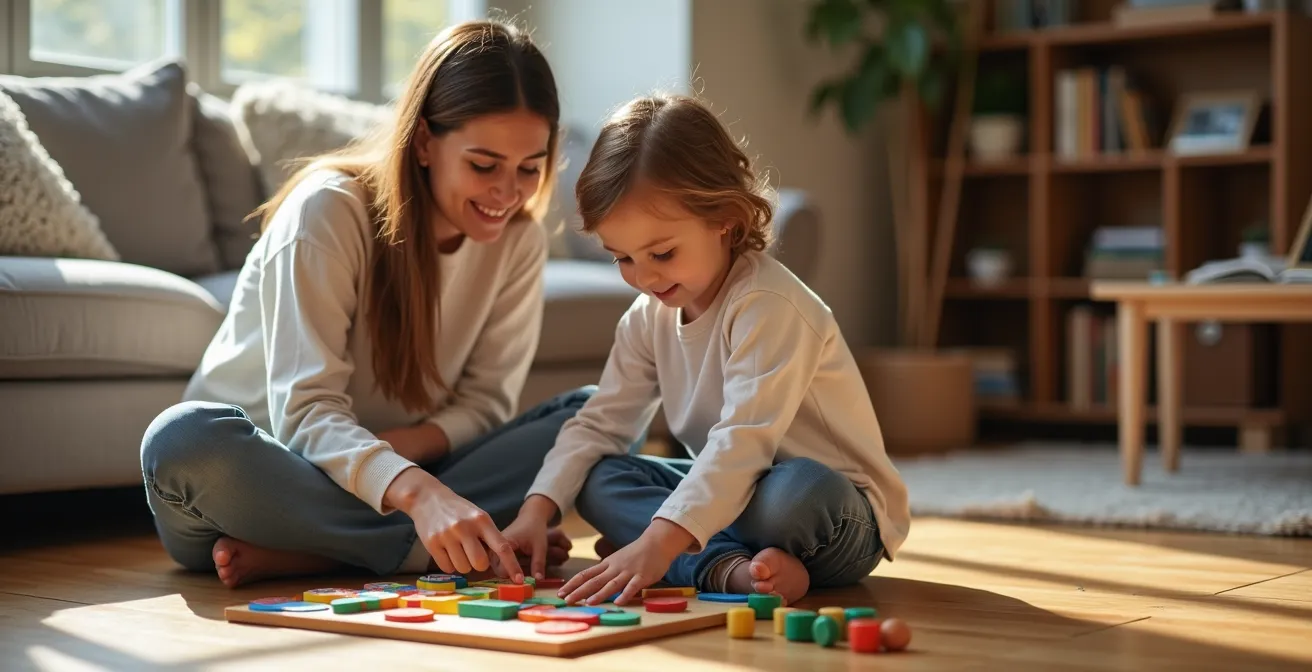
For decades, parents have been told that academic achievement (IQ) is the primary key to a child’s success. The data now points to a different reality: Emotional Intelligence (EQ) is the true competitive advantage for the leaders of tomorrow.
- EQ is not a ‘soft skill’; it’s a measurable set of cognitive tools that allows the brain to manage stress, navigate social complexity, and solve problems creatively.
- Skills like empathy and negotiation aren’t just about being ‘nice’—they are strategic competencies that directly correlate with improved relationships, better problem-solving, and effective leadership.
Recommendation: Shift your focus from rote memorization to building a practical emotional toolkit. Start by teaching your child the tactical skill of naming their specific emotions to neurologically calm their brain.
As an ambitious parent, your focus is laser-sharp: providing your child with every advantage to secure a successful future. The traditional playbook has been clear—prioritize academic excellence, top grades, and measurable intellectual achievements. The Intelligence Quotient (IQ) has long been the gold standard, the ultimate metric for future potential. We’ve invested in tutors, enrichment programs, and STEM camps, all in pursuit of a higher score on a standardized test.
But the landscape of success is undergoing a seismic shift. The future of work, dominated by automation, collaboration, and constant change, will not be won by the best memorizers. It will be led by the most adaptable, resilient, and socially adept thinkers. While the world focused on IQ, a quieter, more powerful predictor of long-term success was emerging: the Emotional Quotient (EQ). Many dismiss it as a ‘soft skill,’ a nice-to-have for raising a well-behaved child. This is a fundamental, and costly, misunderstanding.
The truth is, Emotional Intelligence is a hard, strategic skill set. It’s a cognitive toolkit that can be taught, practiced, and mastered. This isn’t about suppressing feelings or simply being ‘nice’; it’s about understanding the neurological and psychological mechanics of human interaction. It’s about giving your child the ability to read a room, negotiate a conflict, recover from a setback, and inspire a team. These are not platitudes; they are the core competencies that will define the next generation of leaders, innovators, and creators.
This article will deconstruct the myth of EQ as a soft skill. We will move beyond generic advice and provide a practical, science-backed framework for building this crucial toolkit. We will explore how to teach your child to name their emotions to calm their brain, how to practice strategic empathy, and how to navigate complex social dynamics from the playground to the future boardroom.
This guide offers a clear roadmap to understanding and implementing the foundational pillars of Emotional Intelligence. By exploring these distinct but interconnected skills, you can equip your child with a durable advantage that test scores alone can never provide.
Summary: Building the Strategic Toolkit of Emotional Intelligence
- Sad, Mad, or Frustrated: Why Naming the Specific Emotion Calms the Brain?
- The “Shoes” Game: How to Teach Empathy to a Self-Centered 6-Year-Old?
- Pillows vs. People: Where Is It Okay to Release Anger physically?
- Goldfish Funerals: How to Handle the First Death Experience?
- The Eyebrow Test: Can Your Child Read Social Cues Correctly?
- The “Pause Button” Technique: How to Model Calm When You Want to Scream?
- How to Negotiate a Movie Choice Without Ending the Playdate?
- Sharing vs. Turn-Taking: Which Concept Should You Actually Teach?
Sad, Mad, or Frustrated: Why Naming the Specific Emotion Calms the Brain?
The first and most fundamental tool in the EQ toolkit is not managing emotion, but identifying it with precision. When a child is overwhelmed, their brain’s reactive ‘alarm system,’ the amygdala, is in full control. The common parental response is to use generic labels like “you’re sad” or “don’t be mad.” This approach is imprecise and largely ineffective. The real strategy lies in teaching emotional granularity—the ability to construct more specific emotional experiences. Saying “you seem frustrated that the tower keeps falling” instead of “you’re angry” is more than just semantics; it’s a neurological intervention.
Research from Harvard’s Center on the Developing Child provides a clear explanation for this phenomenon. When we help a child name their specific emotion, we activate their prefrontal cortex, the brain’s executive function center. This act of labeling initiates a neurological shift, transferring energy from the reactive, emotional amygdala to the thoughtful, problem-solving prefrontal cortex. Brain imaging studies show this process can decrease amygdala activation by up to 50%, effectively applying the brakes to an emotional spiral. The child doesn’t just feel better; they are literally moved into a different cognitive state, one where they can think, learn, and solve the problem that caused the distress in the first place.
This skill moves a child from being a passenger in their emotional life to being the pilot. By building a rich vocabulary of feeling words—disappointed, overwhelmed, jealous, anxious, excited—you are giving them a diagnostic dashboard. They learn to differentiate the signals their body is sending them, which is the first step toward effective self-regulation and resilience. A child with high emotional granularity is better equipped to understand not just what they are feeling, but why, creating a foundation for sophisticated problem-solving later in life.
Mastering this single technique is the gateway to all other emotional intelligence competencies. It transforms a moment of crisis into a teachable opportunity, building a brain that is wired for calm and clarity.
The “Shoes” Game: How to Teach Empathy to a Self-Centered 6-Year-Old?
Once a child can identify their own emotions, the next strategic skill is to recognize and consider the emotions of others. This is empathy, and it is far more than simple kindness; it’s the bedrock of collaboration, leadership, and social influence. For a young child, whose world is naturally egocentric, this concept can be abstract. The goal is to make it a concrete, repeatable practice. The classic advice to “imagine walking in their shoes” can be made literal through simple perspective-taking games.
The “Shoes Game” is a practical application of this. During a disagreement, have the children physically swap places and argue the other’s point of view. “Okay, now you’re Sam. Tell me why Sam wants to play with the red car.” This simple act of changing physical position creates a mental shift, forcing the child to articulate a different perspective. It’s a playful but powerful way to build the cognitive muscle of empathy. The impact of such activities is not trivial; research on 200+ children shows that those who practice perspective-taking activities demonstrate 40% better social problem-solving skills by age 8. This is a direct link between an EQ skill and a measurable cognitive output.
This is a foundational exercise in building what can be called strategic empathy. It’s the ability to understand another’s motivations, needs, and desires, which is a critical skill for negotiation, teamwork, and leadership.

As seen in this visualization, the physical act of switching spots serves as a powerful anchor for the mental act of switching perspectives. You can expand on this by using storybooks and asking, “How do you think the wolf feels now?” or by retelling family conflicts from the other person’s point of view. The goal is to make perspective-taking a reflexive habit, an automatic part of how your child processes social information.
A child who masters this won’t just be a kinder friend; they will be a more effective collaborator and a more insightful leader, able to anticipate needs and build consensus.
Pillows vs. People: Where Is It Okay to Release Anger physically?
Emotional regulation is not about suppressing feelings, especially powerful ones like anger. For a child, anger is a huge surge of physical energy that must go somewhere. The strategic goal of EQ is not to stop the feeling but to channel the energy toward a safe, non-destructive outlet. The simplistic command “Don’t hit!” is an incomplete instruction. It tells a child what *not* to do but fails to provide a crucial alternative for what they *should* do. The key is to create a clear, pre-approved framework: “We don’t hit people, but you *can* hit this.”
This requires establishing a clear and consistent set of rules and tools. A “calm-down corner” is not a punishment zone but a resource station. The Martinez family, in a documented case study, transformed their child’s aggressive outbursts by creating a “superhero training space” to master “anger powers.” Their toolkit included weighted blankets, modeling clay, and a visual menu of approved physical outlets. The results were dramatic: a staggering 80% decrease in hitting incidents within three months. The crucial element was framing the physical release as a skill to be mastered, not a behavior to be ashamed of.
Creating a system of safe outlets is essential for channeling a child’s raw emotional energy. This table, based on recommendations from child development specialists, outlines a practical framework for parents.
| Safe Physical Outlets | Why It Works | Setup Required |
|---|---|---|
| Punching a designated pillow | Releases tension without harm | Special ‘anger pillow’ in calm-down corner |
| Ripping paper/newspaper | Satisfying destruction that’s reversible | Stack of old newspapers in a basket |
| Stomping on bubble wrap | Combines sensory input with physical release | Bubble wrap ‘stomp mat’ taped to floor |
| Roaring like a lion | Vocal release of frustration | Designated ‘roar zone’ (garage/basement) |
| Squeezing stress balls | Muscle tension release | Various textures available in calm corner |
By providing these tools, you are teaching a profound lesson in self-management. The child learns that the feeling of anger is acceptable, but the behavior of harming others is not. They learn that they have agency over their actions, even when their feelings are intense. This is a far more sophisticated and effective strategy than simply punishing an outburst. It builds a lifelong skill of channeling intense energy productively, a hallmark of resilient and effective adults.
This framework doesn’t just prevent broken toys or hurt feelings; it builds the neural pathways for impulse control and constructive problem-solving under pressure.
Goldfish Funerals: How to Handle the First Death Experience?
A child’s first encounter with death, often through the loss of a pet, is a pivotal EQ learning moment. It’s a complex cocktail of sadness, confusion, and curiosity that can be overwhelming. The parental instinct may be to shield the child from the pain with euphemisms like “Goldie went to sleep” or “he went away.” This is a strategic error. Such phrases create anxiety around sleeping and an expectation of return, ultimately breeding mistrust. The EQ-focused approach is to be direct, concrete, and supportive.
Use simple, age-appropriate, and honest language. For a preschooler, this might be: “Goldie’s body stopped working. That’s called dying. It means he can’t swim or eat anymore.” This demystifies the event without being overly clinical. It’s crucial to validate whatever reaction the child has. Whether they are devastated, seemingly indifferent, or full of curious questions (“What does dead feel like?”), all responses are normal. The goal is to create a safe space to process a powerful new experience, not to prescribe a “correct” way to feel.
The next step is to channel the grief into a concrete act of commemoration. A “goldfish funeral,” a memory box, or planting a flower are not just sweet gestures; they are practical tools for processing loss. They provide a sense of closure and an outlet for love and sadness. This act of creating a memorial helps a child understand that while the pet is gone, the memory and the love can remain.
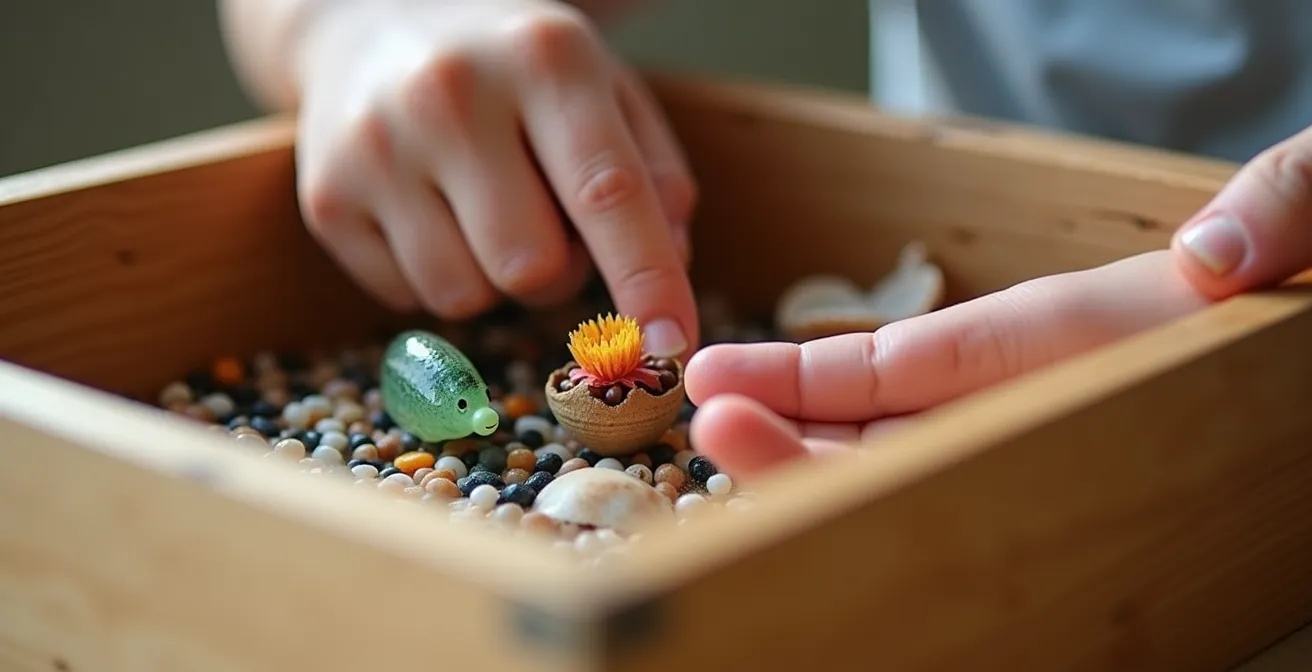
As this image shows, the physical act of creating a tribute provides a focal point for abstract emotions. The child is actively doing something with their grief, transforming it from a passive state of sadness into a proactive act of remembering. This process teaches a vital life skill: how to navigate loss and honor memory in a healthy, constructive way. It builds resilience by showing that it’s possible to experience deep sadness and still move forward.
You are teaching your child that even the most painful emotions can be navigated with courage and love, a lesson far more valuable than any academic subject.
The Eyebrow Test: Can Your Child Read Social Cues Correctly?
If emotional granularity is the internal dashboard, then the ability to read social cues is the external radar. Success in a collaborative world depends on accurately interpreting the non-verbal data that people transmit constantly. This goes far beyond recognizing a simple smile or frown. It’s about detecting the subtle shift in tone, the slight tensing of shoulders, or the fleeting expression that betrays a person’s true feelings. Many parents assume this skill is innate, but it is highly teachable.
Developmental science shows us that this skill matures over time. For example, according to the Emotions in Childhood project at Oxford University, while young children can spot happiness easily, reliably differentiating complex emotions like surprise and fear from facial expressions often doesn’t happen until age 7 or 8. We can accelerate and refine this process by turning our children into “whole-body detectives.” This moves beyond just faces—the “eyebrow test”—and teaches them to look for clues in posture, gestures, and proximity.
Case Study: The “Whole-Body Detective” Program
A study of kindergarteners demonstrated the power of this approach. One group was taught to be ‘whole-body detectives,’ learning to interpret a wide range of non-verbal signals by watching movie scenes with the sound off. They learned that crossed arms could mean defensiveness, leaning in signals interest, and stepping back might show a person feels overwhelmed. The results were remarkable: after six months, these children showed a 35% improvement in peer relationships compared to a control group. They were better at joining play, resolving conflicts, and supporting their friends because they could more accurately read the social landscape.
You can practice this at home in simple, playful ways. While reading a book, ask, “Look at her hands. What do you think she’s feeling?” While watching a movie on mute, ask your child to narrate the characters’ emotions based only on their body language. This trains their brain to scan for a wider array of data points and make more accurate social calculations. It’s a direct investment in their future ability to collaborate effectively, negotiate successfully, and lead with perception.
A child trained as a whole-body detective has a significant advantage, equipped with a sophisticated social radar that will serve them in every human interaction for the rest of their lives.
The “Pause Button” Technique: How to Model Calm When You Want to Scream?
Children do not learn emotional regulation from lectures; they learn it through observation and absorption. The most powerful EQ lesson you can ever teach is how you manage your own emotions in moments of stress. When you are about to lose your temper, you are on stage. Your child is the audience, and they are learning the script for how to handle frustration. This is the moment to model the “Pause Button” technique, a conscious and deliberate act of self-regulation that is more instructive than any chart or conversation.
The “Pause Button” is a physical and mental stop. When you feel the wave of anger rising, you physically freeze. You then narrate your internal state to your child in a calm, factual tone: “I am feeling very frustrated right now. My body is tight and I want to yell. I need to press my pause button for a minute.” Then, you use a pre-planned calming tool: take three deep “box breaths,” step outside for a moment, or take a sip of cold water. This act of narrating your own regulation process is profoundly powerful. It shows your child that the feeling is separate from the action, and that even adults need to use tools to manage big emotions.
This isn’t just a psychological trick; it’s a biological one. The practice is known as co-regulation. Your state of calm directly influences your child’s nervous system. When you regulate yourself, you provide an external source of stability that helps their developing brain return to a state of calm. The effect is measurable; recent child development research on co-regulation found that when parents practiced these techniques, their children’s bodies produced up to 50% less of the stress hormone cortisol during difficult situations. Your calm is literally, biologically, contagious.
If you lose control and yell, the “repair” is also a critical part of the model. Returning later and saying, “I’m sorry I yelled. I was overwhelmed. Let’s try that again,” teaches accountability and reinforces that relationships can be repaired after a mistake. It is perhaps the most advanced, and most important, leadership lesson of all.
How to Negotiate a Movie Choice Without Ending the Playdate?
Conflict is inevitable. For children, something as simple as choosing a movie can feel like a high-stakes battle. For the ambitious parent, these moments are not irritants to be shut down, but training grounds for a critical executive skill: negotiation. Teaching a child to negotiate is teaching them to solve problems, compromise, and find win-win solutions. Simply imposing a decision (“You will watch this movie!”) robs them of a valuable learning opportunity. The strategic approach is to provide a framework of child-friendly negotiation tactics.
The appropriate strategy depends on the child’s developmental stage. For young children (ages 4-5), simple turn-taking is concrete and easy to understand: “You pick this time, your friend picks next time.” As they get older (ages 6-7), they can grasp the concept of a trade-off: “If you let Sarah pick the movie, you can have first choice of the board game.” By ages 8-9, they can handle more complex solutions like time-splitting (“We’ll watch 30 minutes of your movie, then 30 minutes of mine”) or even trying to find a “third option”—a movie that both children are excited to see. Using a randomizer like flipping a coin is also a powerful tool, as it teaches children to accept an outcome they may not like but perceive as fair.
However, the most important lesson in negotiation is often learning how to handle a failed one. This is where you teach disappointment management. A program by Empowering Education created “disappointment protocols” for classrooms. When negotiations failed, teachers guided children to acknowledge the feeling (“It’s tough when we don’t get what we want”), normalize it, and then pivot to a new solution. After this was implemented, playdate conflicts dropped by 60%. Children learned that disappointment is survivable and that it is often the catalyst for finding a new, creative solution.
By coaching them through these small-scale disputes, you are building their capacity for high-stakes negotiation and collaborative innovation in their future professional lives.
Key Takeaways
- Emotional Intelligence (EQ) is not a ‘soft skill’ but a strategic, teachable toolkit that predicts future success more reliably than IQ.
- Core EQ skills include emotional granularity (naming feelings precisely), strategic empathy (understanding others’ perspectives), and self-regulation (managing intense emotions constructively).
- Parents are the primary EQ coaches, and modeling behavior—especially calming techniques and repairing after conflict—is the most effective teaching method.
Sharing vs. Turn-Taking: Which Concept Should You Actually Teach?
The word “share” is perhaps one of the most misused and conflict-inducing words on the playground. Parents often use it as a blanket command, demanding a child give up a prized toy at a moment’s notice. This creates resentment and confusion. From a strategic EQ perspective, we need to be far more precise. The reality is that there are two distinct concepts we should be teaching: sharing and turn-taking. Conflating them is a recipe for failure.
Sharing should be reserved for items that are divisible and can be used simultaneously, like a box of crayons, a pile of building blocks, or a plate of snacks. The script is, “Everyone can use some at the same time.” This teaches cooperation and the concept of communal resources. Turn-taking, on the other hand, applies to singular, non-divisible items: one bicycle, one specific doll, one tablet. The script here is fundamentally different: “Jamie is using the truck now. You can use it when she is finished.” This respects the child’s autonomy and current engagement.
This distinction is crucial because it connects directly to the concept of consent and bodily autonomy. Forcing a child to “share” their toy on demand sends the message that their possessions (and by extension, their personal space) can be accessed by others at any time. Framing it as turn-taking teaches a more sophisticated and respectful social contract: you have a right to your space and your things, and you can decide when your turn is over. It also honors that it’s okay for a child to have a few “special” items that they are not required to give up during a playdate. This respects their feelings and gives them a sense of control, which paradoxically makes them more willing to engage in turn-taking with other items.
Your Action Plan: Clarifying Sharing vs. Turn-Taking
- Categorize Toys: Before a playdate, mentally separate items into ‘sharable’ (blocks, crayons) and ‘turn-taking’ (a single scooter, a favorite doll).
- Use a Visual Timer: For highly desired turn-taking items, use a sand timer or phone timer to make the abstract concept of “five more minutes” concrete and fair.
- Honor ‘Special’ Items: Allow your child to choose 2-3 cherished items that can be put away and are not part of the turn-taking pool for that day. This gives them agency.
- Model the Right Language: Stop saying “Share your truck!” Instead, say, “It looks like Liam would like a turn when you’re finished. Can you let him know when you’re done?”
- Link to Consent: Explicitly connect the concepts. “Just like you decide who gets to give you a hug, you can decide when you’re finished with your turn on the bike.”
This simple shift in vocabulary from “sharing” to “turn-taking” is a micro-lesson in the kind of clear, respectful communication that defines effective leadership. It’s not just about keeping the peace during a playdate; it’s about laying the groundwork for a lifetime of healthy, consensual relationships.