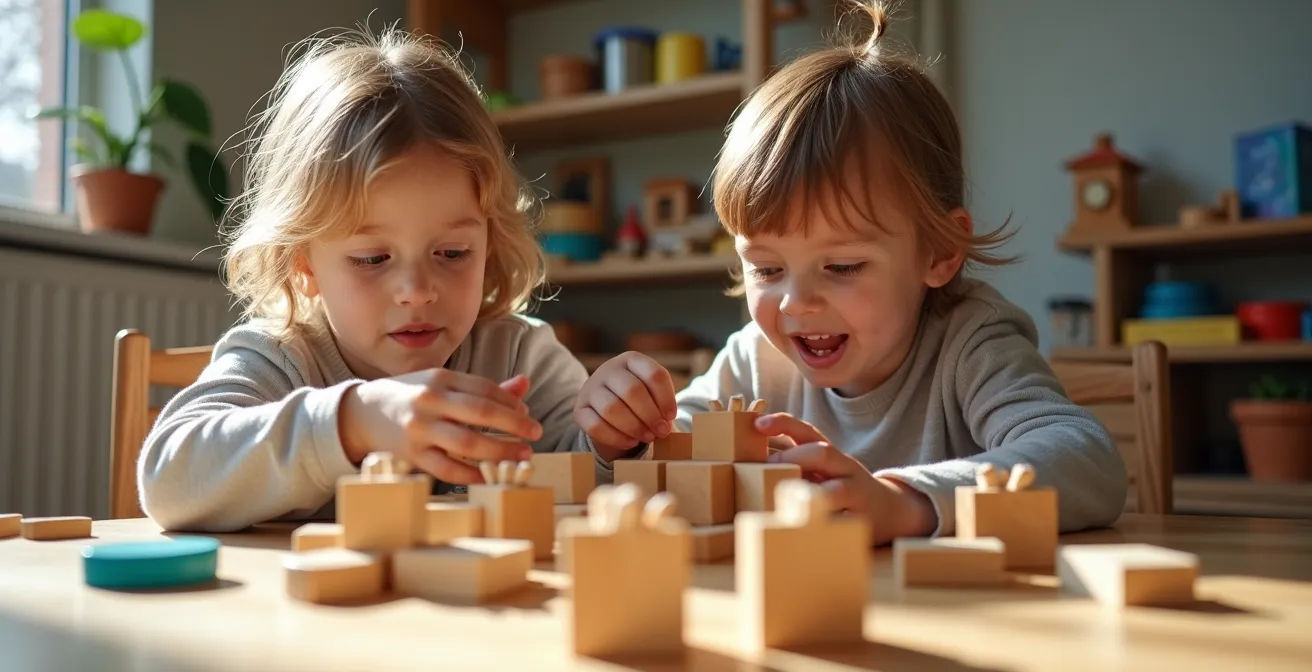
Contrary to the belief that more classes equal a smarter child, neuroscience shows that unstructured free play is the single most important activity for building the brain’s executive functions.
- Self-directed play physically changes the prefrontal cortex, the brain’s “CEO,” enhancing planning, problem-solving, and emotional regulation.
- Interrupting a child deep in play (e.g., for dinner) can disrupt a critical state of neuroplasticity, hindering deep learning.
Recommendation: Instead of scheduling another activity, focus on architecting a play-friendly environment and protecting your child’s time for deep, uninterrupted, and self-directed exploration.
The pressure is immense. From coding camps for toddlers to Mandarin lessons before kindergarten, modern parents are bombarded with the message that every moment of childhood must be optimized for enrichment. We see a neighbor’s child heading to violin practice and feel a pang of guilt. Is our child, currently lost in a world of cardboard boxes and cushions, falling behind? This constant push for structured activities is rooted in a deep fear of inadequacy, a belief that without our constant intervention and scheduling, our children won’t reach their full potential. We’ve been led to view unstructured playtime as a mere ‘break’ from the real work of learning, a filler between ‘important’ scheduled events.
But what if this entire paradigm is fundamentally flawed? What if the greatest cognitive leaps aren’t happening in the classroom, but on the living room floor? This article challenges the cult of over-scheduling by revealing a liberating scientific truth: free, unstructured play is not a void in a child’s development, but the very engine of it. We will explore the powerful neurobiological processes that are activated when a child is “just playing.” This isn’t about finding a ‘balance’ between two equal options; it’s about understanding that self-directed play is the primary, non-negotiable work of childhood, essential for building the cognitive architecture of a resilient, creative, and intelligent mind.
This guide will deconstruct the myth of the empty calendar, showing you how simple toys build complex brains, how to foster deep independent play, and why protecting that state of “flow” is more critical than adhering to a rigid schedule. Prepare to see boredom not as a problem to be solved, but as a launchpad for genius.
Summary: The Real Blueprint for a Better Brain
- Why “Just Playing” Is a Myth: The Math Behind Building Blocks
- How to “Strew” Toys to Spark Independent Play for 45 Minutes?
- Play-Based Preschool vs. Academic: Which leads to Higher Ivy League Acceptance?
- The Interruption Error: Why You Should Never Stop a Lego Session for Dinner?
- Boredom Busters: How to Turn “I’m Bored” Into a Creative Project?
- Visual vs. Auditory: Is Learning Styles Theory Actually a Myth?
- Red Light, Green Light: How Simple Games Build Complex Impulse Control
- Magnetic Tiles vs. Wooden Blocks: Which Investment Lasts Longer?
Why “Just Playing” Is a Myth: The Math Behind Building Blocks
The phrase “just playing” is one of the most misleading in the parental lexicon. It implies a passive, aimless activity that pales in comparison to “real” learning. The neuroscientific reality is precisely the opposite. When a child stacks wooden blocks, they are not just passing time; they are engaging in a high-intensity cognitive workout. Each placement is a real-time calculation of physics, gravity, and geometry. This process is fundamental to development, especially when you consider that over 75% of a child’s brain development happens after birth, with play being a primary catalyst.
This isn’t just theory. When researchers study animal brains, the evidence is stark. A landmark series of studies showed that rats raised in “enriched” environments with toys and tunnels to explore developed measurably different brains. Compared to their isolated counterparts, the playing rats had larger brains, thicker cerebral cortexes, and were significantly faster at learning cause-and-effect and navigating mazes. Play isn’t just a behavior; it is a biological imperative that literally sculpts the cognitive architecture of the brain.
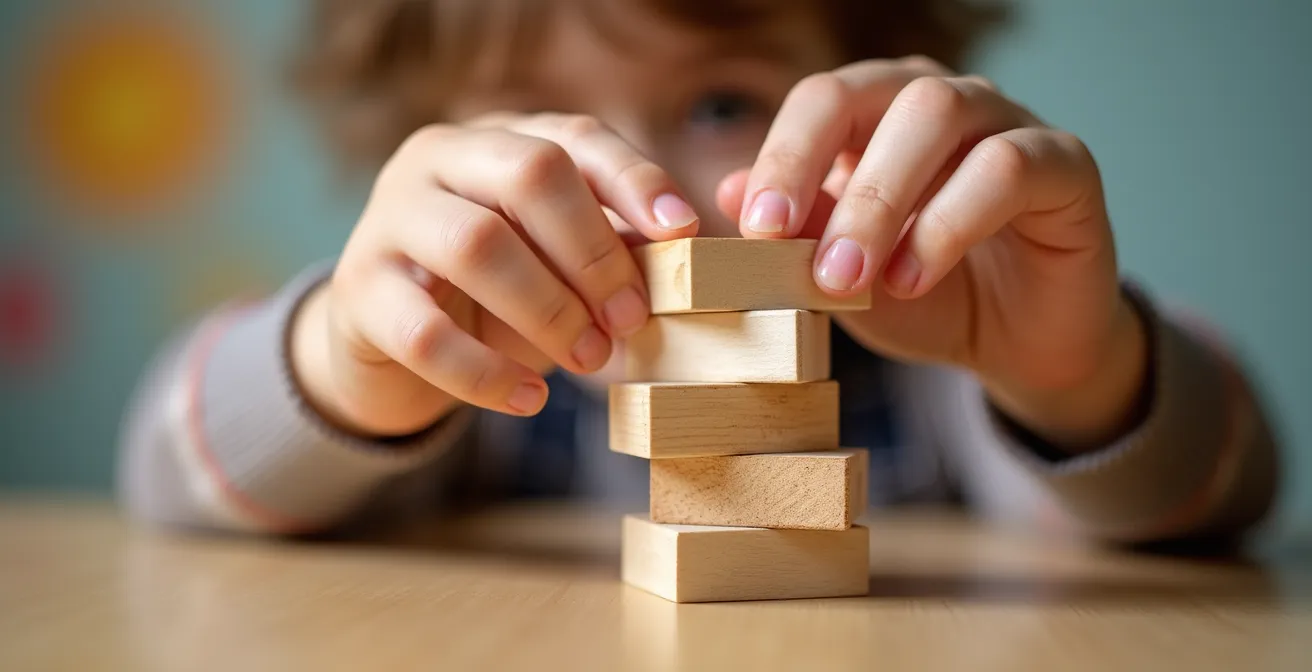
Look closely at a child’s hands as they build. That focused gaze, the minute adjustments of the fingers, the slight tremor as they test the limits of balance—this is not idleness. It’s a deep, multi-sensory engagement with the physical world. They are building an intuitive understanding of structural integrity and spatial relationships, creating mental models, or schemas, that will form the foundation for future learning in mathematics and engineering. Far from being a myth, the “math” behind building blocks is a profound neurological event happening in plain sight.
How to “Strew” Toys to Spark Independent Play for 45 Minutes?
The goal is not to direct play, but to create an environment so inviting that play becomes inevitable. This is the art of “strewing.” It moves the parent from the role of entertainer or instructor to that of a thoughtful “environment architect.” Strewing involves strategically placing a few open-ended items (the “invitation to play”) in your child’s path and then stepping back. The power of this approach is backed by science; neuroscience research indicates that about one-third of measured genes significantly changed with just half an hour of daily play, showing how profoundly this activity alters biological expression. You are not just setting out toys; you are triggering a cascade of beneficial genetic and neurological activity.
Effective strewing is about minimalism and intention. Instead of a toy box overflowing with plastic, consider placing a basket with a few silk scarves, smooth stones, and a cardboard tube on the floor. Or set out a magnifying glass next to a leaf from the garden. The key is using open-ended materials—items that can be used in a hundred different ways, unlike a single-purpose electronic toy. This ambiguity is what sparks the creative and problem-solving circuits in the brain. It forces the child to ask “What can I do with this?” rather than “What does this do?”
Your Action Plan for Intentional Strewing
- Observe Interests: Note what your child is currently fascinated by. Is it bugs? Pouring water? Lining things up? Your strewing should be based on these organic interests, not what you think they *should* play with.
- Select 2-3 Open-Ended Items: Choose a few versatile materials. Examples: a bowl of water with a few cups, a collection of different-textured fabrics, or clay with some twigs and beads. Less is more.
- Create an Invitation: Arrange the items artfully on a low table or a specific rug. This defines the space and makes the materials feel special. It’s a non-verbal “come and explore.”
- Step Back and Be Unavailable: This is the hardest part. Once you’ve set the stage, retreat. Sit down with a book or a cup of tea. Your goal is to be a quiet, supportive presence, not a participant. Resist the urge to “show” them how to play.
- Rotate and Reset: Don’t leave the same strewing out for days. When the child is done, put the items away. Introduce a new, simple invitation the next day to keep the sense of novelty and discovery alive.
As experts from the Karyn Purvis Institute of Child Development note, play is powerful because it removes barriers to cognitive growth like fear and stress, while simultaneously building skills like self-regulation and curiosity. Strewing is the practical application of this principle, creating a safe, low-pressure space where your child’s brain can do its best work, completely on its own terms.
Play-Based Preschool vs. Academic: Which leads to Higher Ivy League Acceptance?
The pressure to choose a preschool with a heavy academic focus—early reading, worksheets, rote memorization—is a direct symptom of parental anxiety. It seems logical: an earlier start on academics must lead to better outcomes. However, landmark longitudinal studies tell a strikingly different story. The famous Perry Preschool Project, which has tracked its participants for decades, provides the most compelling evidence. This program, which focused on high-quality, child-initiated play, showed an incredible return of $12.90 for every dollar invested, measured in better life outcomes.
This wasn’t just about feeling happier. As Nobel laureate economist James Heckman and his colleagues analyzed, the long-term success of the Perry participants was not due to an early IQ boost, which faded over time. Instead, the success was driven by the development of crucial socio-emotional skills and executive functions. They had better impulse control, more persistence, and superior social skills—all honed through the complex negotiations and problem-solving inherent in play-based learning. In comparison to a control group, they achieved higher earnings, committed fewer crimes, and reported better health in adulthood.
So, which path leads to higher Ivy League acceptance? The question itself is a trap. While there’s no direct study correlating preschool type to Ivy League matriculation, the evidence strongly suggests that the skills valued by top institutions—critical thinking, creativity, leadership, and resilience—are the very skills cultivated in a play-based environment. An academic-heavy preschool might produce a child who can recite the alphabet at age three, but a play-based program produces a child who can invent a game, negotiate its rules with peers, and adapt when the game doesn’t work. One is a feat of memory; the other is a demonstration of a functioning prefrontal cortex, the brain’s executive control center.
The Interruption Error: Why You Should Never Stop a Lego Session for Dinner?
A child is on the floor, completely absorbed. Their Lego creation is intricate, their focus absolute. Then comes the call: “Dinner’s ready! Time to clean up!” While it seems harmless, from a neurological perspective, this is a critical mistake: the Interruption Error. This isn’t just about stopping an activity; it’s about forcibly pulling the brain out of its most productive learning state. This state of deep engagement, often called “flow,” is what neuroscientists might describe as a portal to plasticity.
At a biological level, a child in deep play is engaging in what the Huberman Lab podcast terms low-stakes contingency exploration. Their prefrontal cortex is running countless simulations: “What happens if I put this long piece here? Will it balance? What if I use a different color?” This process of exploring possibilities without real-world risk is one of the few ways the brain can safely and effectively rewire itself. Interrupting this state is like shutting down a supercomputer while it’s running a vital optimization program. The learning isn’t just paused; the entire sequence is broken, and the potential for deep synaptic connection is lost.
Case Study: Prefrontal Cortex Activation During Sustained Play
Neuroscience reveals that during sustained, self-directed play, the prefrontal cortex becomes highly active. This is the brain’s executive control center, responsible for planning, problem-solving, and regulating emotions. When a child is allowed to play without interruption, this area is essentially in a training session. It learns to sustain attention, manage frustration when a tower falls, and flexibly adapt its strategy. Each “error” in play, like a block that won’t fit, strengthens the neural pathways for resilience and creative problem-solving. This is the biological definition of learning through experience.
Of course, children do need to eat dinner. The solution isn’t to let them play indefinitely but to change our approach. Instead of an abrupt command, try a gentle transition. Give a 10-minute warning, then a 5-minute one. Approach them and show interest: “Wow, that’s an amazing structure. In a few minutes, we’ll need to pause for dinner. Where’s a good ‘save point’ for your project?” This respects their cognitive process, acknowledges the importance of their work, and models respectful communication—a far more valuable lesson than rigid adherence to a dinner-time schedule.
Boredom Busters: How to Turn “I’m Bored” Into a Creative Project?
The two words parents dread most: “I’m bored.” Our immediate instinct is to solve the problem. We offer a tablet, suggest a game, or become an on-demand entertainer. This reaction, while well-intentioned, robs the child of a profoundly important developmental opportunity. Boredom is not a void to be filled; it is the brain’s signal that it has finished processing old information and is ready to create something new. It is the quiet runway from which divergent thinking—the ability to generate multiple unique ideas—takes flight.
When you resist the urge to “fix” boredom, you are telling your child, “I trust you to be the author of your own experience.” This is a powerful message. Initially, they may flounder. But in that space of “nothing to do,” the prefrontal cortex kicks into gear. They start to notice things they previously overlooked: the way light filters through the window, an old cardboard box in the corner, the sound of the wind. This is the genesis of creativity. The box becomes a spaceship. The light becomes a stage. The wind becomes a monster to hide from. This is pretend play in its purest form, an activity that research confirms can boost problem-solving skills.
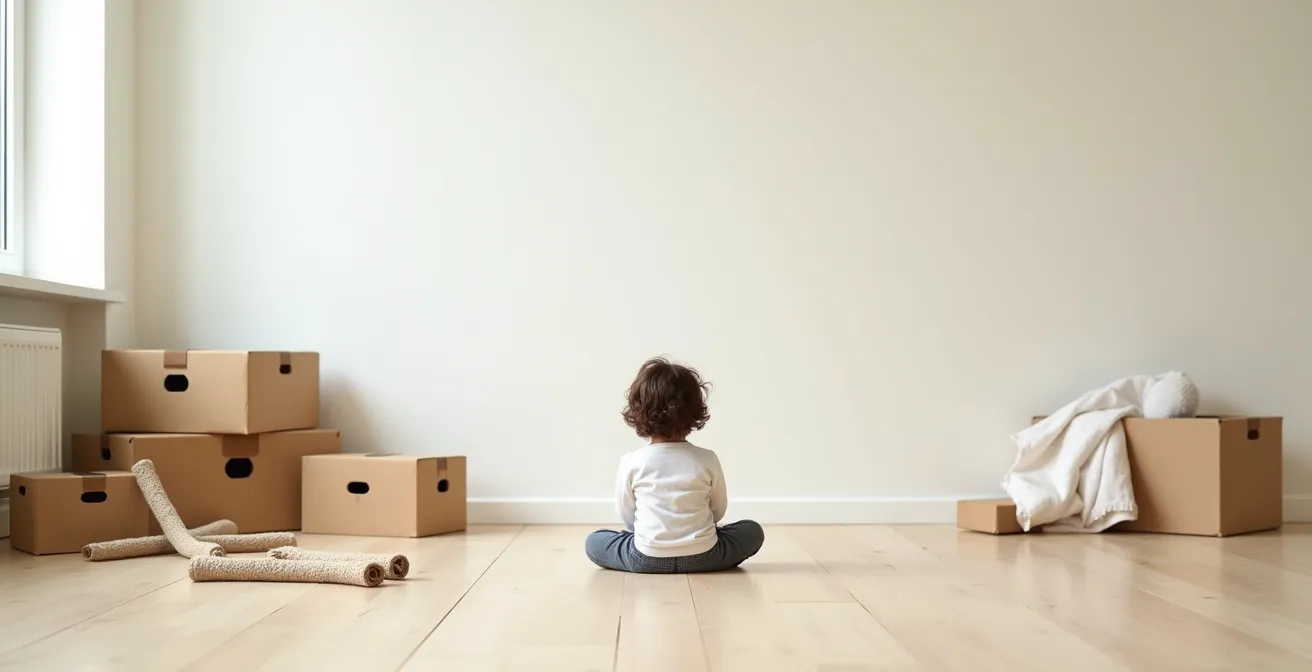
Your role is not to provide the project, but to have curated the environment beforehand (as with “strewing”). A minimalist space with a few open-ended materials is far more conducive to creativity than a room cluttered with prescriptive toys. When “I’m bored” is met not with a solution but with a calm, “Oh, I’m sure you’ll think of something,” you create the space for this magic to happen. You are teaching your child the most valuable skill of all: how to generate their own meaning and engagement from within. This is the ultimate “boredom buster”—not an activity, but an internal capacity.
Visual vs. Auditory: Is Learning Styles Theory Actually a Myth?
For years, educators and parents have been attached to the theory of “learning styles”—the idea that each child is primarily a visual, auditory, or kinesthetic learner. We buy specific products and tailor activities, believing we are optimizing for our child’s unique brain wiring. However, a vast body of cognitive science research has largely debunked this concept. While children may have preferences, there is no credible evidence to suggest that teaching to a specific style improves learning outcomes. The brain is a multi-modal organ; it learns best when multiple senses are engaged simultaneously.
This is precisely why unstructured play is such a superior learning modality. Think again about a child building with blocks. They are visually assessing space, auditorily hearing the clack of the wood, and kinesthetically feeling the weight and texture. It is a fully integrated sensory experience. According to cognitive science, activities like block play are strongly linked with improvements in cognitive flexibility and divergent problem-solving, skills far more valuable than the rote memorization often associated with style-based teaching methods. Play doesn’t care about a preferred “style”; it engages the whole brain at once.
When juvenile rats were deprived of opportunities for unrestricted social play, they developed fewer inhibitory synapses in the prefrontal cortex, and they experienced impaired cognitive skills as adults.
– Diamond et al., Greenough and Black, Bijlsma et al., Studies on play and brain development in animals
The persistence of the learning styles myth speaks to our desire for simple labels and quick fixes. The truth is more complex and more liberating: the best way to support learning is not to pigeonhole a child into a “style” but to provide rich, hands-on, multi-sensory experiences. Free play is the ultimate multi-modal learning environment. By letting go of the pressure to cater to a specific, and likely non-existent, learning style, we can focus on what truly works: creating opportunities for holistic, brain-building play.
Red Light, Green Light: How Simple Games Build Complex Impulse Control
It may seem like just a silly way to burn off energy, but a simple game of “Red Light, Green Light” is one of the most effective workouts for a child’s developing prefrontal cortex. This game is a masterclass in building impulse control and self-regulation, two of the most critical executive functions for life success. Every time a child forces themselves to freeze mid-stride when “Red Light!” is called, they are strengthening the neural pathways that inhibit impulsive behavior. They are practicing the crucial skill of overriding an automatic motor command (“run!”) with a conscious, goal-directed rule (“stop to win!”).
The foundational theorist Lev Vygotsky identified this exact mechanism as a core benefit of play. He argued that social make-believe play is the ideal context for cognitive development because it requires children to act according to internal ideas and social rules rather than their immediate impulses. Whether it’s “Red Light, Green Light” or a game of “house” where one must “act like a baby,” the child is practicing self-restraint and cognitive flexibility. This practice has tangible, measurable benefits. For example, developmental studies indicate that 60% of children who engage in regular play show better emotional regulation.
This is a powerful counter-narrative to the idea that only quiet, structured activities build focus. The boisterous, joyful, and social nature of these simple games is precisely what makes them so effective. The social stakes (not getting sent back to the start) provide the motivation, and the simple, clear rules provide the structure within which self-regulation can be practiced. These games are not a replacement for quiet focus, but they are an essential and complementary part of building a brain that can both generate creative ideas and control the impulses needed to bring those ideas to fruition.
Key Takeaways
- Unstructured play is not empty time; it is the active process of building the brain’s executive functions.
- Protecting a child’s state of “flow” from interruption is critical for fostering deep learning and neuroplasticity.
- Skills cultivated through play (resilience, problem-solving, self-regulation) are stronger predictors of long-term success than early academic achievement.
Magnetic Tiles vs. Wooden Blocks: Which Investment Lasts Longer?
Parents often get caught in the trap of the “perfect toy.” We debate the merits of magnetic tiles versus classic wooden blocks, wondering which is the better investment for our child’s development. This debate, however, misses the point. From a neuro-developmental perspective, the specific toy is far less important than the *type* of play it enables. Both magnetic tiles and wooden blocks are superb open-ended materials. The real “return on investment” comes not from the object itself, but from the thousands of hours of unstructured, child-led exploration it facilitates.
The true value of a toy is measured in its capacity to be a portal to plasticity. As neuroscientist Sergio Pellis from the University of Lethbridge explains, the experience of play physically changes the neural connections in the prefrontal cortex—the brain’s executive control center. Without this experience, those critical changes don’t happen. A “good” toy is simply a tool that invites this process. Wooden blocks might teach more about gravity and friction, while magnetic tiles offer lessons in polarity and geometry. Both lead to the same end: a brain that is more adept at planning, problem-solving, and regulating emotions.
So, which investment lasts longer? The one that is used more. The real answer lies not in the material, but in the environment. A home that values and protects time for free play, that reframes boredom as an opportunity, and that resists the urge to interrupt a child deep in their work will see a far greater “return” on any toy, be it a set of expensive magnetic tiles or a collection of simple cardboard boxes. The most lasting investment is not in a specific product, but in the philosophy of parenting that champions the profound, brain-building power of unstructured play.
Embrace the power of unstructured time. The next step isn’t to buy another ‘educational’ toy, but to consciously create the space and freedom for your child’s brain to do its most important work. This is the path to building a truly capable, resilient, and brilliant mind.