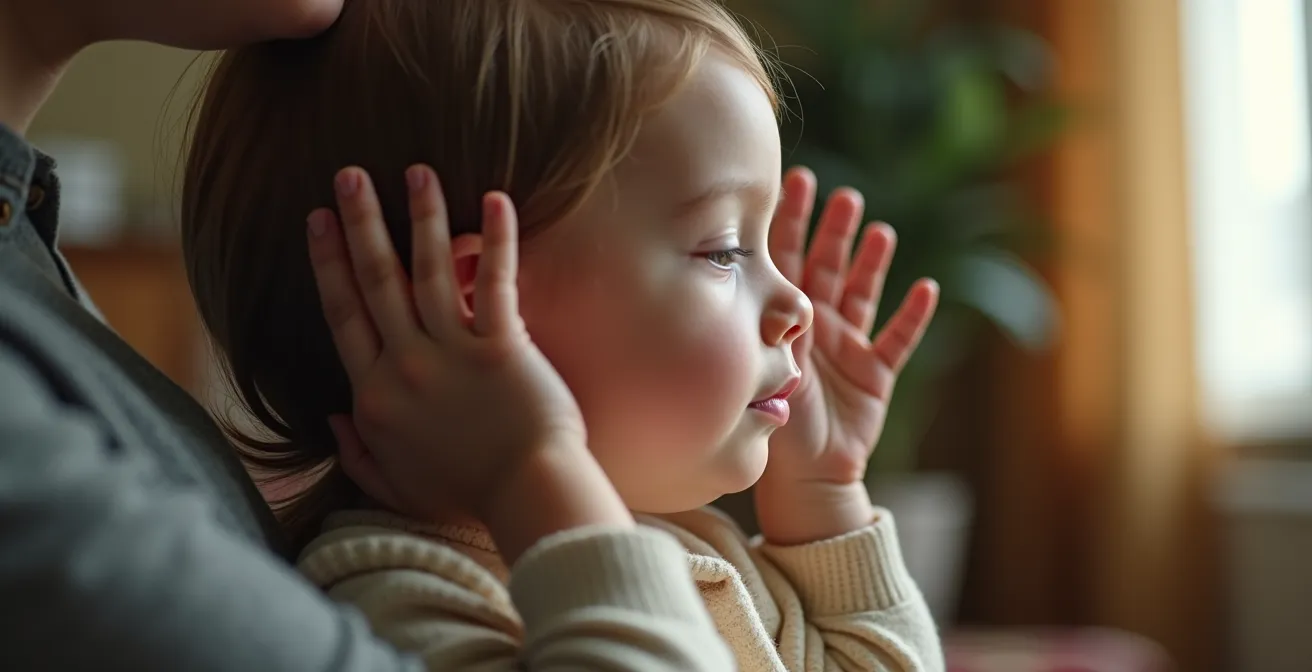
Contrary to popular belief, learning to read starts with the ears, not the eyes. A child’s ability to decode letters is built on a hidden foundation of auditory skills.
- Rhyming and syllable counting build the initial “auditory blueprint” for language.
- Isolating sounds in words and blending them together are the direct precursors to reading.
- A rich conversational environment is more crucial than early exposure to written words.
Recommendation: Before picking up another flashcard, put the book down and start playing with the sounds in spoken words.
You have the flashcards ready. You point to the letter ‘C’ next to a picture of a cat. “Cuh, cuh, cat,” you say, enunciating perfectly. Your child, however, just stares blankly, more interested in the picture than the symbol. Frustration mounts. Why can’t they make the connection? The common advice is to keep practicing, to read more books, to make it a game. But what if the problem isn’t with the eyes or the letters at all? What if the real work of reading happens long before a book is even opened?
As a speech pathologist, I see parents make the same understandable mistake: they jump to the visual part of reading—the letters—before the auditory foundation is solid. Reading is not a primary human function like speaking; it’s a code we invented. To crack that code, a child’s brain must first be trained to hear the individual sounds, or phonemes, that make up spoken language. This is the essence of phonological awareness. It’s the ability to manipulate the sounds of language, a skill so crucial that research shows that at least 80% of poor readers demonstrate a weakness in this area. It is the single strongest predictor of reading success.
This guide shifts the focus from sight to sound. We will deconstruct literacy into its core auditory components, moving from the largest sound chunks (rhymes and syllables) down to the individual phonemes. You will learn why simple, screen-free games are more powerful than any app and how everyday conversation builds the “reading brain.” It’s time to stop asking your child to see what they cannot yet hear.
To help you build this crucial foundation, this article breaks down the essential auditory skills, explaining the science behind each and providing practical, no-prep games to play with your child. The following sections will guide you step-by-step through this auditory-first approach.
Summary: The Auditory Blueprint for Literacy
- The Rhyme Crime: Why Detecting Rhymes Is the First Step to Literacy?
- Clapping Names: How Syllable Counting Fixes Spelling Later?
- First Sound, Last Sound: The Game That Predicts Reading Success?
- No Book Required: How Telling Stories Builds Reading Brains?
- Sheep vs. Ship: Why Vowel Discrimination Matters for Spelling?
- Robot Talk: A No-Prep Game to Teach Blending Sounds?
- Why Invented Words Are a Sign of High Intelligence?
- The 30 Million Word Gap: How Conversation at Dinner Changes IQ?
The Rhyme Crime: Why Detecting Rhymes Is the First Step to Literacy?
Before a child can understand that ‘c-a-t’ spells “cat,” they must first notice that “cat” sounds like “hat” and “bat.” Rhyming is the first and most accessible entry point into phonological awareness. It teaches the brain to pay attention to the sound structure of words, not just their meaning. When a child detects a rhyme, they are performing a sophisticated auditory task: ignoring the beginning sound of a word (the onset) and focusing on the part that is the same (the rime). This ability to break words into smaller parts is the foundational skill upon which all other phonemic awareness rests.
For a preschooler, this isn’t an academic exercise; it’s play. Singing nursery rhymes, reading rhyming books, and making up silly rhyming strings (like “dog, log, fog, bog”) trains their ear to catch sound patterns. You’re building their auditory blueprint of the language. Without this blueprint, the idea that different letters can share a common sound (like the ‘ight’ in light, night, and fight) will remain abstract and confusing. Rushing past this stage is what I call the “rhyme crime”—it robs a child of the most fundamental tool for understanding how our language is built.
Your Action Plan: The Rhyme Ladder
- Exposure and Repetition: Start by simply reading and singing songs and poems with strong rhyme schemes. Emphasize the rhyming words as you say them to draw your child’s attention to the pattern.
- Rhyme Detection: Present simple pairs of words (“Do ‘cat’ and ‘hat’ rhyme?”) and ask for a yes/no answer. Start with obvious rhymes before moving to non-rhyming pairs.
- Spot the Odd One Out: Say three words, two of which rhyme (“pig, wig, sun”). Ask your child which one doesn’t belong. This sharpens their detection skills.
- Subtle Rhyme Identification: Progress to more subtle rhymes that may not be spelled the same way, such as ‘laugh’ and ‘graph’, to focus purely on the sound.
- Rhyme Generation: The final step is asking your child to generate their own rhyming word (“What’s a word that sounds like ‘blue’?”). This demonstrates true mastery of the concept.
Clapping Names: How Syllable Counting Fixes Spelling Later?
Once a child’s ear is tuned to rhymes, the next step is to hear the “beats” in words: the syllables. Clapping out the syllables in a name (“Ma-ri-a,” clap-clap-clap) or a word (“el-e-phant,” clap-clap-clap) is a classic game for a reason. It physically and audibly demonstrates that long words are made of smaller, manageable chunks. This skill, known as syllable segmentation, is a crucial bridge between the big-picture awareness of rhyming and the fine-grained awareness of individual phonemes.
This seemingly simple game has profound implications for future literacy. A child who can hear that “butterfly” has three parts is already learning to analyze a word’s structure. Later, when they face the daunting task of spelling “butterfly,” their brain will instinctively break the problem down into three smaller, more manageable parts: “but-ter-fly.” They are less likely to be intimidated or miss sounds because they have an internal, auditory road map of the word. This skill is so fundamental to language structure that it transcends languages. As the International Literacy Association notes, research shows that phonological awareness skills developed in one language can be directly applied to learning a new one like English.
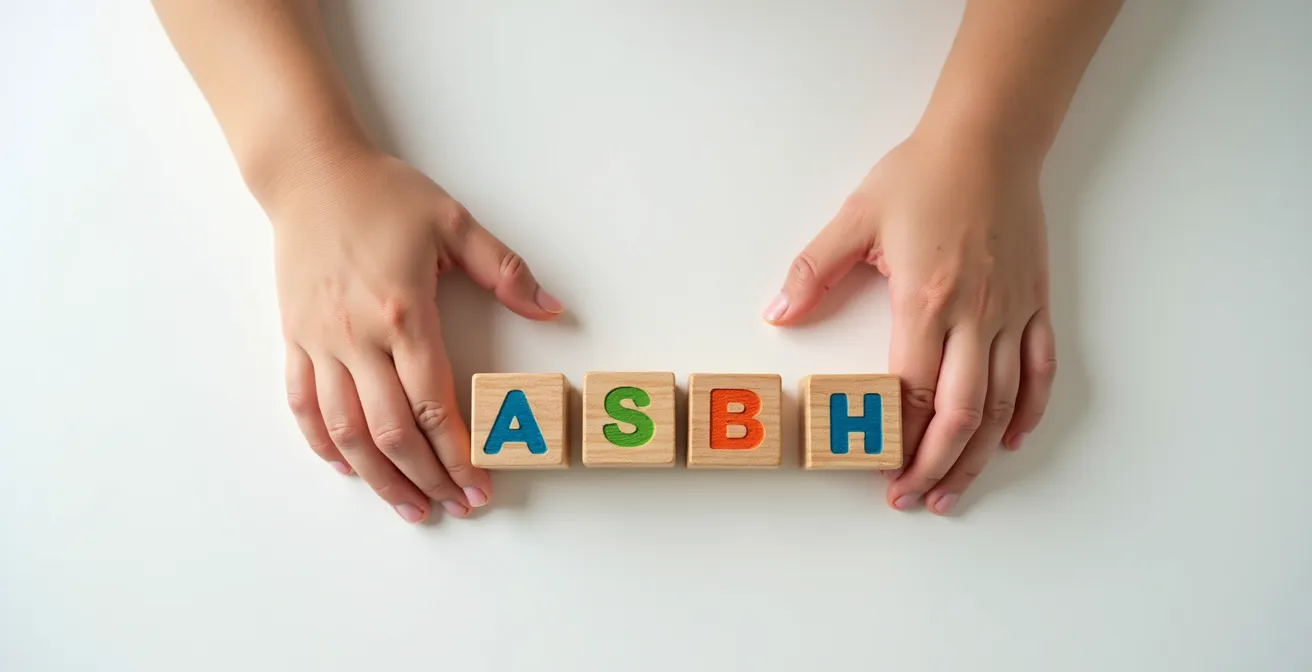
Using physical objects like blocks, as shown above, can make this concept even more concrete. Each clap gets a block, creating a visual representation of the word’s auditory structure. This multisensory approach solidifies the understanding that words have a distinct, countable rhythm, a key insight for future readers and spellers.
First Sound, Last Sound: The Game That Predicts Reading Success?
After mastering rhymes and syllables, the brain is ready for the most critical and challenging phonological skill: phonemic awareness. This is the ability to hear and manipulate the smallest individual sounds (phonemes) in words. The gateway to this skill is a simple game: “I Spy” with sounds, not letters. “I spy something that starts with the /s/ sound.” This game, focusing on initial and final phonemes, is a powerful predictor of future reading success because it’s the first time a child isolates a single sound from the rest of the word.
Why does this matter so much? When a child learns to read, they must perform this exact function in reverse. They see the letter ‘S’ and must retrieve the /s/ sound. If they’ve never consciously isolated that /s/ sound in spoken words like “sun” or “snake,” the letter ‘S’ will remain a meaningless shape. Identifying the last sound is equally important for spelling. A child who can hear that “boat” ends with a /t/ sound is far more likely to remember to write the ‘t’ at the end. These are not just fun games; they are targeted training for the brain’s decoding and encoding machinery.
Case Study: Lasting Impact of Sound Identification
The power of this specific training is well-documented. For instance, a 2024 intervention study with preschoolers from low-SES backgrounds showed that targeted practice in identifying first and last sounds led to significant improvements in phonological awareness. Crucially, these gains were maintained sixteen weeks after the intervention ended, demonstrating that this foundational skill, once learned, becomes a permanent part of a child’s cognitive toolkit for literacy.
You can make this tangible by using blocks to represent the beginning, middle, and end of a word like “mop.” Have your child touch the first block as they say /m/ and the last block as they say /p/. This physicalizes the concept of a sound having a specific position in a word, building a critical piece of their pre-literacy hearing.
No Book Required: How Telling Stories Builds Reading Brains?
While we’ve focused on the micro-level of sounds, the macro-level of story is just as critical for building a reading brain, and it doesn’t require a single written word. The simple act of telling stories—recounting your day, making up a tale about a squirrel in the park, or asking your child to describe a dream—is a powerful cognitive workout for literacy. When a child listens to an oral story, their brain is doing something amazing: it’s creating mental movies. They are translating your auditory input into rich visual imagery, character emotions, and a sequence of events.
This mental process is not just for entertainment. As reading development researchers have noted, “The act of converting auditory input into visual imagery is the exact same cognitive muscle used when reading words on a page.” A child who is proficient at building a world in their mind from spoken words can devote more cognitive energy to the difficult task of decoding when they finally start reading. They already have the “story blueprint”—an innate understanding of narrative structure, cause and effect, and character motivation. They know what a story is *supposed* to feel like, so they can focus on what the letters *say*.
Case Study: The Power of Oral Tradition
Recent research confirms this connection. A 2024 study on early reading development found that children who regularly engaged in collaborative oral storytelling with their parents demonstrated superior understanding of narrative structure and even prosody (the rhythm and intonation of language). When these children began formal reading instruction, they could focus their mental resources on decoding, because the ‘what’ of the story was already a familiar cognitive process for them.
Encourage your child to be a co-creator. Ask “And what do you think happened next?” or “Why was the bear so sad?” These questions build inferencing and prediction skills, two pillars of advanced reading comprehension. You are teaching them to be an active participant in a narrative, a skill that is essential for a lifetime of engaged reading.
Sheep vs. Ship: Why Vowel Discrimination Matters for Spelling?
One of the most challenging auditory tasks for a young learner is vowel discrimination. While the difference between /b/ and /p/ is relatively clear, the subtle shift between the /ee/ in “sheep” and the /i/ in “ship” can be very difficult to hear. This isn’t just a pronunciation issue; it’s a major hurdle for both reading and spelling. English is notoriously tricky with its vowels, and a child who cannot hear the difference between these sounds will be endlessly confused when trying to match them to letters. They will struggle to read “pin” and “pen” as different words and will guess at which vowel to use when spelling.
The key to teaching this is making the invisible visible. Vowel sounds are produced by the shape of your mouth and the position of your tongue. You can teach your child to feel the difference. For /ee/, your mouth makes a wide smile. For /i/, it’s more relaxed. This physical feedback provides a concrete anchor for the abstract sound. Playing games with “minimal pairs”—words that differ by only one sound—is an incredibly effective way to train this skill. Ask your child to listen closely as you say “sleep” and “slip,” and have them tell you if they are the same or different. This sharpens their auditory discrimination to a fine point.
The following chart can help you and your child connect the sound of a vowel to the physical feeling of making it, a crucial step in mastering these tricky sounds.
| Vowel Sound | Mouth Position | Example Words | Physical Cue |
|---|---|---|---|
| /ee/ (high-front) | Smile position | sheep, meet, feet | Wide smile, tongue high |
| /i/ (mid-front) | Relaxed smile | ship, sit, bit | Slight smile, tongue mid |
| /ah/ (low-back) | Yawn position | father, car, spa | Open mouth, tongue low |
| /oo/ (high-back) | Whistle position | boot, food, moon | Rounded lips, tongue back |
Robot Talk: A No-Prep Game to Teach Blending Sounds?
All the skills we’ve discussed—rhyming, syllable counting, and sound isolation—lead to this pivotal moment: blending. Blending is the ability to string individual phonemes together to form a word. It’s the direct auditory rehearsal for the act of reading. When you play “Robot Talk” by saying “Can you get the /b/-/aw/-/l/?” and your child runs to get the ball, they have just successfully blended sounds. They have taken separate auditory parts and synthesized them into a meaningful whole. This is precisely what their brain will do when they see the letters b-a-l-l on a page.
This skill of phonological manipulation is the engine of decoding. A child who is a good “robot talker” can hold a sequence of sounds in their working memory and smoothly connect them. The game can be made progressively harder. Start with a slow robot voice with no pauses (“sssuuunnn”). As their working memory improves, you can add slight pauses (“s…un”). The next step is “Reverse Robot,” where you say the whole word (“cup”) and they break it into its robot sounds (/c/ /u/ /p/), a skill known as segmentation, which is the foundation of spelling.
While these auditory games are powerful on their own, their effect is magnified when eventually paired with letters. A meta-analysis by Stalega et al. (2024) found that phonological awareness instruction that included print had a massive effect size of g = 0.64 for improving word reading. This confirms our core idea: sound comes first, but when sound and symbol are finally united, true literacy takes off. “Robot Talk” is the final, essential auditory step that prepares a child for that momentous connection.
Why Invented Words Are a Sign of High Intelligence?
Your child proudly points to a drawing and calls it a “flibbert.” Your first instinct might be to correct them, to say “That’s not a real word.” But a speech pathologist would urge you to pause and celebrate. Inventing words, or creating “neologisms,” is not a sign of confusion; it’s often a sign of high-level linguistic processing. It shows that a child has moved beyond simply memorizing words and has started to internalize the rules of how their language works.
A child creating a word like ‘flibbert’ is not speaking gibberish; they are testing the phonotactic rules of their language – the rules of how sounds can be combined.
– Language Development Specialists
The word “flibbert” might be nonsense, but it “sounds” like an English word. It follows the rules. The ‘fl’ blend is common, the short ‘i’ vowel is standard, and the ‘-ert’ ending is plausible. The child is not just making random noises; they are running a phonological experiment. They are demonstrating a deep, intuitive understanding of their language’s sound system. This is language as Lego; they are showing you they know how the blocks are allowed to fit together, even if they are building something new.
Case Study: Invented Words and Cognitive Flexibility
This isn’t just a theory. A 2024 study of dual-language preschoolers found that children who frequently created novel words to fill gaps in their vocabulary also scored higher on measures of cognitive flexibility. These “phonological experiments” were not random; the invented words consistently followed the sound patterns (phonotactics) of the children’s native language, proving they had a sophisticated, implicit grasp of linguistic structure.
So, the next time your child invents a word, see it for what it is: a sign of a clever, curious brain at work. Instead of correcting, show curiosity. “A flibbert! Tell me about a flibbert. What does it do?” You’ll be encouraging the very linguistic creativity that underpins all language and literacy.
Key Takeaways
- Reading is an auditory skill first. A child must be able to hear and manipulate the sounds in spoken language before they can connect them to written symbols.
- Phonological awareness develops in a sequence: from large sound chunks like rhymes and syllables to the smallest individual sounds (phonemes). Skipping steps leads to frustration.
- Simple, no-prep auditory games (like “I Spy” with sounds) and rich, daily conversation are more effective for building pre-reading skills than flashcards or apps.
The 30 Million Word Gap: How Conversation at Dinner Changes IQ?
The specific auditory games we’ve covered are essential, but they exist within a larger context: the overall language environment of your home. The sheer volume and quality of words a child hears every day has a staggering impact on their cognitive development and, ultimately, their reading ability. This was famously demonstrated by the landmark Hart & Risley study, which found that children in different socioeconomic environments were exposed to vastly different amounts of language. The study revealed that by age three, a significant “word gap” had already formed.
The most shocking finding was the difference in quantity: the landmark Hart & Risley study found children heard 2,153 words per hour in professional families versus 616 in welfare families. This difference accumulates to a gap of roughly 30 million words by the time a child enters school. This isn’t just about vocabulary size; it’s about exposure to complex sentences, varied grammar, and the back-and-forth of conversation. A rich language environment is like a constant, low-intensity workout for a child’s auditory processing and working memory systems. It builds the cognitive infrastructure needed to handle the demands of reading.

The family dinner table, free from screens and distractions, is one of the most powerful arenas for closing this gap. It’s not about quizzing your child, but about engaging in quality conversation. Here are some simple strategies:
- Ask “wonder” questions: Instead of “What did you do today?”, try “I wonder what the funniest thing that happened at school was?” This prompts more descriptive language.
- Practice “serve-and-return”: Actively listen to your child’s response and build on it with a follow-up question or comment. This models conversational turn-taking.
- Use rich vocabulary: Don’t be afraid to use “big words.” If you use the word “enormous,” your child will learn it from the context of your conversation far more effectively than from a vocabulary list.
Every conversation is an opportunity to build your child’s brain. By creating a home filled with rich, interactive language, you are giving them the single greatest advantage for becoming a successful, lifelong reader.
By focusing on this auditory-first approach, you are not just teaching reading; you are building the fundamental architecture of a literate brain. Start today by putting down the flashcards, tuning in to the sounds of your language, and celebrating every “robot” word and silly rhyme.