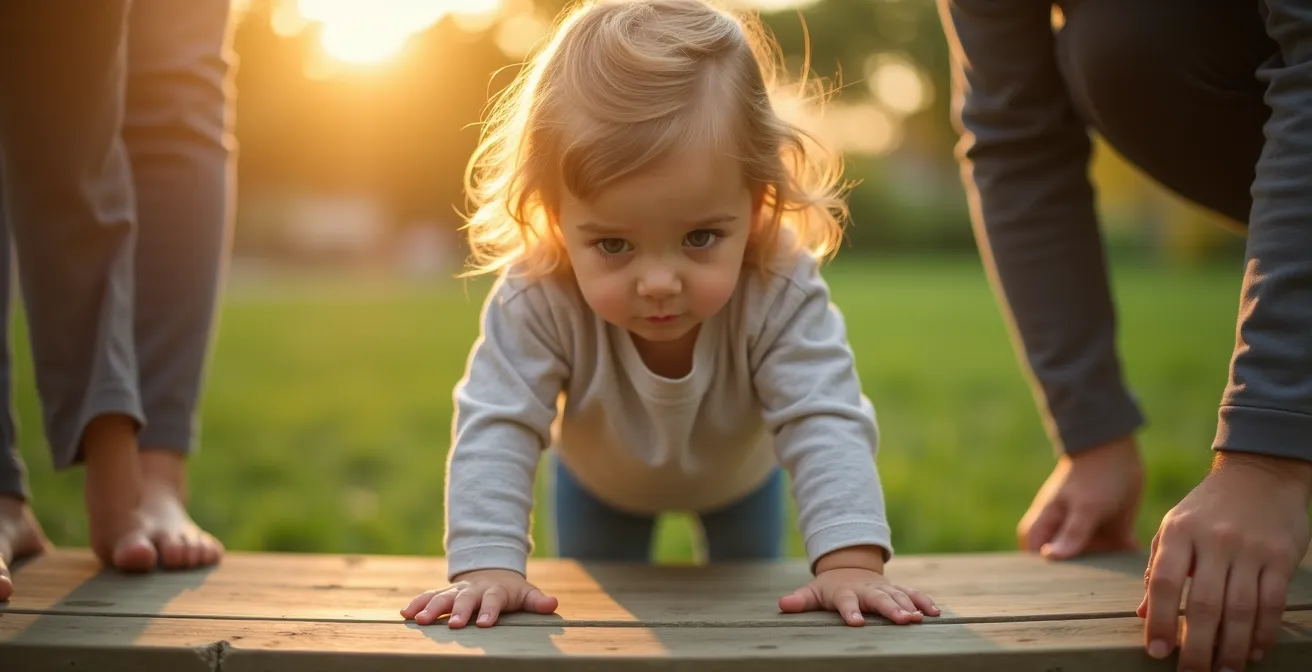
Watching your child struggle with coordination can be worrying, and common advice to “just practice more” often fails. The true key to building physical confidence lies not in repetition, but in understanding the body’s foundational systems. This guide, from a pediatric physical therapist’s perspective, shifts the focus from the symptom of “clumsiness” to its root causes: core stability, sensory processing, and motor planning. By strengthening these building blocks, you can empower your child with the physical literacy they need to thrive.
As a parent, you notice everything. You see the hesitation before they climb the playground ladder, the frustration when they can’t keep up in a game of tag, or the way they drop a ball that seems to come right to them. It’s natural to worry and label it “clumsiness.” Friends and family might tell you it’s just a phase or that you should sign them up for a sport to “get better.” While well-intentioned, this advice often misses a crucial point about how a child’s body learns and develops.
Gross motor skills—the large movements like running, jumping, and throwing—are not just about muscle. They are the result of a complex conversation between the brain, nerves, and muscles. Simply forcing more practice without addressing the underlying foundation can sometimes decrease confidence rather than build it. A child who feels they are failing will start to avoid the very activities they need for development, a cycle known as ‘activity avoidance’.
But what if the key wasn’t forcing them to be a better athlete, but helping them become a more knowledgeable owner of their own body? This is where an anatomical and developmental approach makes all the difference. Instead of just looking at the clumsy catch, we need to look at the systems that make a successful catch possible: core stability that provides a steady base, the vestibular system that manages balance, and the brain’s ability to plan the movement before it even happens. This is the essence of building true physical literacy.
This guide will walk you through the key anatomical and sensory components that underpin your child’s coordination. We will deconstruct common challenges and provide targeted, playful strategies to build a strong foundation from the inside out, turning frustration into confident, joyful movement.
The following sections break down specific areas where motor skills are built, from the power of the body’s core to the nuances of sensory processing in different activities. Each part offers insights and practical steps to support your child’s journey toward physical confidence.
Summary: A Therapist’s Guide for the “Clumsy” Child
- Why Core Strength Affects Handwriting Legibility?
- How to Teach Bike Riding in Under 2 Hours?
- Swimming vs. Gymnastics: Which Builds Better Body Awareness?
- The Sedentary Trap: Physical Risks of Screen Time Over 2 Hours
- When to Worry About Coordination: Milestones for Walking Backward
- Why a Hungry Child Cannot Listen to Logic: The Physiology of Tantrums
- Swipe vs. Pinch: Why Tablets Are Weakening Toddler Hands?
- Catching the Ball: How to Train Reaction Time in Non-Athletic Kids?
Why Core Strength Affects Handwriting Legibility?
It seems counterintuitive: how can the muscles in a child’s belly and back possibly influence how neatly they write their name? The connection lies in a fundamental principle of motor development called proximal stability for distal mobility. Think of the body as a crane. For the crane’s arm (the distal part) to move with precision and control, its base (the proximal part) must be rock-solid. For a child, the core is that stable base.
When a child has poor core strength, their body must work overtime just to sit upright at a desk. Their brain and body expend significant energy on maintaining posture, leaving fewer resources available for the fine motor control required for handwriting. You might see them slouching, propping their head on their hand, or constantly shifting in their chair. These are all compensations for a core that isn’t providing adequate support. This is why developmental research shows that core control is foundational for the development of fine motor skills.
A strong core allows the shoulders, arms, and hands to operate from a stable platform. This frees up the small muscles in the hands to perform the intricate, controlled movements of forming letters. By building gross motor strength in the trunk, you are directly paving the way for improved fine motor skills like legible handwriting. It’s about building the body’s foundation from the center out.
Integrating simple, playful core-building activities into your child’s day can make a significant difference. These don’t need to feel like a workout; they should feel like a game.
- Animal Walks: Challenge your child to races or obstacle courses using bear crawls (walking on hands and feet) and crab walks. These engage the entire core musculature.
- Wheelbarrow Walking: Hold your child’s legs while they walk on their hands. This is fantastic for building both core and upper body strength.
- Superman Pose: Have them lie on their tummy and lift their arms and legs off the floor simultaneously, as if they’re flying. See how long they can hold it.
- Pillow Play: Sitting or balancing on an unstable surface like a couch cushion or pillow forces the core muscles to fire constantly to maintain balance.
Ultimately, strengthening these large muscle groups provides the essential support system that allows for precision and endurance in tasks we might not immediately connect to gross motor skills, like sitting through a lesson or writing a story.
How to Teach Bike Riding in Under 2 Hours?
The traditional method of teaching a child to ride a bike—training wheels, a running parent holding the seat, and lots of tears—is often a lesson in frustration. The secret to teaching this skill quickly and confidently is to throw out that playbook and focus on the single most important component: balance. Pedaling is easy; staying upright is the hard part.
This “balance-first” approach isolates the skill by removing the pedals entirely. A balance bike, or a regular bike with the pedals removed, allows a child to focus solely on their body’s relationship with gravity. They learn to steer, to lean into turns, and to feel how their body shifts to maintain equilibrium. This process directly trains two critical internal sensory systems. The first is the vestibular system, located in the inner ear, which is our internal gyroscope for balance. The second is proprioception, the body’s awareness of its position in space. By scooting and gliding, a child gets hundreds of micro-reps in learning how these systems work together.
This is far more effective than using training wheels, which teach a child to ride a tricycle, not a bicycle. Training wheels prevent the bike from leaning, which is essential for steering and balance. In fact, studies and anecdotal evidence consistently show that children who start with balance bikes learn to ride 30% faster, often mastering the balance portion in a single session. Once they can confidently glide for 10-15 feet with their feet up, adding pedals becomes a simple, mechanical next step.
Find a gentle, grassy slope. This is the perfect training ground, as it allows gravity to do the work of creating momentum, freeing up the child to focus entirely on balance without having to push off aggressively.
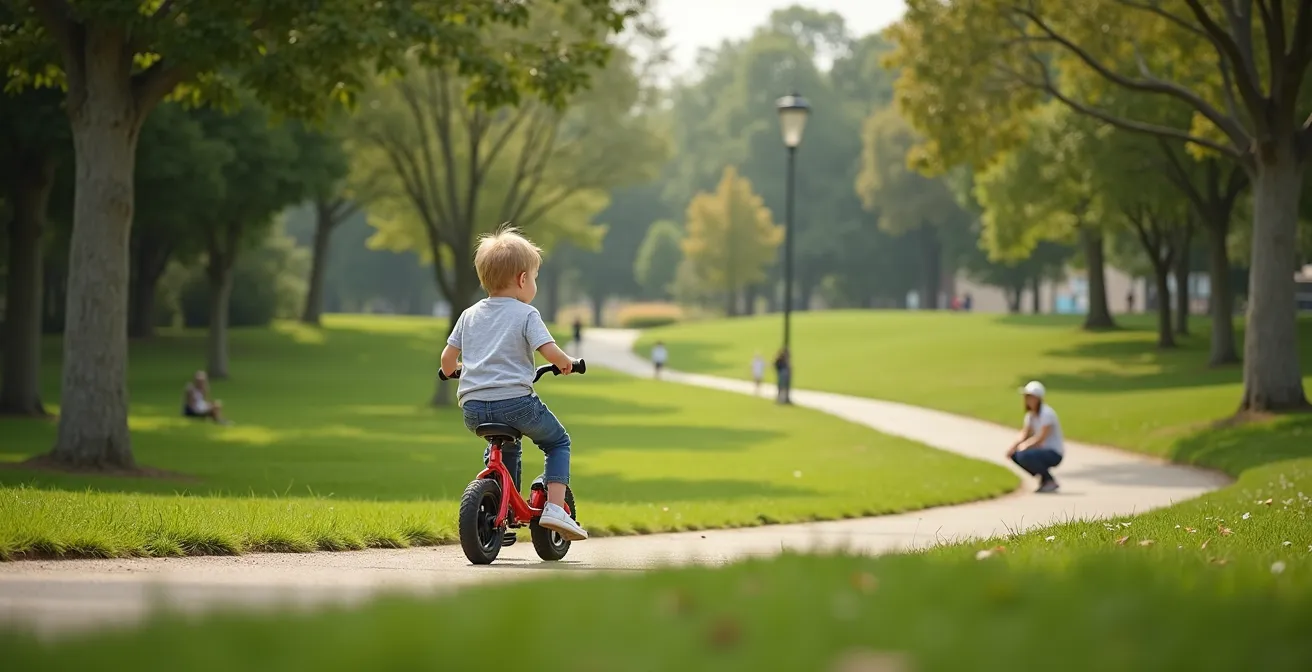
As you can see in this ideal learning environment, space and a slight incline are your best tools. The process becomes one of discovery rather than instruction. Let your child experiment with lifting their feet for short glides, gradually increasing the distance. Once they have mastered this, reattaching the pedals is often the final, surprisingly quick, 15-minute step to independent riding.
By breaking down the skill and respecting the body’s natural learning sequence—balance first, then propulsion—you transform a dreaded milestone into a joyful and rapid achievement.
Swimming vs. Gymnastics: Which Builds Better Body Awareness?
When parents look for activities to boost coordination, swimming and gymnastics are often at the top of the list. Both are excellent for developing gross motor skills, but they build body awareness, or proprioception, in fundamentally different ways. The “better” choice depends entirely on your child’s unique sensory profile and needs. There is no one-size-fits-all answer; instead, it’s about matching the environment to the child.
Swimming takes place in a gravity-neutral environment. The water provides constant, uniform pressure all over the body—a sensation that is deeply calming and organizing for many children, especially those who are sensitive or tend to be sensory-avoiding. In the water, movement is fluid and rhythmic. A child learns body awareness through the resistance of the water, feeling how their arms and legs work together to propel them. It’s a fantastic full-body workout that builds endurance and motor coordination without the high impact or jarring movements of land-based sports.
Gymnastics, on the other hand, is a constant battle against gravity. It’s filled with high-impact sensory input: jumping, tumbling, landing, and hanging. This type of intense feedback can be highly organizing for children who are sensory-seeking—those who love to crash, jump, and spin. Gymnastics excels at teaching kinesthetic awareness and precise body positioning through static holds (like a handstand) and explosive movements. It demands a high degree of core strength and motor planning to execute skills safely and correctly.
The following table breaks down the key differences in how each sport contributes to motor development. As noted by experts in the field, gross motor skills impact on your endurance to cope with a full day of school and navigate your environment, making the choice of activity significant.
| Aspect | Swimming | Gymnastics |
|---|---|---|
| Sensory Input | Uniform pressure, muffled sound | High impact, varied textures |
| Body Awareness Type | Proprioceptive in gravity-neutral | Kinesthetic against gravity |
| Best For | Sensory-avoiding children | Sensory-seeking children |
| Core Strength Building | Moderate, full-body | High, targeted positions |
| Coordination Focus | Fluid, rhythmic movements | Static holds, precise control |
For a child overwhelmed by loud noises and rough play, the quiet, cocoon-like world of the pool may be perfect. For a child who is constantly on the move and seeking intense physical feedback, the structured challenges of a gymnastics class could be the ideal fit.
The Sedentary Trap: Physical Risks of Screen Time Over 2 Hours
In our digital world, screens are an unavoidable part of childhood. But when screen time becomes excessive, it often displaces the one thing a developing body needs most: movement. The “sedentary trap” isn’t just about a lack of exercise; it’s about the physical consequences of prolonged stillness on a growing musculoskeletal and neurological system. A child’s body is designed to move, and when it doesn’t, critical developmental processes are hindered.
From an anatomical perspective, sitting for long periods weakens the very muscles required for confident movement. The postural muscles of the back and core, which are essential for balance and stability, become disengaged and weak. The hip flexors can become tight, affecting gait and posture. This creates a physically deconditioned state where even basic motor tasks like running and jumping feel more effortful and less coordinated, reinforcing a child’s belief that they are “not good” at physical activities.
Neurologically, movement is how the brain builds its map of the body and the world. Every time a child runs, jumps, or climbs, they are feeding their brain rich sensory information—proprioceptive and vestibular—that fine-tunes their motor control. When this input is drastically reduced, the brain’s ability to plan and execute complex movements can stagnate. It’s no surprise that health organizations are concerned; for instance, it is widely accepted that physical activity is crucial, and experts recommend at least 60 minutes of moderate-to-vigorous physical activity daily for school-aged children.
The solution isn’t necessarily to eliminate screens, but to consciously counterbalance them with movement. One of the most effective strategies is to introduce “movement snacks”—short, 5-10 minute bursts of physical activity throughout the day, especially as breaks from screen time.
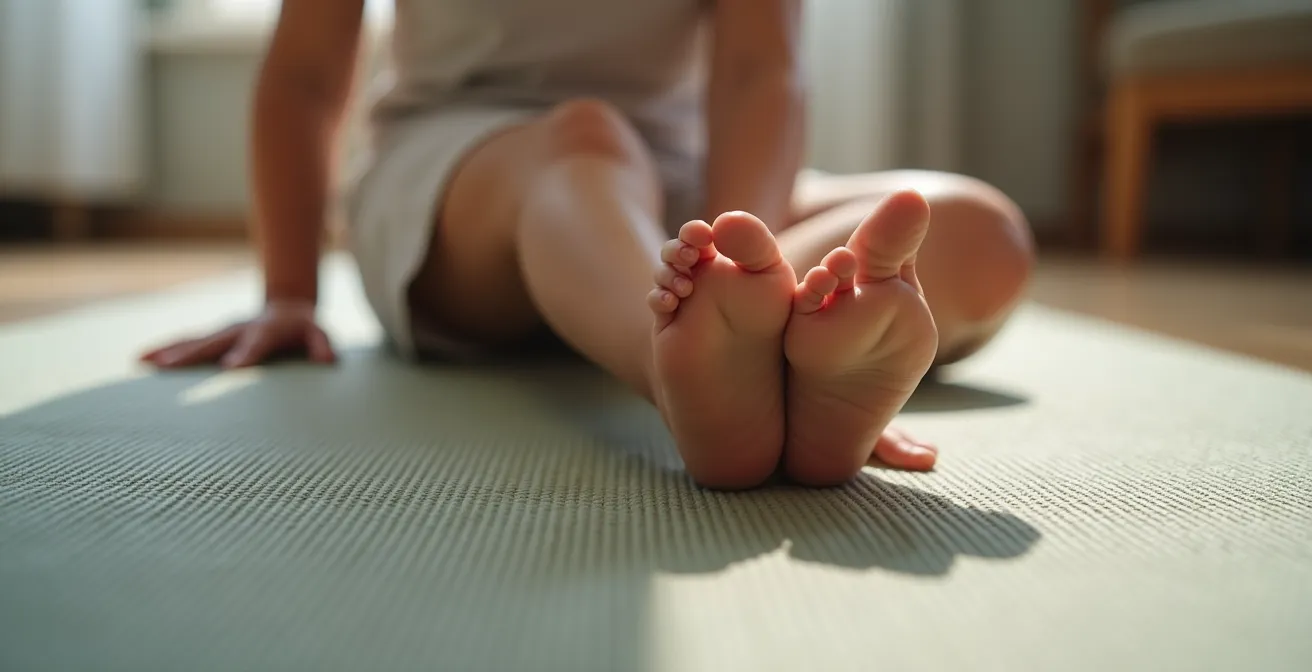
These short breaks are powerful because they reactivate postural muscles, send a flood of sensory information to the brain, and prevent the negative effects of prolonged sitting. Here are some easy “movement snack” ideas:
- The Floor is Lava: Challenge your child to get from one side of the room to the other without touching the floor, using furniture and pillows.
- Wall Sits: A great way to build quadriceps and core endurance. Start with 30 seconds and build up.
- Dance Freeze Party: Put on a favorite song and dance wildly. When the music stops, everyone freezes in their position until it starts again.
- Balloon Volleyball: The simple goal of keeping a balloon from touching the ground is a fun way to work on visual tracking, reaction time, and coordination.
These strategies help integrate physical activity back into the day, ensuring that a child’s developmental need for movement is met, even in a screen-filled world.
When to Worry About Coordination: Milestones for Walking Backward
All children develop at their own pace, and a bit of clumsiness is a normal part of growing up. However, sometimes persistent difficulty with motor skills can be a sign of an underlying issue that warrants a closer look. As a parent, it’s helpful to know some general developmental milestones not to create anxiety, but to empower you to be a knowledgeable observer of your child’s progress. One surprisingly insightful milestone is the ability to walk backward.
Why is walking backward so telling? Because it requires a high degree of motor planning, body awareness (proprioception), and balance. A child can’t see where they are going, so they must rely entirely on their internal sense of their body in space to move safely and efficiently. While a toddler might take a few clumsy backward steps, most children can walk backward heel-to-toe with good coordination by the age of 5 or 6. Consistent difficulty with this task, or with other age-appropriate skills like hopping on one foot or skipping, could be a flag.
If you notice your child consistently struggling, avoiding physical games, or seems significantly less coordinated than their peers, it may be worth considering Developmental Coordination Disorder (DCD). DCD is a neurodevelopmental condition that affects motor coordination. These are not children who are lazy or unmotivated; their brains simply have more difficulty planning and executing movements. It’s a “how to” problem, not a “want to” problem.
Case Study: Recognizing Developmental Coordination Disorder
A 7-year-old girl named Jane was described by her parents as “terminally clumsy.” She had a history of avoiding the playground and talking her way out of participating in gym class. One of the key indicators identified by her therapist was that she showed early signs including difficulty with backward walking at age 5. After being diagnosed with DCD, she began occupational therapy focused on building her vestibular and proprioceptive systems. Within six months of targeted intervention, Jane gained significant confidence and was able to master complex movements that had once seemed impossible, finally choosing to join her friends in games.
If you have concerns, a simple audit of your child’s skills and environment can be a helpful first step before speaking with a professional. This checklist can help you gather specific observations.
Your Action Plan: Auditing Your Child’s Motor Skills Environment
- Identify Strengths & Challenges: List 3 physical activities your child enjoys and 3 they actively avoid. Note what aspects of the avoided activities seem most difficult (e.g., balance, speed, catching).
- Observe Foundational Skills: Over a weekend, observe your child attempting to hop on one foot (5 times), skip 10 feet, and walk backward 10 feet. Note their strategy and level of stability without judgment.
- Assess the Environment: Does your home and local park offer opportunities for varied movement? (e.g., things to climb, open space to run, different textures to walk on). Inventory these opportunities.
- Compare to Milestones: Look up age-appropriate gross motor milestones from a reputable source (like the CDC or a pediatric health organization). Compare your observations to these general guidelines.
- Formulate Questions: Based on your observations, write down 3 specific questions to ask your pediatrician or a physical therapist (e.g., “I noticed my 6-year-old can’t hop on their left foot. Is this typical?”).
If your gut tells you something is off, trust it. A consultation with your pediatrician or a pediatric physical or occupational therapist can provide clarity, reassurance, and a targeted plan if needed.
Why a Hungry Child Cannot Listen to Logic: The Physiology of Tantrums
Every parent has been there: your child, who was perfectly reasonable a moment ago, is now melting down over a minor issue. You try to reason with them, but it’s like talking to a brick wall. This isn’t a failure of your parenting or a sign of a “naughty” child. More often than not, it’s a simple matter of physiology: a hungry brain cannot regulate itself.
This phenomenon, often dubbed “hanger,” is rooted in how the brain uses energy. The brain, particularly the prefrontal cortex, is a glucose-hungry organ. This part of the brain is our executive function center, responsible for things like emotional regulation, impulse control, problem-solving, and—crucially for our topic—complex motor planning. When blood sugar levels drop (hypoglycemia), the prefrontal cortex is one of the first areas to be affected. It essentially goes “offline” to conserve energy.
When the prefrontal cortex is offline, the more primitive, emotional parts of the brain (like the amygdala) take over. This is why a hungry child can’t listen to logic; their logical brain is literally running on empty. Their capacity for emotional control evaporates, and a small frustration can quickly escalate into a full-blown tantrum. This state doesn’t just affect mood; it directly impacts their ability to learn and perform physical skills.
Imagine trying to teach your child to catch a ball when they are “hangry.” The task requires focus, visual tracking, and precise motor planning—all functions of the prefrontal cortex. If that part of their brain is struggling due to low blood sugar, the task becomes nearly impossible. They are neurologically unprepared to succeed. Pushing them to “try harder” at this moment will only lead to more frustration for both of you.
Recognizing the signs of low blood sugar—irritability, lack of focus, whining—and addressing them with a healthy snack containing protein and complex carbs can be the single most effective strategy for preventing a meltdown and creating a teachable moment. A fueled brain is a receptive brain.
Swipe vs. Pinch: Why Tablets Are Weakening Toddler Hands?
The rise of tablets and smartphones has introduced a new dynamic in motor development. While these devices can be wonderful educational tools, the primary movements they require—the swipe and the tap—are very different from the physical tasks that have built hand strength for generations. Over-reliance on screens can lead to an imbalance where fine motor skills appear to develop without the necessary gross motor foundation, particularly in the hands and shoulders.
A swipe is a gross motor movement of the whole arm, originating from the shoulder. A tap uses a single, isolated finger. What’s missing is the vast world of movements in between that build robust hand and finger strength. Specifically, the “pinch”—the precise coordination between the thumb and index finger—is used far less on a screen than in the real world. Activities like picking up small objects, buttoning a shirt, or using crayons all rely on and build the strength of the pincer grasp.
More importantly, the development of hand strength doesn’t start in the hand. It starts in the shoulder and core. Before a child can develop refined control in their fingers, they need stability in their shoulder girdle. This stability is built through weight-bearing activities where they put pressure through their arms and hands. Think of a baby crawling: this classic developmental stage is a powerhouse for building the shoulder and arm strength that will later support writing, cutting, and tying shoes. Tablet use involves no such weight-bearing.
To counteract the passive nature of screen time and build a strong foundation for both gross and fine motor skills, it’s essential to incorporate activities that focus on squeezing, pinching, and weight-bearing. This ensures the entire kinetic chain, from the core to the fingertips, is being developed.
- Squeezing: Playing with play-dough, squeezing water out of sponges in the bath, or using a spray bottle to water plants are all great for building grip strength.
- Pinching: Building with LEGOs or other construction toys, threading beads onto a string, or using clothespins to pick up pom-poms all refine the pincer grasp.
- Weight-Bearing: This is the most crucial for building the shoulder girdle. Prioritize animal walks (bear crawls, crab walks), wheelbarrow races, and wall push-ups.
By focusing on these foundational movements, you provide the underlying strength and stability necessary for your child’s hands to master both a pencil and a pinch-to-zoom gesture with equal confidence.
Key Takeaways
- Core is King: A stable core (proximal stability) is the non-negotiable foundation for controlled movement in the arms and legs (distal mobility).
- Listen to the Senses: Building confidence is about more than muscle. It’s about training the brain’s sensory systems, like balance (vestibular) and body awareness (proprioception).
- Deconstruct to Reconstruct: Break down complex skills like bike riding or catching into their smallest, most manageable parts. Master one part before adding the next.
Catching the Ball: How to Train Reaction Time in Non-Athletic Kids?
For many children, the simple act of catching a ball is a source of immense anxiety. A hard ball flying toward their face can be scary, and repeated misses can quickly erode confidence. The problem often isn’t a lack of athletic ability, but underdeveloped motor planning and visual tracking skills. To catch a ball, a child’s brain must perform several complex calculations in a split second: track the object, predict its trajectory, calculate its speed, and then orchestrate a precise sequence of movements to get the hands to the right place at the right time.
For some children, especially those with underlying coordination challenges like dyspraxia, this process can be overwhelming. As one expert notes, “Many children with dyspraxia trade speed for accuracy, and as a result, work at a slower pace than their peers.” This insight is crucial; when a task happens too fast, their system can’t keep up. The key to training this skill is to slow the entire process down and remove the fear factor.
Many children with dyspraxia trade speed for accuracy, and as a result, work at a slower pace than their peers.
– ADDitude Magazine, Understanding Dyspraxia and Coordination Disorders
Instead of starting with a ball, start with objects that are slow, predictable, and soft. This allows the child to practice the visual tracking and motor planning components without the pressure of speed or the fear of impact. A progressive sequence is the most effective way to build both the skill and the confidence needed for success.
This training sequence methodically reduces the fear and increases the challenge at a pace the child can handle:
- Start with Bubbles: Chasing and popping bubbles is a joyful way to practice visual tracking and hand-eye coordination with zero pressure.
- Progress to Silk Scarves: Tossing lightweight scarves in the air is the next step. They float down slowly and unpredictably, giving the brain ample time to plan the “catch.”
- Move to Balloons: A balloon is the perfect intermediate “ball.” It moves more quickly than a scarf but is still relatively slow, large, and completely safe on impact.
- Introduce Underinflated Beach Balls: A soft, large beach ball is a great first “real” ball. It’s a big target and the soft impact continues to build confidence.
- Graduate to Foam Balls: Finally, introduce a smaller, slightly heavier foam ball to begin working with more speed and a smaller target.
This methodical, confidence-first approach respects the child’s neurological process, transforming a dreaded activity into a winnable game and proving that coordination is a skill that can be taught, not just an innate talent.
Frequently Asked Questions About Gross Motor Development
At what age should a child walk backward?
Most children master walking backward heel-to-toe by age 5-6 years. This skill requires significant balance and body awareness, as the child cannot see where they are going and must rely on their internal sense of space.
What is ‘motor overflow’ and is it normal?
Motor overflow—like when a child sticks their tongue out or their other hand moves while they are concentrating on a task like cutting with scissors—is completely normal. It’s a sign that the brain is working incredibly hard to learn a new, complex skill, and the effort is “overflowing” to other parts of the body. It typically diminishes as a skill becomes more automatic.
When should I seek professional help?
If your child consistently struggles with multiple age-appropriate milestones, actively avoids physical activities that their peers enjoy, or if your parental intuition tells you that their clumsiness is more than just a phase, it is always a good idea to consult your pediatrician. They can provide a referral for a physical or occupational therapy evaluation to get a clearer picture and a supportive plan if needed.