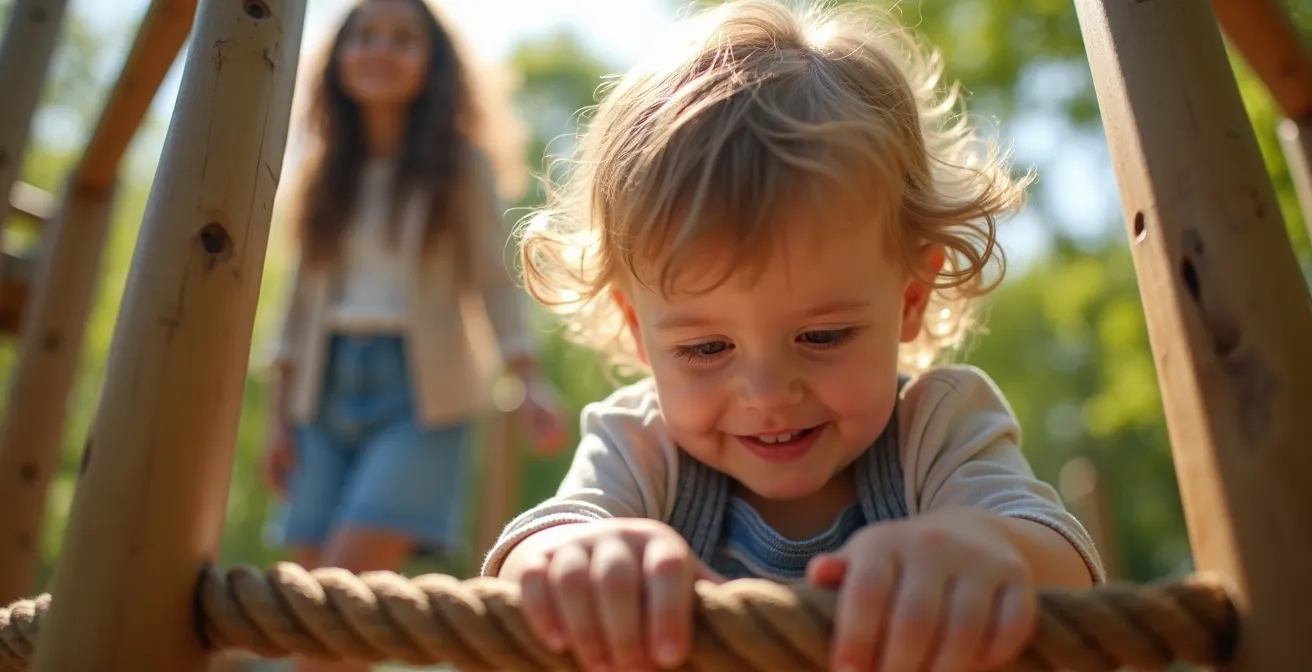
Many parents believe managing a toddler is about preventing risky behavior. However, this perspective is flawed. A toddler’s “risk-taking” isn’t a defiance to be corrected, but a deep developmental appetite that needs to be fed. The true solution isn’t to build a padded cell, but for you to become a “sensory nutritionist”—an expert who provides the right developmental experiences in a safe environment, satisfying their need for challenge and preventing meltdowns before they even begin.
As an occupational therapist, I see countless well-meaning parents caught in a cycle of fear. You watch your toddler teetering on a curb or climbing the “wrong” way up the slide, and your heart leaps into your throat. The instinct is to shout “Be careful!” or rush in to stop them. This is the hallmark of “helicopter parenting,” a role born from love but one that can inadvertently stifle the very development you wish to protect. You feel trapped between the terror of an emergency room visit and the guilt of holding your child back.
The common advice—to simply “supervise more” or “child-proof everything”—misses the fundamental point. These approaches treat risk as the enemy. They focus on eliminating all potential for bumps and scrapes, creating a sterile environment that starves a child’s developing brain and body of essential experiences. This starvation is often the hidden cause of the very behaviors parents find so challenging: tantrums, recklessness, and an inability to listen.
But what if the key wasn’t to eliminate risk, but to understand and provide it correctly? The secret lies in shifting your role from a security guard to what I call a “sensory nutritionist.” Your child has a powerful, healthy appetite for sensory input and physical challenge. This article will guide you on how to satisfy that appetite safely and effectively. We will explore the physiological roots of toddler behavior, provide practical tools for co-regulation, and build your confidence in fostering your child’s independence.
This guide will walk you through the core principles of satisfying your child’s developmental needs, turning moments of fear into opportunities for growth. Below is a summary of the key areas we will cover to help you reframe risk and build resilience.
Summary: A Developmental Approach to Toddler Safety and Risk
- Why a Hungry Child Cannot Listen to Logic: The Physiology of Tantrums
- How to Build a Sensory Bin for Under $20 to Calm an Overstimulated Child?
- Listening vs. Solving: Which Approach Stops Tears Faster?
- The Hydration Error: Is Your Child Cranky or Just Thirsty?
- When to Ask “How Was Your Day”: The Bedtime vs. Car Ride Debate
- Red Light, Green Light: How Simple Games Build Complex Impulse Control
- Pillows vs. People: Where Is It Okay to Release Anger Physically?
- Free Play vs. Structured Activities: Which Builds a Better Brain?
Why a Hungry Child Cannot Listen to Logic: The Physiology of Tantrums
You’ve been there: your toddler is screaming, flailing, and completely deaf to your calm, logical pleas. You might see this as defiance, but it’s often pure physiology. A toddler’s brain, which is still developing its capacity for self-regulation, is incredibly sensitive to blood sugar levels. When their glucose drops, the part of their brain responsible for impulse control and emotional regulation effectively goes offline. As Stanford Medicine Children’s Health explains, when blood glucose falls below the normal range, mood and behavioral changes are one of the first symptoms.
Expecting a “hangry” toddler to listen to reason is like expecting a car to run without fuel. Their body is in a state of physiological stress, and the meltdown is a primal signal of that distress. This is the first lesson for a “sensory nutritionist”: before addressing behavior, you must first check the body’s basic fuel gauge. Is your child hungry, thirsty, or tired? These are not excuses for bad behavior; they are often the direct causes. Recognizing these cues before a full-blown tantrum is a foundational parenting skill that has nothing to do with discipline and everything to do with biological attunement.
Thinking like a nutritionist means planning ahead. Instead of reacting to a meltdown, you can prevent it by ensuring your child’s energy levels remain stable throughout the day. This is especially crucial before activities that you know will be challenging for them, such as a trip to the grocery store or a long car ride. A small, balanced snack can be the most effective behavioral tool in your entire parenting arsenal, providing the brain with the resources it needs to stay regulated.
Your Plan for Preventing Blood Sugar-Related Meltdowns
- Assess the Schedule: Ensure your toddler doesn’t go more than 2-3 hours without a snack or meal to maintain stable energy.
- Balance the Snack: Always pair carbohydrates with a protein or fat source (e.g., apple with peanut butter, crackers with cheese) to prevent sharp sugar spikes and subsequent crashes.
- Watch for Early Warnings: Learn to spot the first signs of low blood sugar, which can include sudden clumsiness, difficulty speaking, or a dazed, confused look.
- Prepare an Emergency Kit: Keep a fast-acting sugar source, like a small juice box or a little honey, on hand for moments when you need to raise their blood sugar quickly.
- Plan Preemptively: Schedule a “preventative” snack about 30 minutes before entering a situation that typically triggers stress or challenging behavior.
By managing their physical needs first, you create a foundation of stability from which all other learning and emotional growth can happen.
How to Build a Sensory Bin for Under $20 to Calm an Overstimulated Child?
A toddler’s “reckless” behavior—crashing, jumping, throwing—is often not a deliberate attempt to be destructive. It’s a search for sensory input. When their nervous system is overwhelmed or under-stimulated, they instinctively seek out intense sensations to help themselves feel organized and calm. A sensory bin is a simple, inexpensive tool that acts as a perfect “nutritional supplement” for this sensory appetite. It provides a contained, safe space for them to explore textures, temperatures, and sounds, which helps regulate their nervous system.
You don’t need expensive, specialized toys. A simple plastic tub and a few materials from around your house or a craft store are all it takes. The key is to offer a variety of textures. Think about a base material like uncooked rice, dried beans, or even water. Then, add “treasures” for them to find and explore: smooth stones, rough pieces of bark, soft pom-poms, and small scoops or cups. The goal is to create a rich tactile experience that captures their attention and channels their energy into focused, constructive play.

As their hands dig through the rice or pour the water, they are receiving calming proprioceptive and tactile input. This focused activity gives their brain a break from the overwhelming sights and sounds of the world, allowing their nervous system to reset. Instead of crashing into the furniture, they are satisfying their need for intense sensation in a way that is both safe and beneficial for their brain development. A $20 sensory bin can prevent thousands of dollars’ worth of stress (and broken lamps).
This simple act of providing a dedicated sensory space empowers you as a “sensory nutritionist,” proactively feeding your child’s needs rather than just reacting to their behavior.
Listening vs. Solving: Which Approach Stops Tears Faster?
When a child falls and starts to cry, a parent’s first instinct is often to solve the problem. We rush in with “You’re okay!”, “It’s just a little scrape!”, or “Let’s get a bandage!” While well-intentioned, this problem-solving approach often invalidates the child’s feeling of fear or pain, which can prolong the tears. The faster path to calm is not solving, but listening. This means getting down on their level, acknowledging their emotion (“Wow, that was a big surprise and it really hurt”), and offering comfort without minimizing their experience. This is emotional co-regulation in action.
This approach is even more critical when it comes to “risky” play. The fear that makes you want to intervene is a powerful one, but stepping back for just a moment can be transformative. It communicates trust and gives your child the space to assess a situation and solve a problem on their own. This pause builds their competence and judgment in a way that constant warnings never could. Experts in child development have even quantified this pause, offering a concrete tool for anxious parents.
The 17-Second Rule for Parent Intervention
As outlined by researchers at Boston University’s Children’s Center, the “17-second rule” is a powerful technique for parents. When you start to feel uneasy about how your child is playing, the advice is to step back, take a breath, and simply observe for 17 seconds before you intervene or remind them to “be careful.” In many cases, this brief period is all a child needs to figure out how to navigate the challenge safely on their own. It is a practical exercise in trusting your child’s developing abilities and resisting your own urge to “solve” a problem that they are capable of handling.
Adopting this “listen first, solve second” mentality changes your role. You are no longer the rescuer, but the safe harbor. Your child learns that you are a source of comfort when they are hurt or scared, and a source of confidence when they are facing a challenge. They learn that their feelings are valid and that they are capable of overcoming obstacles. This foundation of trust is far more protective in the long run than a lifetime of “Be careful!”
By mastering the 17-second pause, you give your child the priceless gift of self-efficacy.
The Hydration Error: Is Your Child Cranky or Just Thirsty?
Just like hunger, dehydration is a powerful physiological stressor that directly impacts a child’s behavior and cognitive function. A thirsty child is often a cranky, clumsy, and emotionally volatile child. However, because the signs can be subtle, parents often misinterpret this physiological need as a behavioral problem. The truth is, even mild dehydration can significantly impair a toddler’s ability to regulate their emotions and even their physical movements. As research published in Medicine & Science in Sports & Exercise shows, cognitive performance impairment increases significantly when dehydration exceeds just 2% of body mass loss.
For a toddler engaged in “risky” play—climbing, running, jumping—this impairment is doubly dangerous. Their physical coordination, balance, and, most importantly, their judgment are all compromised. A wobbly climb up the playground ladder might not be a sign of recklessness, but a simple indicator that their brain and muscles don’t have the water they need to function optimally. As a “sensory nutritionist,” tracking water intake is just as important as tracking food. Keeping a water bottle accessible at all times and offering it frequently, even when they don’t ask for it, is a simple but profound safety strategy.
Understanding the direct link between hydration and ability allows you to reframe your child’s behavior. Instead of seeing a “clumsy” child, you see a child who might need a drink. Instead of a “defiant” child who isn’t listening, you see a child whose brain is struggling to process information. This simple shift in perspective moves you from a place of frustration to one of proactive care.
The following table, based on a recent analysis of hydration’s effects, clearly illustrates how a child’s physical and mental state declines with even mild dehydration, directly impacting their ability to play safely.
| Hydration Level | Physical Effects | Risk Assessment Impact |
|---|---|---|
| Well Hydrated | Optimal coordination and balance | Clear judgment of physical capabilities |
| Mild Dehydration (1-2%) | Reduced attention span | Slightly impaired motor coordination |
| Moderate Dehydration (>2%) | Impaired balance and proprioception | Significantly reduced executive function and impulse control |
Ensuring your child is well-hydrated is one of the easiest and most effective ways to support their physical safety and emotional stability.
When to Ask “How Was Your Day”: The Bedtime vs. Car Ride Debate
Every parent craves that connection, that moment when their child opens up about their day. We often save this important question—”How was your day?”—for bedtime, thinking it’s a quiet, intimate moment. However, for many toddlers and young children, this timing is counterproductive. At the end of a long day, their brain is tired, their capacity for self-regulation is at its lowest, and they are often overstimulated. Being put on the spot with a direct question can feel like a demand, leading to one-word answers like “fine” or “good,” or even a complete shutdown.
The car ride home from daycare or preschool, on the other hand, is often the “magic window” for communication. There are several reasons for this. First, the lack of direct eye contact can be less intimidating for a child. They are strapped into their car seat, looking out the window, which frees them up to talk without the pressure of a face-to-face interrogation. Second, they are in a transitional state—moving from one environment to another—and the events of the day are still fresh in their mind. Their cognitive load is lower than it will be at bedtime after dinner, bath, and stories.
To capitalize on this moment, avoid the direct “How was your day?” Instead, try more specific, observational prompts. “I wonder what the funniest thing that happened today was,” or “Tell me about one thing you built with the blocks.” These open-ended invitations to share are far more effective than direct questions. The car ride provides a contained, predictable environment where your child feels safe. Your role as the “sensory nutritionist” here is to recognize the optimal conditions for emotional connection and create a low-pressure space for it to unfold naturally.
By understanding the environmental and cognitive factors at play, you can turn a mundane daily commute into a priceless opportunity for bonding and insight.
Red Light, Green Light: How Simple Games Build Complex Impulse Control
Impulse control is not an innate characteristic; it’s a skill that is built over time through practice, like a muscle. For a toddler, whose brain is wired for immediate action, learning to pause and think before acting is a monumental task. As parents, we often try to teach this skill through verbal commands—”Stop!”, “Wait!”, “Don’t touch!”—but these are often ineffective in the heat of the moment. A far more effective approach is to build these neural pathways through play. Simple, classic games are fantastic “workouts” for the brain’s self-regulation centers.
Games like “Red Light, Green Light” or “Simon Says” are not just for fun; they are complex neurological exercises. In “Red Light, Green Light,” a child must initiate an action (“Green Light!”), sustain it, and then abruptly inhibit it (“Red Light!”). This sequence of starting and stopping on command directly strengthens the neural connections responsible for inhibitory control. It’s practicing the very skill they need when they’re about to run into the street or grab something they shouldn’t.

The beauty of these games is that they are intrinsically motivating. The challenge is fun, and the repetition builds mastery. Each time they successfully freeze their body mid-stride, they get a small dopamine hit of success, reinforcing the behavior. This is a core principle of being a “sensory nutritionist”: embedding crucial skill development within joyful, engaging activities. Instead of a power struggle over rules, you are co-creating a fun experience that happens to build a better, more regulated brain. You’re not just stopping bad impulses; you’re building the internal “brakes” they will use for the rest of their lives.
This playful practice transforms the abstract concept of “self-control” into a tangible, achievable skill.
Pillows vs. People: Where Is It Okay to Release Anger Physically?
When a toddler is overwhelmed with anger, their emotions are immense and physical. Telling them to “use their words” is often futile because the part of their brain that handles language and logic is swamped by the emotional flood. The feeling needs to come out, and it often does through hitting, kicking, or throwing. Our instinct is to stop the physical expression entirely. However, a more effective strategy is to redirect it. The goal is not to suppress the feeling, but to teach a safe way to express it. The rule is simple: it’s never okay to hit people, but it is always okay to hit a pillow.
This approach provides a safe and acceptable outlet for their intense physical energy. This need for physical release is tied to a sensory system called proprioception—the awareness of one’s body in space. As occupational therapists know, activities that involve pushing, pulling, and deep pressure (known as “heavy work”) can have a powerfully calming and organizing effect on the nervous system. Punching a pillow, stomping on the ground, or ripping up paper are all forms of heavy work that help a child’s body process the intense energy of anger.
The goal isn’t just obedience; it’s to build the neural pathway for self-regulation.
– Occupational Therapy research, Your Therapy Source
By providing a “yes” space (the pillow) instead of only a “no” (don’t hit), you are doing several things at once. You are validating their feeling (“It’s okay to be angry”), maintaining a boundary (“but it’s not okay to hurt others”), and teaching a practical self-regulation tool. You are the “sensory nutritionist” who understands that the appetite for physical release is real and provides a safe “food” to satisfy it. This builds a foundation of emotional intelligence, teaching your child from a very young age that they can manage their biggest feelings without causing harm.
Over time, they will need the pillow less as they develop the verbal and cognitive skills to manage anger in other ways, but you will have given them a crucial first tool.
Key Takeaways
- A toddler’s “risky” behavior is often a sign of an unmet physiological or sensory need, not defiance.
- Parents can shift from being a “guard” to a “sensory nutritionist” by proactively providing the right developmental experiences.
- Simple tools like sensory bins, impulse control games, and safe outlets for anger are more effective than constant verbal warnings.
Free Play vs. Structured Activities: Which Builds a Better Brain?
In our highly scheduled world, it’s tempting to fill a child’s day with structured activities—music class, sports, educational apps. While these have their place, the real powerhouse of brain development, especially for risk assessment, is unstructured free play. During free play, a child is the CEO of their own experience. They set the goals, they make the rules, and most importantly, they assess the risks. This is where they learn the limits of their own bodies and the physical laws of the universe in a way no structured class can teach.
This idea terrifies many parents, who equate “risky play” with a high likelihood of injury. The data, however, tells a very different story. The act of navigating small, manageable risks is precisely what teaches children how to avoid major injuries later on. They learn cause and effect firsthand. As a surprising body of research from OutsidePlay.ca indicates, children who are deprived of risky play are often the ones who get hurt more seriously later, as they haven’t had the chance to build their own sense of judgment. They haven’t learned to “train for terror” in small, manageable doses.
Your role as a “sensory nutritionist” isn’t to eliminate risk but to “scaffold” it. Scaffolding means setting up an environment where your child can learn safely, with you as a supportive coach, not the main player. For example, instead of forbidding them from the ladder, you might talk them through how to hold on and what to do if they feel wobbly. You coach from the ground, offering just enough support to ensure they succeed. This process builds not just their physical skills but their confidence and their ability to accurately assess risk—a critical life skill.
By embracing scaffolded free play, you are giving your child the tools to navigate a complex world safely and confidently, trusting them to build their own resilient brain.