Learning and development
Every parent has witnessed that magical moment when a child suddenly grasps a new concept—whether it’s recognizing their first written word, successfully navigating a friendship conflict, or solving a puzzle that stumped them yesterday. These breakthrough moments don’t happen in isolation. They’re the visible result of complex developmental processes happening simultaneously across emotional, cognitive, social, and physical domains.
Understanding how children learn transforms parenting from reactive troubleshooting into proactive support. This foundation encompasses far more than academic achievement. It includes emotional self-regulation, the ability to think critically, executive function skills that manage daily life, and the social competencies that shape relationships. Recent research reveals surprising connections—like how sleep architecture directly impacts learning retention, or why unstructured play builds stronger problem-solving skills than structured lessons. This comprehensive look at learning and development will give you the framework to recognize what’s happening in your child’s growing brain and how to nurture each dimension of their development.
Emotional Regulation: The Foundation of All Learning
Before a child can focus on reading or master multiplication, they need something more fundamental: the ability to manage their own emotional state. Think of emotional regulation as the operating system that allows all other programs to run smoothly. A child flooded with frustration or anxiety simply cannot access their learning potential.
The journey toward self-regulation begins with co-regulation—the process where parents essentially lend their calm nervous system to help a child return to baseline. This isn’t about eliminating difficult emotions, but rather teaching children to recognize what they’re feeling and develop strategies to move through those feelings. Young children lack the biological capacity for full self-regulation because their prefrontal cortex—the brain’s control center—won’t fully mature until their mid-twenties.
Practical regulation strategies work best when they’re age-appropriate. For young children, breathing techniques must be concrete and playful: “smell the flower, blow out the candle” engages the same diaphragmatic breathing that calms the nervous system in adults. As children develop, they can learn to identify their own biological triggers—hunger, fatigue, overstimulation—that signal approaching dysregulation. The most powerful teaching tool parents have is modeling: children who regularly see adults naming emotions, taking deep breaths, or stepping away to calm down internalize these strategies far more effectively than through direct instruction alone.
Sleep’s Critical Role in Learning and Development
Sleep is not simply rest. It’s when the brain processes, consolidates, and integrates everything a child learned while awake. During sleep, particularly during REM cycles, the brain transfers information from short-term to long-term memory, making sleep as essential to learning as the initial instruction.
The relationship between sleep and learning creates a powerful feedback loop. Quality sleep enhances attention, emotional regulation, and memory consolidation. Poor sleep, conversely, produces symptoms remarkably similar to ADHD: impulsivity, difficulty focusing, emotional reactivity, and hyperactivity. Many parents don’t realize their child’s behavioral challenges stem from insufficient or disrupted sleep rather than an attention disorder.
Strategic timing of sleep can actually enhance learning outcomes. The practice of spacing study sessions with sleep intervals leverages the brain’s natural consolidation process. A child who reviews material before bed and again in the morning benefits from overnight processing that strengthens neural pathways. REM sleep specifically supports emotional processing, helping children make sense of social interactions and challenging experiences. This is why a problem that felt overwhelming at bedtime often seems more manageable in the morning—the dreaming brain has been working on it all night.
Social and Emotional Intelligence
Recognizing and managing emotions extends beyond self-awareness into the realm of interpersonal relationships. Children need a robust emotional vocabulary that goes beyond “happy,” “sad,” “mad,” and “scared.” The more precisely a child can name what they’re feeling—frustrated versus disappointed, excited versus anxious—the better they can communicate their needs and understand others.
Emotional intelligence develops through practice and observation. Children learn to read facial expressions and body language by having their own emotions reflected back accurately: “I see your fists are clenched and your jaw is tight—you look really frustrated right now.” This type of specific feedback trains the pattern recognition that allows children to eventually identify emotions in others, building the foundation for empathy.
Managing difficult emotions safely requires both skills and permission. Aggressive outbursts often signal a child who doesn’t yet have strategies for intense feelings. Creating a framework where anger is acceptable but hitting isn’t, where sadness deserves space rather than rushing to “fix” it, teaches children they can experience the full range of human emotion without being overwhelmed by it. Processing grief and loss in childhood, when supported appropriately, actually builds emotional resilience rather than creating fragility.
Building Social Skills and Peer Relationships
The social landscape of childhood provides a laboratory for learning cooperation, conflict resolution, empathy, and self-advocacy. These skills don’t develop automatically—they require practice, failure, and refinement, ideally with decreasing adult intervention as children mature.
Navigating peer dynamics involves understanding complex social hierarchies, unwritten rules, and constantly shifting alliances. The goal isn’t to shield children from these challenges but to help them develop strategies for managing them. Resolving conflicts without adult intervention is a critical skill, yet many parents instinctively jump in to mediate, inadvertently preventing their child from building this competency.
Different social challenges require different approaches:
- Introversion versus shyness: Introversion is a temperament (preferring fewer, deeper relationships and needing alone time to recharge), while shyness is anxiety-driven. Understanding this distinction prevents parents from pushing introverted children into overwhelming social situations in the name of “fixing” something that isn’t broken.
- Exclusion and bullying dynamics: Teaching children the difference between normal social friction and systematic exclusion helps them recognize when to problem-solve independently and when to seek adult support.
- Group play hierarchies: Children naturally create structure in group settings. Learning to navigate these hierarchies—sometimes leading, sometimes following, sometimes opting out—builds social flexibility.
- Neurodiverse friendship skills: Children with autism, ADHD, or other neurological differences may need explicit instruction in social skills that neurotypical children absorb implicitly through observation.
Reading, Writing, and Language Development
Literacy is built on a surprisingly complex foundation of skills that must develop in roughly sequential order. Before a child can read fluently, they need phonological awareness—the understanding that words are made up of individual sounds that can be isolated, blended, and manipulated.
Phonological Awareness: The Pre-Reading Foundation
This metalinguistic awareness typically develops through playful activities: rhyming games, clapping syllables in words, identifying beginning or ending sounds. A child who struggles with these auditory skills will likely face challenges when asked to connect those sounds to written letters. Multi-sensory techniques—using sandpaper letters, forming letters with their bodies, connecting sounds to movements—engage multiple neural pathways and strengthen the sound-symbol connection.
Oral storytelling builds narrative comprehension and sequencing skills that later transfer to reading. When children hear stories, they’re developing mental models for how narratives work: characters face problems, take actions, experience consequences. This framework becomes the scaffold for understanding written texts.
From Decoding to Comprehension
Early reading instruction focuses on mechanics—decoding individual words. But true literacy requires comprehension, which depends heavily on vocabulary. A robust word bank allows children to understand more complex texts and use context clues to figure out unfamiliar words. Teaching word relationships (synonyms, antonyms) and root words creates exponential vocabulary growth: understanding that “graph” means “write” unlocks autograph, biography, photograph, and hundreds of other words.
Signs of dyslexia often appear in early childhood: difficulty with rhyming, trouble learning letter names, confusion between similar-looking letters. Early identification allows for intervention during the optimal window when the brain is most plastic. Reading aloud to older children—even after they can read independently—continues building comprehension, exposing them to vocabulary and sentence structures more complex than they’d choose independently.
Writing and Creative Expression
Writing develops separately from reading and often lags behind. Storytelling begins orally, where children can focus on narrative structure without the mechanical demands of handwriting or spelling. Teaching character creation, plot development, and conflict resolution as verbal skills first allows these concepts to strengthen before adding the complexity of written expression.
The creative writing process in children often derails at predictable points: fear of criticism, perfectionism, or writer’s block. Establishing that there’s no “correct” language in creative art—that invented words, experimental formats, and unconventional grammar are valid artistic choices—removes barriers to expression. Structured routines (daily writing time, specific prompts) provide scaffolding for children who feel overwhelmed by blank-page freedom.
Executive Function and Cognitive Development
Executive function encompasses the mental processes that allow us to plan, focus attention, remember instructions, manage multiple tasks, and regulate behavior. These skills, governed primarily by the prefrontal cortex, develop gradually throughout childhood and adolescence.
Understanding Executive Function Delays
The prefrontal cortex matures slowly and unevenly. This biological reality explains why a child might excel academically yet struggle to remember their homework, keep track of belongings, or estimate how long tasks will take. “Time blindness”—difficulty perceiving the passage of time—is a common executive function challenge that looks like poor planning but is actually a developmental or neurological issue.
Creating external support systems compensates for developing executive function: visual schedules, checklists, timers, designated spaces for belongings. These aren’t crutches that prevent skill development—they’re scaffolding that supports the child while their brain matures. The error of “over-functioning” for your child (doing tasks they could manage with supports) prevents them from building independence, while expecting them to function beyond their developmental capacity creates chronic failure.
Problem-Solving and Spatial Reasoning
Spatial reasoning—the ability to mentally manipulate objects, understand perspective, and visualize rotations—strongly predicts success in STEM fields. Yet it receives far less attention than literacy or numeracy in early education. Activities that build spatial skills include:
- Map reading and navigation exercises that develop orientation and directional awareness
- Three-dimensional puzzles that require mental rotation and visualization
- Building toys that involve planning, sequencing, and structural problem-solving
- Drawing and visual art that explores perspective and spatial relationships
Research indicates that girls, on average, receive less encouragement in spatial activities, contributing to spatial anxiety that can later manifest as STEM avoidance. Intentionally providing spatial challenges to all children, regardless of gender, helps close this gap.
Computational and Logical Thinking
Computational thinking—breaking problems into steps, recognizing patterns, developing algorithms—doesn’t require computers. Daily life provides constant opportunities: following recipes, planning multi-step projects, debugging when something doesn’t work as expected. Teaching “if-then” logic through everyday scenarios (If we leave now, then we’ll arrive on time; if we don’t, then we’ll be late) builds the conditional reasoning fundamental to both programming and general problem-solving.
The “give up” response—immediately seeking help when encountering difficulty—often develops when adults intervene too quickly. Productive struggle is essential for learning. Optimizing difficulty progression means providing challenges just beyond current skill level: hard enough to require effort but not so hard as to create helpless frustration.
Play-Based Learning and Critical Thinking
Unstructured play is not frivolous—it’s the primary mechanism through which young children develop creativity, problem-solving, social skills, and emotional regulation. The persistent myth of “just playing” devalues an activity that builds neural connections more effectively than many structured educational interventions.
True play happens in flow states: that absorbed, timeless quality when a child is fully engaged without self-consciousness. Interrupting these states, even with positive attention, disrupts the deep learning occurring. The parent’s role in play is facilitating without directing: providing materials, ensuring safety, and then stepping back to let the child’s intrinsic motivation guide the activity.
Play outcomes frequently surpass rote memorization for deep learning. A child building an elaborate block structure learns physics (balance, gravity, force), mathematics (symmetry, patterns, spatial relationships), and persistence through failure—all while intrinsically motivated. Compare this to flashcard drills, where motivation is external and the learning often stays surface-level.
Puzzles and brain games serve as structured play that builds cognitive skills. Physical puzzles offer advantages over digital versions: tactile feedback, spatial manipulation, and the absence of programmed hints that short-circuit problem-solving. The key is resisting the urge to help too soon. Lateral thinking—approaching problems from unexpected angles—develops through sustained engagement with challenges that don’t have obvious solutions.
Critical Thinking in a Digital World
Modern children face unprecedented information complexity. Teaching them to question sources, analyze validity, and recognize bias is no longer optional. This starts with seemingly simple skills: differentiating news from advertisements, understanding that search results are algorithmically curated rather than objective, questioning authority respectfully while seeking evidence.
The danger of confirmation bias—seeking information that confirms existing beliefs—affects children as much as adults. “I Wonder” prompts encourage genuine curiosity: “I wonder why this website is telling us this?” “I wonder who benefits from this message?” This questioning stance builds analytical thinking without cynicism, maintaining openness while developing healthy skepticism.
Supporting Your Child’s Learning Journey
Understanding these developmental domains transforms how parents structure their child’s environment, time, and activities. Rather than seeking the “best” educational toys or programs, focus on open-ended materials that support creative, child-directed play: building blocks, art supplies, dress-up materials, basic tools for construction and creation.
Collaboration skills develop through structured opportunities and organic interactions. Playdates benefit from having a loose framework—planned activities with defined goals—while still leaving room for child-directed play. Teaching the distinction between leadership (inspiring others toward a shared goal) and bossiness (controlling others for personal preference) gives children vocabulary for social dynamics.
The balance between challenge and support looks different for every child. High achievers may struggle in group settings where they can’t control outcomes. Neurodiverse children might need explicit teaching of skills their peers absorb implicitly. The risk of social burnout is real—even extroverted children need downtime to process experiences and restore energy.
Above all, modeling remains the most powerful teaching tool. Children who see parents reading for pleasure become readers. Children who watch adults manage frustration productively learn emotional regulation. Children who observe critical thinking, creative problem-solving, and intellectual curiosity develop these capacities themselves. Your own learning journey—staying curious, admitting mistakes, demonstrating persistence—provides the template your child will follow.

Beginning, Middle, End: How to Help Your Child Finish a Story?
The endless “and then…” story isn’t a sign of a vivid imagination, but a broken narrative engine that lacks structure. Replace the weak “and then” link with a causality chain: something happens BECAUSE of a reason, BUT a problem occurs,…
Read more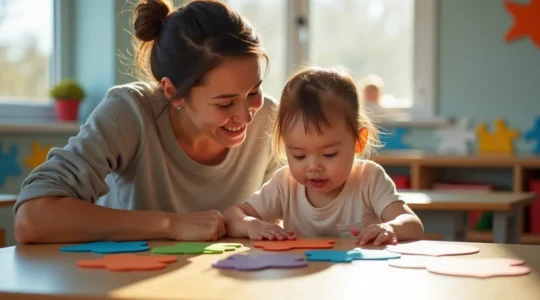
Metaphor and Rhyme: How to Teach Poetry Without Being Boring?
The common belief is that teaching poetry requires being a literary expert; the truth is it’s about creating the right conditions to unlock your child’s innate poetic intelligence. Creative “mistakes” like invented words are signs of a brain actively engaging…
Read more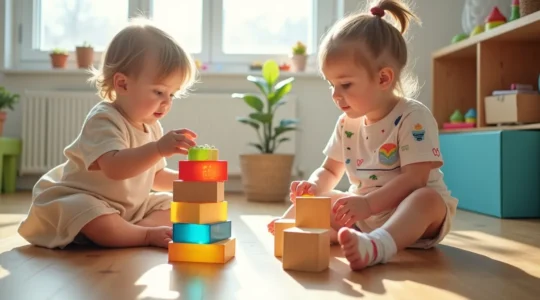
Magnetic Tiles vs. Wooden Blocks: Which Investment Lasts Longer?
The most expensive, high-tech toy isn’t always the best long-term investment for your child’s development. Magnetic tiles offer quick, satisfying builds, but their system-based nature can limit creativity and pose safety risks with cheaper brands. Wooden blocks, while simpler, provide…
Read more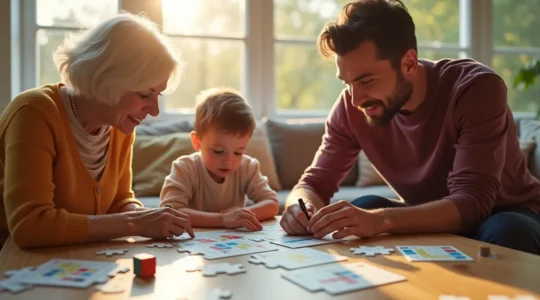
Sudoku or Crosswords: Which Puzzle Is the Ultimate Weapon Against Cognitive Decline?
Contrary to popular belief, the choice between Sudoku and crosswords is the wrong question; the real key to fighting cognitive decline is understanding and targeting the specific *cognitive mechanics* each puzzle trains. Logic puzzles like Sudoku build procedural thinking, while…
Read more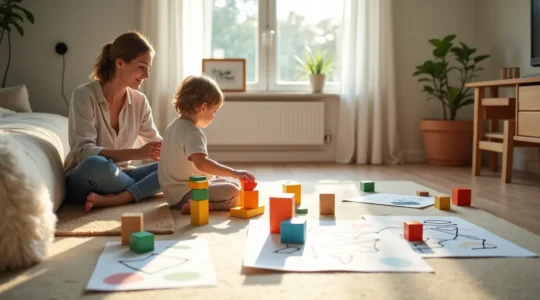
Coding Without Screens: How to Teach Logic to a 5-Year-Old?
Teaching coding isn’t about screens or syntax; it’s about giving your child a “computational mindset” to solve everyday problems. Daily routines can be “debugged” like a program to reduce friction and build predictability. Emotional states like frustration are “infinite loops”…
Read more
The CEO Brain: How to Teach Planning Skills to a Disorganized Teen?
Most advice for disorganized teens fails because it tries to fix the teen, not their environment. The real key is to act as their temporary ‘External Frontal Lobe’. Your teen’s brain is still under construction; their planning and organization skills…
Read more
Tetris for Toddlers: How to Teach Spatial Reasoning Without Screens?
In summary: Spatial reasoning is a foundational skill for future math and science success, and it can be taught playfully through everyday activities. Focus on teaching the *strategy* behind an activity (like packing a bag or solving a puzzle), not…
Read more
Free Play vs. Structured Activities: The Surprising Neurological Truth About How Your Child’s Brain Is Built
Contrary to the belief that more classes equal a smarter child, neuroscience shows that unstructured free play is the single most important activity for building the brain’s executive functions. Self-directed play physically changes the prefrontal cortex, the brain’s “CEO,” enhancing…
Read more
How to Teach Collaboration to a Solo-Player Child Without Tears?
The common advice to “force sharing” often backfires with high-achieving children; the real key is to reframe collaboration as a strategic tool, not a social obligation. Effective teamwork is built on structured interdependence, where individual success is impossible without the…
Read more
Fact vs. Opinion: How to Teach Media Literacy to a 10-Year-Old?
Teaching media literacy is not about memorizing a list of ‘bad’ websites. It’s about giving your child the tools to deconstruct the digital systems that deliver their content. Algorithms and sponsored posts are not neutral; they are persuasive systems designed…
Read more