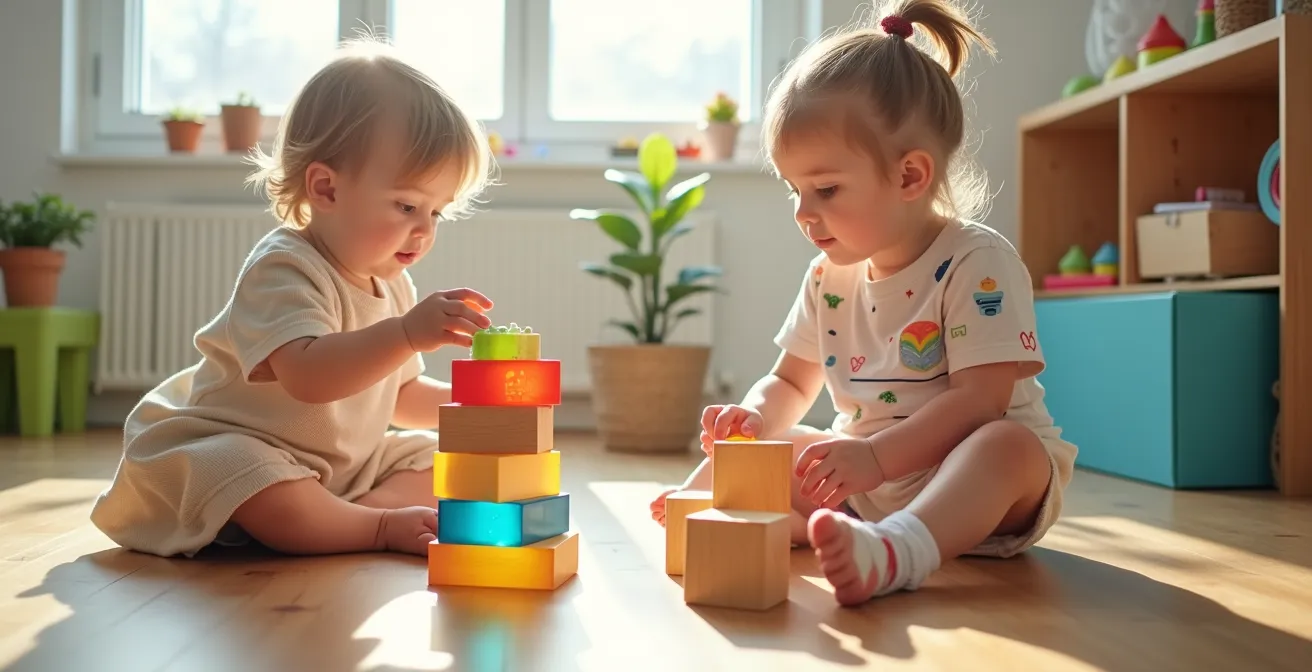
The most expensive, high-tech toy isn’t always the best long-term investment for your child’s development.
- Magnetic tiles offer quick, satisfying builds, but their system-based nature can limit creativity and pose safety risks with cheaper brands.
- Wooden blocks, while simpler, provide a deeper, frustration-powered education in real-world physics and adapt better to a child’s growing skills.
Recommendation: For the best long-term return on investment (ROI) in terms of learning, safety, and versatility, a high-quality set of wooden blocks is the superior foundational choice.
As a parent navigating the crowded toy aisle, you’re faced with a constant question: what is truly worth the investment? The debate between modern magnetic tiles and classic wooden blocks is a perfect example. Both promise hours of open-ended play and are praised for building STEM skills. You’ve likely heard that both are “great” and that “open-ended play is essential.” But when you’re on a budget and want the best return on your investment—not just in dollars, but in developmental value—that answer feels insufficient. You need to know which toy will stand the test of time, not just in terms of physical durability, but in its ability to engage your child as they grow.
The common advice is to look at the materials or the immediate “wow” factor. Magnetic tiles click together with a satisfying snap, allowing for instant, colorful creations. Wooden blocks seem almost archaic in comparison. But what if the true measure of a toy’s long-term value lies not in its cleverness, but in its limitations? This guide moves beyond the surface-level comparison. We will analyze the “system” of play each toy creates, the hidden costs of frustration and management, and the fundamental physics they teach. We’ll explore why the “magic” of magnets might be a developmental shortcut, and how the simple, unguided reality of gravity and balance taught by wooden blocks builds a more resilient and creative problem-solver.
This article provides a comprehensive breakdown to help you decide. By exploring the nuances of creativity, safety, and the real-world skills each toy cultivates, you’ll be equipped to make an informed choice that aligns with your budget and your long-term goals for your child’s learning journey.
Summary: Magnetic Tiles vs. Wooden Blocks: The Ultimate Investment Guide
- Why Specific Kits Kill Creativity Compared to Plain Blocks?
- The Piece Problem: How to Manage and Store Each System?
- Brand vs. Generic: Is Saving Money Now Worth the Frustration Later?
- The Safety Factor: Age Appropriateness and Choking Hazards
- Sorting First: Why Teaching Prep Work Changes the Building Experience?
- Why “Just Playing” Is a Myth: The Math Behind Building Blocks
- Scaffolding Play: How to Guide Learning Without Taking Over
- Towers That Fall: How to Teach Gravity and Balance to a 4-Year-Old?
Why Specific Kits Kill Creativity Compared to Plain Blocks?
The core promise of both magnetic tiles and wooden blocks is open-ended creativity. However, the nature of that creativity is fundamentally different. Magnetic tiles operate as a system; they are designed to connect in a specific way. Wooden blocks are pure substance; they have no inherent rules for connection, forcing the child to invent them. This distinction is critical. While the guided nature of tiles can lead to impressive-looking structures quickly, it can also subtly stifle the deeper, problem-solving aspect of true invention. The toy provides the “how,” leaving the child with only the “what.”
This concept is supported by research into play quality. An eight-year study on play, known as the TIMPANI study, found a consistent pattern. As detailed in an article by Fatherly, researchers consistently found that both boys and girls display the most engaged play when handling simple, traditional toys like wooden blocks. This is because the lack of a pre-defined system forces more cognitive engagement. With blocks, a child must grapple with balance, friction, and gravity. With tiles, the magnets do much of that work for them. This aligns with broader findings that children build number and math skills from open-ended block play, as they are constantly experimenting with real-world physics and spatial relationships.
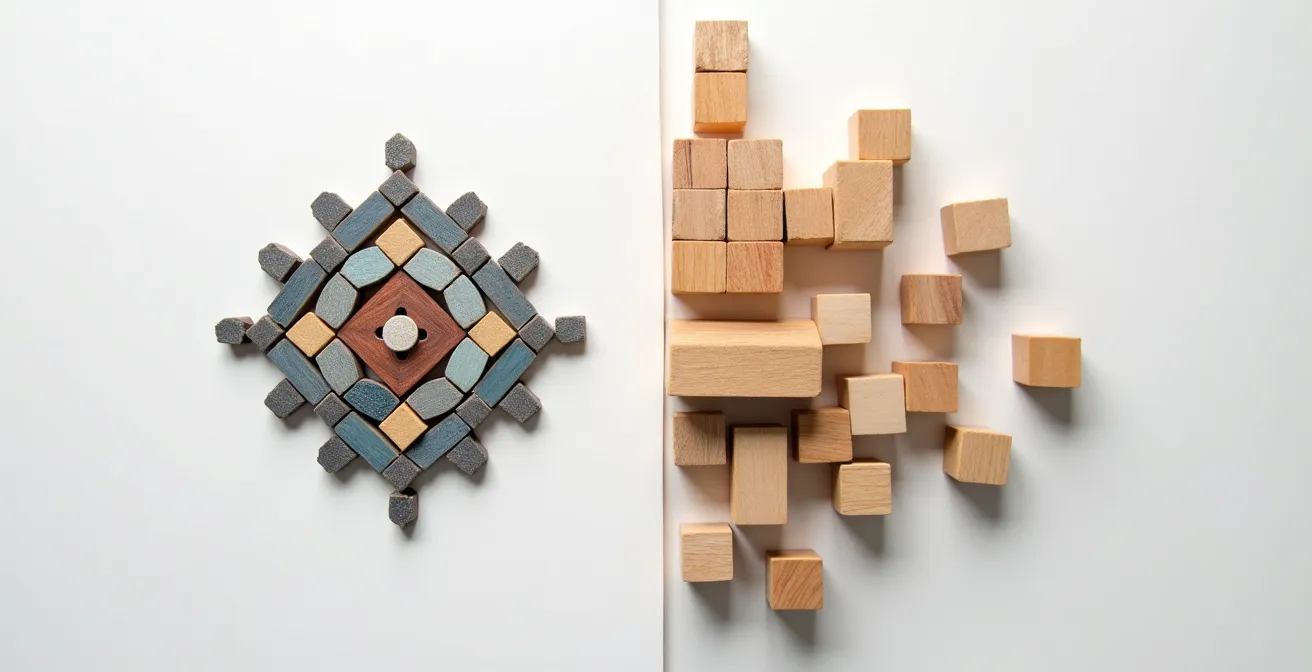
As the image above symbolizes, magnetic tiles offer a precise, interlocking system, while wooden blocks offer organic, free-form substance. The system is easy to learn but has a ceiling. The substance has a steeper learning curve but offers limitless possibilities. For a long-term investment in creativity, the toy that presents more problems—and thus, more opportunities for discovery—often yields a higher return.
Ultimately, a toy that requires the child to invent the rules, not just follow them, builds a more robust creative muscle for the long haul.
The Piece Problem: How to Manage and Store Each System?
For any parent, the long-term reality of a toy includes the cleanup. The “Lego Vacuum” effect—the dread of tiny, essential pieces scattered across the floor—is a real concern. When comparing magnetic tiles and wooden blocks, the management of their parts presents a clear trade-off between convenience and bulk. Magnetic tiles, with their flat shapes and inherent attraction, are champions of quick cleanup. They stack neatly and their magnetic pull helps keep them together, making them a space-saving option.
Wooden blocks, by contrast, are bulkier. They don’t stick together and require bins or boxes for storage. Gathering dozens of individual blocks of various shapes and sizes is undoubtedly a more time-consuming task. However, this seeming disadvantage has a silver lining. Because they are individual units, losing one or two blocks from a 100-piece set is not a critical failure. The set remains just as functional. With magnetic tiles, especially in more complex builds, a missing shape can halt a project and lead to frustration.
This table breaks down the practical differences in storage and organization:
| Feature | Magnetic Tiles | Wooden Blocks |
|---|---|---|
| Piece Size | Large, flat tiles (3-6 inches) | Various sizes (1-4 inches) |
| Storage Method | Stack flat, magnetic attraction keeps together | Require bins or boxes |
| Cleanup Time | Stack up neatly for quick and efficient tidying | Individual pieces need gathering |
| Space Required | Flatter and store more easily, an important space-saving consideration | Bulkier storage needs |
| Organization Benefit | Shape sorting reinforces geometry | Size sorting teaches seriation |
Moreover, the process of organizing the pieces can itself be a learning experience. Sorting wooden blocks by size teaches seriation (arranging items in a sequence), while sorting magnetic tiles by shape reinforces geometry. The key is to frame storage not as a chore, but as part of the play. Using clear containers, creating a dedicated “construction zone” on a mat, or setting up a magnetic building station on a vertical surface can turn cleanup and organization into an invitation to play.
While tiles win on tidiness, the robustness and low-stakes nature of a block collection may prove less stressful over years of play.
Brand vs. Generic: Is Saving Money Now Worth the Frustration Later?
For the budget-conscious parent, the allure of generic magnetic tiles is powerful. They often come at a fraction of the cost of premium brands like Magna-Tiles or Connetix. However, this is one area where trying to save money upfront can lead to a much poorer long-term investment due to frustration and significant safety concerns. The difference between premium and generic tiles isn’t just a brand name; it’s about magnet strength, material quality, and construction.
Weaker magnets are the number one complaint with off-brand tiles. This means towers are less stable, connections are flimsy, and a child’s ambitious creation is far more likely to collapse, leading to frustration that can cause them to abandon the toy altogether. Furthermore, the construction quality is often inferior. Premium brands use rivets to secure the plastic casings, while many cheaper versions are simply glued. Over time, these glued tiles can break open, exposing the small, powerful magnets inside—a serious safety hazard.
As one toy safety analysis notes, this construction difference is critical. In a review from The Fairy Glitch Mother, the expert points out:
Cheaper tiles often use a lock-click system, which isn’t as secure and could more easily open.
– Fairy Glitch Mother Review, Magnetic Tiles Safety Analysis
This table highlights the crucial differences that justify the higher price point of established brands:
| Feature | Premium Brands (Magna-Tiles/Connetix) | Generic Brands |
|---|---|---|
| Magnet Strength | Heavier tiles with bigger, stronger magnets | Lighter weight, weaker magnetic force |
| Safety Features | Rivets indicate stronger, safer tiles that won’t break easily | Often glued, may separate over time |
| Material Quality | Food-grade, non-toxic MABS plastic with ceramic magnets resistant to demagnetization | Variable plastic quality |
| Compatibility | Connetix, Playmags, and Picasso Tiles all compatible with Magna-Tiles | May have size or polarity issues |
| Price Point | $40-180 per set | $20-60 per set |
In this case, the return on investment is clear: paying more for a premium set ensures a safer, more satisfying, and ultimately longer-lasting play experience. With wooden blocks, the quality variance is more about the finish and wood type, with far fewer safety implications.
The Safety Factor: Age Appropriateness and Choking Hazards
Beyond durability, the most critical factor in a toy’s longevity is its safety. Both magnetic tiles and wooden blocks have excellent safety records when used as intended and with age-appropriate supervision. The primary concern for both is small parts. For wooden blocks, this is straightforward: larger blocks for toddlers, with smaller, more complex shapes introduced as the child grows and is no longer mouthing objects. The risk is manageable and intuitive.
With magnetic tiles, the danger is more complex. While the tiles themselves are large, the hidden risk lies within. If a tile breaks, it can release small, high-powered magnets. If a child swallows more than one of these magnets, they can attract each other across intestinal walls, leading to life-threatening internal injuries. While rare with high-quality, riveted tiles, it’s a significant risk with cheaper, glued versions. The data on magnet ingestion is sobering; safety data shows nearly 2,900 magnet ingestions were treated in U.S. emergency rooms over a five-year period, prompting stricter safety standards.
Understanding the developmental stages is key to ensuring safety and maximizing play value. A toy introduced too early can be a hazard, while one introduced too late can be unengaging. This developmental roadmap offers a general guide for introducing different types of building toys:
- 12-18 months: Large, soft blocks for gross motor skills and basic stacking.
- 18-24 months: Wooden blocks with different textures and colors for improved hand-eye coordination.
- 2-3 years: Introduction to large, high-quality magnetic tiles for spatial awareness and easy connection.
- 3-4 years: Mix of wooden blocks and magnetic tiles for more complex constructions.
- 4-5 years: Addition of smaller building sets with proper supervision.
- 5+ years: Graduate to micro-blocks like LEGO for fine motor precision and complex planning.
Ultimately, while both toys are safe when quality is prioritized, the potential failure mode of magnetic tiles carries a higher intrinsic risk. A solid wooden block, by its very nature, presents a simpler and more predictable safety profile over its entire lifespan.
Sorting First: Why Teaching Prep Work Changes the Building Experience?
A hidden aspect of long-term play value is how a toy influences a child’s executive functions—skills like planning, organization, and focus. A messy pile of 200 mixed pieces, whether tiles or blocks, can be overwhelming. This creates a high cognitive load, where a child spends more mental energy searching for the right piece than they do creating. Teaching prep work, like sorting, can transform this experience from chaotic to creative.
Sorting pieces before building is not just about being tidy; it’s an engineering principle. Professional engineers don’t rummage through a random pile for materials; they have an organized inventory. By teaching a child to sort magnetic tiles by shape or wooden blocks by size, you are reducing the cognitive load of the “search” phase, freeing up their mental bandwidth for the “build” phase. This simple act of preparation can be the difference between a 5-minute frustrated play session and a 45-minute deep-focus one.
This preparation also subtly teaches valuable mathematical concepts. As noted in play research, pattern recognition, symmetry, fractions, and linear measurement are all intrinsic parts of block play. Sorting and arranging pieces makes these concepts tangible. Here are some simple “resource management” techniques to introduce:
- Sort magnetic tiles by shape (squares, triangles) into separate, clear containers.
- Arrange wooden blocks by size, from smallest to largest, on a low shelf.
- Practice “material estimation” by asking, “How many long blocks do you think we’ll need for this wall?”
- Implement a “clean as you go” system to keep the building area organized during play.
By framing organization as the first step of building, you’re not just cleaning up; you’re teaching a foundational skill for problem-solving that will last far longer than any single toy.
Why “Just Playing” Is a Myth: The Math Behind Building Blocks
When a child is quietly stacking blocks or clicking tiles together, it’s easy to dismiss it as “just playing.” But beneath the surface, their brain is running a complex physics and math simulation. Every successful structure and every collapsed tower is a data point in their understanding of the world. This is where the fundamental difference between magnetic tiles and wooden blocks becomes most apparent. They are not just different materials; they teach different lessons.
Wooden blocks are a direct interface with real-world physics. There are no shortcuts. A child must intuitively grasp gravity, balance, and symmetrical support to build something that stands. The weight, texture, and friction of the wood are all part of the equation. Magnetic tiles, on the other hand, introduce the “magical” force of magnetism. This allows for the creation of structures that defy gravity in ways wooden blocks cannot, which is excellent for exploring 3D geometry and the concept of nets (a 2D shape that can be folded into a 3D object). However, it also outsources the lesson of structural integrity to the magnets.
This table compares the core learning concepts each toy emphasizes:
| Learning Concept | Wooden Blocks | Magnetic Tiles |
|---|---|---|
| Physics Principles | Balance, symmetry, and gravity concepts through experimentation | Magnetic attraction and repulsion concepts |
| Mathematical Concepts | Linear measurement, proportions, fractions | Geometry, symmetry, color mixing with transparent tiles |
| Spatial Skills | Important for success in STEM fields | 3D visualization, net folding into shapes |
| Problem Solving | Balance and stability challenges | Structural integrity with magnetic forces |
| Sensory Experience | Tactile wood texture, weight variation | Visual color mixing, magnetic sensation |
Long-term studies confirm the profound impact of this type of play. Far from being “just for fun,” research demonstrates that children’s block play is related to later math competence and even interest in STEM careers. The hands-on, trial-and-error nature of block play builds a foundational understanding of principles that will be formalized in school years later.
For a pure, unadulterated education in physics, the unforgiving nature of wooden blocks provides a richer, more foundational curriculum than the helpful assistance of magnets.
Scaffolding Play: How to Guide Learning Without Taking Over
The best toys are not standalone objects; they are tools for interaction between a child and a caregiver. Your role as a parent is not to direct the play, but to “scaffold” it—providing just enough support to help your child reach the next level of understanding without giving them the answer. This technique is the key to maximizing the educational ROI of any open-ended toy. The “I Do, We Do, You Do” framework is a simple but powerful way to implement this.
This method involves a gradual release of responsibility. First, you model the behavior (I Do), then you collaborate with your child (We Do), and finally, you let them try independently (You Do). For example, when building with blocks, you might first build a simple bridge yourself, narrating your choices. Then, you might build a more complex castle together. Finally, you would step back and watch as your child builds their own creation, offering only encouragement. This approach builds confidence and competence simultaneously.
Experts in early childhood development emphasize this guided interaction. As researchers at the Schoenbaum Family Center at Ohio State University observe when watching teachers in a classroom:
The teachers have been scaffolding this block building by asking questions such as ‘What goes in this structure?’, ‘Who lives in here?’ and ‘What kind of building is this?’
– Schoenbaum Family Center, Early Childhood Development Research
You can apply this same scaffolding technique at home using this framework:
- I Do: Parent demonstrates building a structure while narrating the process and decisions (“I’m using the wide blocks on the bottom to make a strong base.”).
- We Do: Parent and child collaborate on a project, with the parent providing gentle guidance (“What shape should we use for the roof?”).
- You Do: Child builds independently while the parent observes and offers encouragement.
- Reflection: Discuss what worked, what was challenging, and what to try next time.
- Documentation: Take photos of creations to track progress and celebrate achievements.
This method transforms a simple toy into a powerful teaching tool, ensuring the investment continues to pay dividends in learning and connection.
Key takeaways
- The true value of a toy is its ability to teach fundamental concepts and adapt to a child’s growing skills.
- Wooden blocks excel at teaching real-world physics like gravity and balance through unguided trial and error.
- Magnetic tiles offer quick success but can create a dependency on the “magic” of magnets, short-circuiting deeper problem-solving.
Towers That Fall: How to Teach Gravity and Balance to a 4-Year-Old?
A wobbly tower that comes crashing down is not a failure; it’s a science experiment. For a young child, this is their first and most visceral lesson in gravity, structural integrity, and cause and effect. While frustrating in the moment, these collapses are invaluable data points. This is where wooden blocks have a distinct advantage as a teaching tool. Because they are subject only to the laws of physics, the feedback is immediate and honest. The tower fell because the base was too narrow, or the weight was unevenly distributed. There’s no magnet to blame.
This process of stacking blocks and fine-tuning a wobbly tower requires immense fine motor skills and precise hand-eye coordination. The goal for a parent is not to prevent the tower from falling, but to help the child understand *why* it fell. By reframing failure as discovery, you can introduce the core concepts of the scientific method in a way that is tangible and age-appropriate. When a tower collapses, don’t rush to rebuild it. Pause and ask, “Hmm, what happened there? What could we try differently next time?”
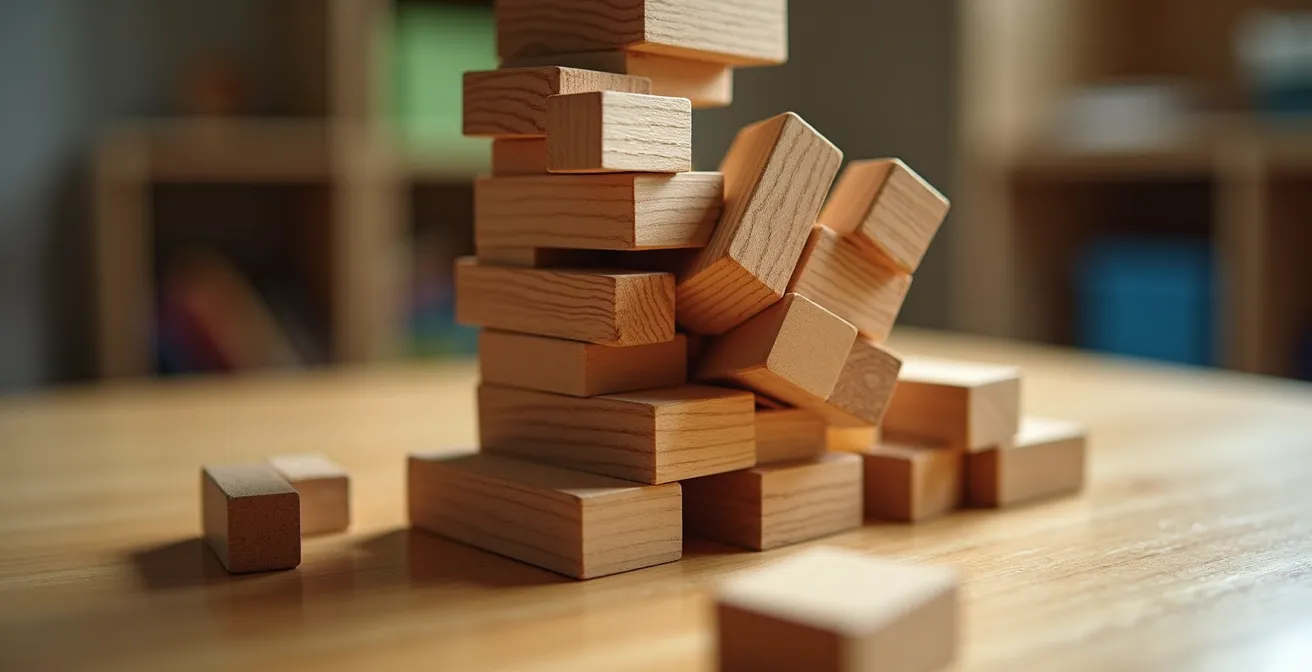
The image above captures this critical learning moment perfectly. Each collapse is a lesson in physics. With magnetic tiles, these lessons can be muted. Strong magnets can hold an unbalanced structure together, giving a false sense of stability and robbing the child of the opportunity to learn from a natural, physics-based failure.
Your Action Plan: Auditing a Failed Tower with the Scientific Method
- Hypothesize: Prompt your child to form a theory. Ask, “What do you think will happen if we add one more block on top?”
- Experiment: Encourage them to carefully place the block and observe the immediate result.
- Observe & Collect Data: Help them describe exactly what they saw. “The tower wobbled slowly and then fell to the right side.”
- Analyze: Guide them to connect the cause and the effect. “Maybe the base wasn’t wide enough to hold up something so tall.”
- Revise & Re-test: Help them formulate a new plan based on the analysis. “Let’s try making the bottom wider this time and see what happens!”
By embracing the collapse, you teach a lesson far more valuable than how to build a tall tower: you teach resilience and the joy of scientific discovery. This is the ultimate long-term return on investment.