
The common belief is that teaching poetry requires being a literary expert; the truth is it’s about creating the right conditions to unlock your child’s innate poetic intelligence.
- Creative “mistakes” like invented words are signs of a brain actively engaging with language, not errors to be corrected.
- Structured forms (like Haiku) and free expression are not opposites; they are tools that can be matched to a child’s unique temperament.
Recommendation: Shift your role from “teacher” to “creative facilitator” by focusing on the process of expression rather than the polished final product.
For many parents, the word “poetry” conjures images of dusty textbooks, impenetrable sonnets, and the dreadful pressure of finding the “right” meaning. The fear isn’t just that it will be boring for your child; it’s that you, the parent, will do it wrong. You worry about enforcing too many rules and stifling creativity, or having no rules at all and watching the effort dissolve into chaos. We are often told to “make it fun” or to focus on simple rhymes, but these well-meaning tips rarely address the core anxiety: how do you guide a child through a creative process you might not fully understand yourself?
But what if the goal wasn’t to “teach” poetry at all? What if poetry isn’t a subject, but a form of innate human intelligence—a fusion of linguistic, emotional, and structural thinking that every child possesses? The true task of a parent, then, is not to be a professor of literature, but a creative facilitator. Your role is to build a safe, playful laboratory where your child can experiment with words, name their feelings, and discover the music in their own voice. This approach moves beyond the surface level of rhyme and meter to touch the very core of self-expression and cognitive development.
This guide will provide a new framework for exploring poetry with your child. We will deconstruct the process, showing how to nurture their natural linguistic play, connect words to the senses, find the right balance between freedom and form, and build a lasting, pressure-free writing habit. It’s time to trade fear for fascination and unlock the poet that already lives inside your child.
text
Summary: A New Approach to Poetry for Kids
- Why Invented Words Are a Sign of High Intelligence?
- Paint Then Write: How to Use Drawings to Generate Vocabulary?
- Haiku or Free Verse: Which Form Unlocks Your Child’s Voice?
- The Red Pen Ban: Why You Should Never Correct Spelling in a Poem?
- The 10-Minute Journal: How to Make Writing a Daily Habit?
- The Rhyme Crime: Why Detecting Rhymes Is the First Step to Literacy?
- Sad, Mad, or Frustrated: Why Naming the Specific Emotion Calms the Brain?
- Beginning, Middle, End: How to Help Your Child Finish a Story?
Why Invented Words Are a Sign of High Intelligence?
The first instinct when a child writes “scrumplicious” or “nervouscited” is often to correct them. But this impulse misses a profound cognitive event: the child isn’t making a mistake; they are engaging in linguistic play, the very same process that drives language evolution. When a child invents a word, they are demonstrating a high-level understanding of how language works—what linguists call ‘morphological awareness.’ They know that parts of words carry meaning and can be combined in new ways. This is not a sign of error, but of a budding linguistic genius testing the boundaries of expression.
This creative act has a rich literary history. As noted by experts at the Poetry Foundation, which named Kenn Nesbitt Children’s Poet Laureate, this playful invention engages young minds in a powerful way. Shakespeare himself coined over 1,700 words we now use daily, including “eyeball,” “bedroom,” and “swagger.” Dr. Seuss built entire worlds on delightful nonsense that children intuitively grasp. By celebrating your child’s neologisms, you are encouraging them to see language not as a set of rigid rules, but as a dynamic and malleable tool for thought. This is the foundation of a true poet’s mindset.
To foster this skill, you can turn word creation into a game. This moves the focus from “correctness” to “creativity” and builds a rich, personal vocabulary.
- Create a ‘Word Invention Journal’: Dedicate a notebook where children can record their made-up words, complete with their own definitions and illustrations.
- Play ‘Portmanteau Challenge’: Combine two existing words to invent a new one, just like “brunch” (breakfast + lunch) or “smog” (smoke + fog). What is a “snackcident”?
- Name New Feelings: Invent words for emotions or situations that don’t have a name yet, like “the cozy feeling of reading on a rainy day” or “the disappointment when a show ends.”
- Build a ‘Word Gallery’: Display your child’s invented words on a wall or board, right next to famous neologisms from literature, showing them they are part of a long creative tradition.
Paint Then Write: How to Use Drawings to Generate Vocabulary?
Poetry often feels abstract and intimidating because it begins with a blank page. For a child, the pressure to “think” of poetic words can be paralyzing. A powerful way to bypass this creative block is to start not with words, but with colors, shapes, and textures. By engaging in a non-verbal, sensory activity like painting or drawing first, a child can generate a wealth of personal imagery and vocabulary before a single line is written. This “paint then write” method translates felt sensations directly into language.
This process encourages a child to build a bridge from the visual to the verbal. A splash of deep blue isn’t just “blue”; it might feel “lonely” or taste “cold.” A jagged red line isn’t just a shape; it could be the sound of a “shout” or the feeling of “anger.” This act of sensory labeling builds the foundation for creating powerful metaphors, the very heart of poetry.
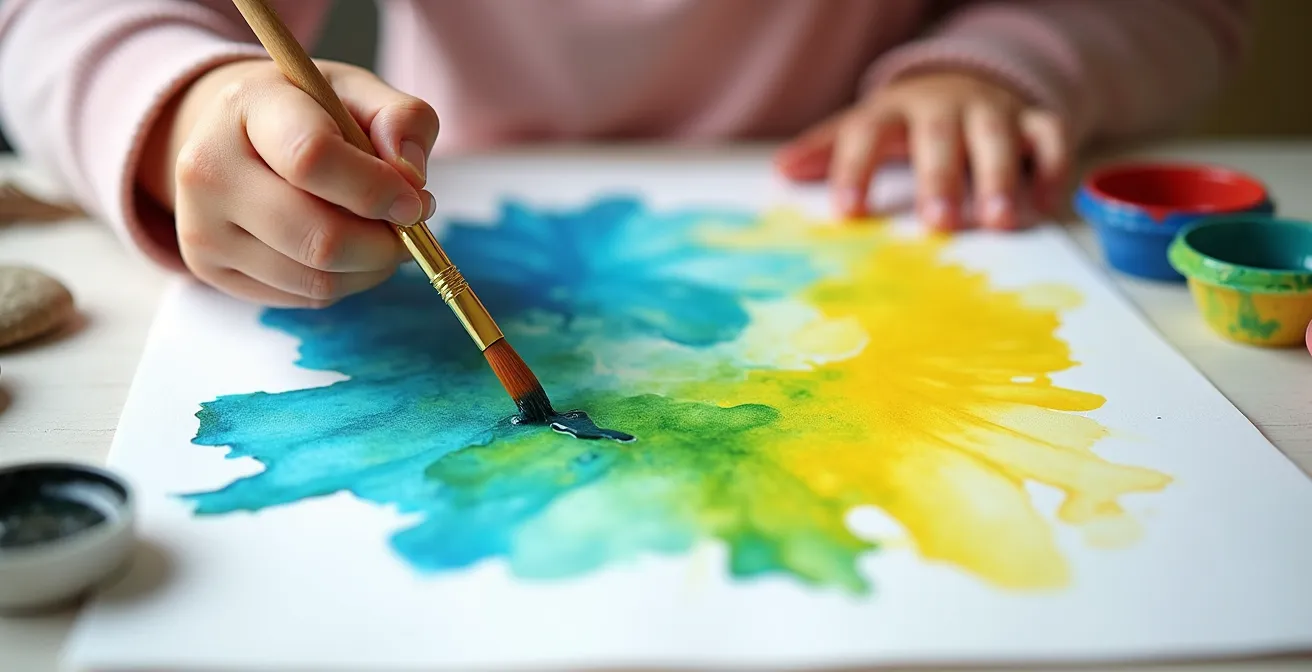
As you can see in this creative moment, the goal isn’t to create a masterpiece but to explore the relationship between color and feeling. The vocabulary that emerges from this activity is authentic, personal, and emotionally resonant because it’s grounded in a direct, physical experience. It transforms the question from “What should I write?” to “What words describe what I just made?” This simple shift empowers the child by making them the expert of their own creation.
- Draw Freely: Set a timer for 5-10 minutes and encourage drawing without a plan. Focus on abstract shapes, colors, and lines.
- Label Everything: Go back over the drawing and label different elements with sensory words. “This spiral feels dizzy.” “This patch of yellow tastes like lemonade.”
- Create Metaphor Bridges: Ask probing questions. “If this green circle was an emotion, what would it be?” “If this soft, blurry texture was a sound, what would it sound like?”
- Build a Word Bank: Collect all the descriptive words, feelings, and metaphors generated from the drawing into a list.
- Write the Poem: Challenge your child to write a short poem using only the words from their new, visually-inspired word bank.
Haiku or Free Verse: Which Form Unlocks Your Child’s Voice?
One of the biggest dilemmas in teaching poetry is the question of structure. Should we impose rules like syllable counts and rhyme schemes, or should we encourage total freedom? The answer is not one or the other; it’s both. The key is understanding that different forms serve different temperaments. Viewing poetic structures not as rigid cages but as different types of playgrounds allows you to find the perfect fit for your child’s personality. This strategic choice creates creative friction—a productive tension between constraint and freedom that can spark surprising results.
For a child who thrives on logic and order, the clear rules of a Haiku (5-7-5 syllables) can feel like a satisfying puzzle to solve. The constraint provides a safe container for their ideas. Conversely, for a child who is highly emotional and expressive, the limitlessness of Free Verse allows them to pour their feelings onto the page without worrying about “breaking the rules.” The form should serve the child, not the other way around. As a resource from the educational site Poetry4Kids suggests, matching the poetic form to the child’s learning style is a highly effective strategy.
| Child’s Temperament | Recommended Form | Why It Works | Example Activity |
|---|---|---|---|
| Logical/Mathematical | Haiku (5-7-5) | Rules provide structure and challenge | Count syllables with clapping |
| Free-spirited/Emotional | Free Verse | No constraints allow full expression | Stream-of-consciousness writing |
| Musical/Rhythmic | Rhyming Couplets | Natural sense of beat and pattern | Set poems to simple melodies |
| Visual/Spatial | Concrete Poetry | Words create shapes on page | Write poems in the shape of the subject |
By presenting these forms as choices, you empower your child to become a conscious creator. They learn that rules in art are not arbitrary laws but creative tools they can choose to use. This demystifies the craft of poetry and gives them ownership over their own expressive journey. The goal is to find the form that makes their unique voice sing.
The Red Pen Ban: Why You Should Never Correct Spelling in a Poem?
Imagine your child proudly presents a poem about a “fierse dragun,” their eyes shining with accomplishment. Your first impulse might be to gently correct “fierce” and “dragon.” But in that moment, the red pen—real or metaphorical—is the single most effective tool for shutting down a young writer. Correcting spelling or grammar during the creative act sends a devastating message: your accuracy is more important than your ideas. It shifts the focus from the vulnerable act of expressing a feeling to the technical task of getting it right. This is where the concept of process over polish becomes paramount.
When a child is writing a poem, they are juggling imagery, emotion, rhythm, and word choice. Adding the cognitive load of perfect spelling on top of that can lead to total system overload. Phonetic spellings like “dragun” are not a sign of laziness; they are evidence of a brain working hard to translate sounds into letters. Celebrating these “phonetic inventions” as part of the drafting process creates a psychologically safe space where the child feels free to take risks without fear of judgment. The time for correction can come later, but it must be a separate, optional stage that the child opts into.
To implement this, you can establish a clear, two-phase writing process: the “Draft Mode,” where all ideas are welcome and spelling doesn’t matter, and the “Publisher-Ready Mode,” which is an optional step for poems the child wishes to share publicly.
Your Action Plan: Creating a Safe Poetry Zone
- Establish ‘Draft Mode’: Announce that for first drafts, the only rule is to get ideas and feelings down. All spelling is celebrated as part of the creative process.
- Celebrate Phonetic Inventions: When you see a word like “enuff,” praise it as evidence of careful listening. “I love how you figured out the sounds in that word!”
- Offer the ‘Publishing’ Phase: After a poem is complete and the child is happy with it, ask, “This is a wonderful poem. Would you like to make it ‘publisher-ready’ to share or display?”
- Collaborate on Corrections: If the child agrees, work together as a team to edit the poem. Frame it as preparing the work for its audience, not fixing mistakes.
- Honor the Original: Always keep the original draft. You can even display it alongside the “published” version to honor the entire creative journey, showing that both versions have value.
The 10-Minute Journal: How to Make Writing a Daily Habit?
The biggest obstacle to developing any skill isn’t a lack of talent, but a lack of consistency. We often treat writing as a special-occasion activity, waiting for a bolt of inspiration to strike. However, the most effective way to nurture a child’s poetic intelligence is to make writing a small, ordinary, and joyful part of their daily routine. The goal is not to produce a masterpiece every day, but to simply open the channel of expression. A 10-minute daily poetry journal is a powerful tool for achieving this.
The key to success is to make the practice so small and low-pressure that it’s easier to do it than to skip it. Creating a dedicated, cozy space for this ritual can also work wonders. A comfortable chair, a special notebook, and a jar of colorful pens can transform a chore into a treat. This isn’t just about the physical space; it’s about creating a mental space dedicated to quiet reflection and creativity.

As this serene image suggests, the environment itself can become an invitation to write. The magic of the 10-minute journal lies in its consistency and its focus on process, not product. Using a method known as “habit stacking,” where you anchor the new habit to an existing one, can make it nearly automatic. For example, “Right after we brush our teeth for bed, we open our poetry journal.” The ritual becomes a predictable and comforting part of the day’s rhythm.
- Anchor to an Existing Routine: Link the journal time to something that already happens every day, like right after breakfast or before a bedtime story.
- Track the Streak, Not the Quality: Use a simple sticker chart or calendar to mark every day that writing happens. The goal is to build a chain of consistency, regardless of what was written.
- Use a ‘Zero-Pressure Prompt Jar’: Fill a jar with fun, low-stakes writing prompts like, “What sound does a color make?” or “Write a poem from the perspective of your left shoe.”
- Set a Timer: Write for exactly 10 minutes. When the timer rings, you stop—even mid-sentence. This removes the pressure of having to “finish” anything.
- End with ‘One-Line Sharing’: To build confidence, have the child read just their single favorite line or phrase from that day’s writing aloud.
The Rhyme Crime: Why Detecting Rhymes Is the First Step to Literacy?
In the world of sophisticated poetry, an over-reliance on simple rhymes can feel elementary. However, for a young child, the ability to hear, identify, and play with rhyming sounds is not just fun—it’s one of the most critical building blocks of literacy. This skill, known as phonological awareness, is the ability to recognize and work with the sounds in spoken language. In fact, research into phonological awareness has shown that a preschooler’s rhyme detection skills can predict future reading ability with remarkable accuracy. When a child can hear that “cat” and “hat” share a sound, they are learning to deconstruct words into smaller parts, a foundational skill for decoding text.
The “rhyme crime” is not using rhyme; it’s thinking that rhyme is the *only* thing that matters in poetry. The true value of rhyme for a young child is as an entry point into the soundscape of language. Before they can create rhymes, they must first learn to detect them. This is why rhyming picture books, songs, and nursery rhymes are so powerful. They train the child’s ear to notice patterns and similarities in sounds, making the abstract concept of written language more concrete and predictable.
Integrating rhyme detection into daily life can be a playful, screen-free activity that strengthens this crucial cognitive muscle without any formal instruction. The goal is to turn your child into a “sound detective.”
- Take a ‘Rhyme Walk’: Go for a walk with the specific goal of finding things that rhyme. “I see a tree!” Your child can respond, “I see a bee!”
- Listen for Rhymes in Songs: While listening to music, simply point out the rhymes you hear. “Hey, ‘star’ and ‘are’ rhyme!” The first step is noticing, not creating.
- Build ‘Rhyme Families’: Start with a simple word like “bug” and brainstorm all the words that belong in its sound family: mug, rug, hug, tug.
- Play Rhyming Games: Use rhyme to make everyday transitions more fun. “It’s time to go if your name rhymes with ‘Joe’.”
Sad, Mad, or Frustrated: Why Naming the Specific Emotion Calms the Brain?
Children experience a swirling vortex of big feelings, but they often lack the words to describe them. An overwhelming feeling might just be called “bad” or “sad.” Poetry offers a powerful toolkit for developing what scientists call emotional granularity—the ability to identify and label emotions with a high degree of specificity. Moving from “sad” to “melancholy,” “lonely,” or “disappointed” is not just a vocabulary exercise; it’s a profound act of emotional regulation. When a child finds the precise word for a feeling, they externalize it, observe it, and gain a sense of control over it.
This phenomenon is beautifully explained by the work of neuroscientist Dr. Dan Siegel. His “Name It to Tame It” principle describes how the simple act of putting a specific word to a powerful feeling can soothe the brain’s alarm system. As he explains, this process helps integrate the emotional and logical parts of the brain. The following concept is central to his work:
When a child puts a specific word to an overwhelming feeling, it integrates the brain and soothes the amygdala’s fight-or-flight response.
– Dr. Dan Siegel, “Name It to Tame It” principle in neuroscience
Poetry is the ultimate laboratory for this practice. It gives children a safe space to “try on” complex emotions and explore their nuances. A poem about anger can help a child differentiate between feeling “frustrated,” “furious,” or “indignant.” This not only builds their emotional intelligence but also provides them with rich, authentic material for their own writing. When they write, they are not just making art; they are processing their inner world.
- Create a ‘Feeling Wheel’: Draw a large circle and fill it with nuanced emotion words beyond the basics: ecstatic, serene, envious, pensive, apprehensive.
- Write ‘Emotion Exploration’ Poems: Challenge your child to write a one-line poem for three different, but related, feelings (e.g., happy, joyful, ecstatic). What’s the difference?
- Ask ‘Where in Your Body?’: When reading an emotional poem together, ask, “Where in your body do you think the character feels that sadness? In their chest? In their throat?”
- Build an Emotion Word Wall: Create a space to display emotion words, grouping them by synonyms or arranging them on an intensity scale from “annoyed” to “enraged.”
Key Takeaways
- Stop “teaching” poetry and start facilitating the discovery of your child’s innate poetic intelligence.
- Celebrate linguistic creativity—invented words and phonetic spellings are signs of an engaged mind, not errors.
- Match the poetic form (structure vs. freedom) to your child’s personality to create productive “creative friction.”
Beginning, Middle, End: How to Help Your Child Finish a Story?
One of the most common frustrations for young writers is the “and then” syndrome. Their stories become a long, rambling sequence of events without a clear focus or conclusion. They have a beginning, but the middle sprawls endlessly, and the end never arrives. While this is a challenge in prose, poetry offers a unique solution. By framing a poem as a “micro-story,” you can teach the fundamentals of narrative structure in a manageable, condensed format. The core components of a story—beginning, middle, and end—can be captured in three short stanzas or even three powerful lines.
A highly effective tool for this is the “Story Spine,” a method famously used by Pixar animators to structure their films. As detailed in teaching resources, adapting this for poetry provides a simple, clear scaffold for storytelling. The classic structure is: “Once upon a time… Every day… Until one day… Because of that… Because of that… Until finally…” For a poem, you can simplify this to three core beats: The Setup (Once upon a time…), The Conflict (Until one day…), and The Resolution (Until finally…). This helps a child move beyond a simple sequence of events to a story with tension and change.
This approach also encourages them to replace “and then” with richer poetic devices. Instead of saying, “And then the dragon was sad,” they can show it through imagery: “The lonely dragon’s fire / turned to smoke-filled sighs.” You are teaching them to connect a character’s actions to their internal, emotional world—the very essence of compelling storytelling. The poem becomes a vessel not just for events, but for a moment of transformation, no matter how small.
Your journey into poetry with your child is not about memorizing terms or producing perfect sonnets. It is about nurturing their innate intelligence—their linguistic play, their emotional depth, and their grasp of structure. Begin today by creating a space for these explorations, and you will give your child a powerful tool for understanding themselves and the world.