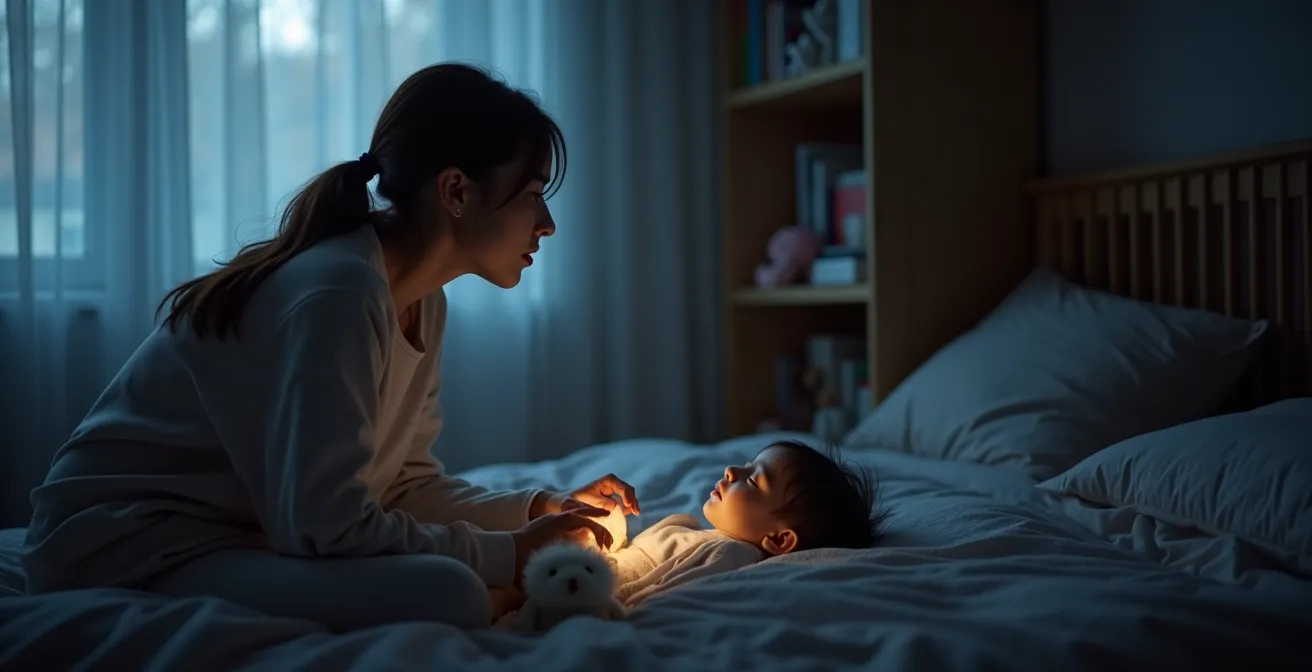
The common belief that a child’s mouth breathing is a harmless phase is incorrect; it is a clinical sign of a dysfunctional breathing pattern that triggers a cascade of systemic health issues.
- Nasal breathing is the biological norm, filtering air and signaling the body for rest-and-digest functions, leading to restorative deep sleep.
- Mouth breathing bypasses these mechanisms, activating the body’s stress response, disrupting sleep architecture, and leading to a host of problems from bedwetting to anxiety.
Recommendation: Instead of dismissing it, parents should view persistent mouth breathing as a critical symptom that warrants investigation to address the root cause and prevent long-term consequences.
As a parent, you may have noticed your child sleeping with their mouth slightly agape, perhaps accompanied by soft snoring. It can seem endearing, a sign of deep slumber. The common assumption is that it’s a temporary habit, perhaps linked to a stuffy nose or just a phase they will outgrow. However, from a physiological standpoint, this assumption is not only incorrect but potentially dangerous. Chronic mouth breathing is not normal; it is a primary indicator of a dysfunctional breathing pattern that prevents your child from achieving truly restorative sleep. It signals that the body is struggling, a state that can have profound impacts on their development, mood, and long-term health.
While parents often focus on external sleep aids or routines, they may overlook the fundamental mechanics of breathing. The distinction between nasal and oral breathing is not trivial. It is the difference between a body functioning in its intended state of recovery and a body stuck in a low-grade state of emergency all night long. This article moves beyond the superficial symptoms to deconstruct the physiological cascade triggered by mouth breathing. We will explore how this single issue connects to everything from bedwetting and anxiety to dark circles and weight gain. Understanding this connection is the first step toward corrective action, shifting the focus from managing symptoms to resolving the underlying cause.
To help you understand these critical connections, this guide breaks down the science behind sleep-disordered breathing and its wide-ranging effects. Follow along as we uncover the evidence, debunk common myths, and provide a clear path forward.
Summary: The Real Impact of Mouth Breathing on a Child’s Health
- Silent Pauses: When Should You Record Your Child Sleeping?
- Why Heavy Sleepers Wet the Bed More Often Than Light Sleepers?
- Wearables for Kids: Are Sleep Trackers Helpful or Anxiety-Inducing?
- White Noise vs. Pink Noise: Which Frequency Keep Kids in Deep Sleep?
- Does Swimming Tire Kids Out More Than TV Before Bed?
- The Sedentary Trap: Physical Risks of Screen Time Over 2 Hours
- Dark Circles and Belly Fat: Is Your Child Stressed or Just Growing?
- Stomach Aches and Anxiety: Is Your Child Sick or Just Worried?
Silent Pauses: When Should You Record Your Child Sleeping?
Identifying a dysfunctional breathing pattern begins with objective observation. While you might notice your child’s open mouth, the sounds they make—or don’t make—during sleep provide the most crucial evidence. Pauses in breathing (apneas), gasps, or the dry, raspy sound of mouth breathing are significant clinical signs. Research shows that for many children with sleep issues, nighttime mouth breathing is the most common symptom, affecting up to 69% of those studied. Capturing these sounds is a vital first step in communicating the problem to a pediatrician or specialist.
Rather than relying on memory, a simple audio recording can provide undeniable proof of sleep-disordered breathing. This evidence is not for self-diagnosis but to facilitate a more productive conversation with a healthcare professional. The visual below illustrates a non-intrusive setup for capturing these important diagnostic sounds.
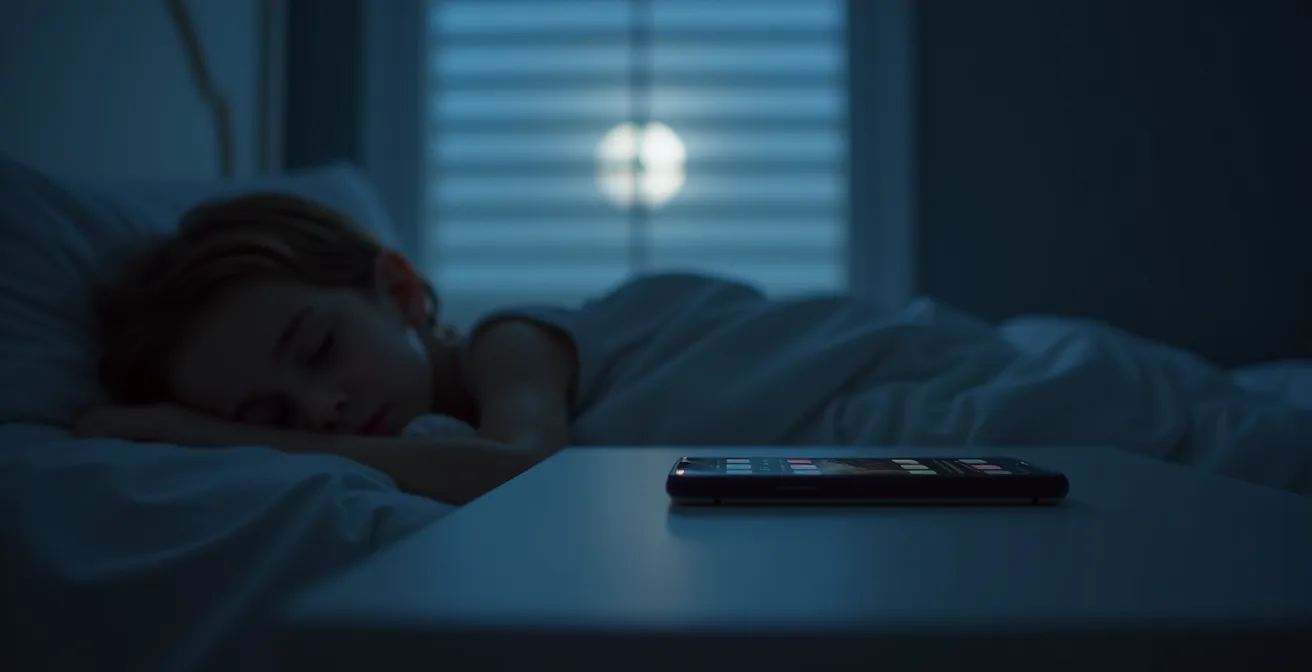
As you can see, the process is simple and respects the child’s sleep environment. The goal is to collect data that reveals what happens when they are in their deepest sleep stages, often when these breathing disruptions are most pronounced. This proactive step transforms a vague concern into concrete, actionable information.
Your Action Plan: Creating a Sleep Audio Log
- Record Audio: Use a smartphone’s voice recorder app placed 2-3 feet from the child’s bed. The best time is during the first 2-3 hours of sleep when breathing patterns are most evident.
- Log Details: Note the time, duration, and type of sound. Distinguish between raspy dry mouth breathing and a deeper, obstructive struggle or gasping.
- Document Position: Record your child’s sleep position (back, side, stomach), as this significantly affects airway patency and breathing.
- Identify Patterns: Create a weekly log to track consistency. Does it happen every night? Only in certain positions?
- Share with a Professional: Bring the log and audio clips to your pediatrician to provide clear evidence and advocate for a proper evaluation.
Why Heavy Sleepers Wet the Bed More Often Than Light Sleepers?
Nocturnal enuresis, or bedwetting, is often dismissed as a developmental delay or a sign of a child being a “heavy sleeper.” However, the physiological reality is far more complex and frequently linked to breathing. When a child struggles to breathe at night, their body does not achieve the restorative deep sleep needed for proper hormonal regulation. One of the key hormones affected is the antidiuretic hormone (ADH), which signals the kidneys to produce less urine at night. Disordered breathing causes frequent micro-arousals, disrupting the brain’s ability to produce and utilize ADH effectively.
This results in the bladder filling more quickly than it should. At the same time, the brain, starved of oxygen and preoccupied with the work of breathing, is less able to receive the signal that the bladder is full. It’s not that the child is sleeping too deeply; it’s that their sleep quality is too poor to manage normal bodily functions. A 2024 study provided clear evidence for this connection, finding that nocturnal enuresis was present in 39.2% of children with Obstructive Sleep Apnea (OSA), compared to just 28% in the control group. This highlights that bedwetting is often a symptom of an airway problem, not a standalone issue.
Therefore, treating bedwetting with alarms or fluid restriction without addressing the underlying breathing issue is like trying to fix a leak by mopping the floor. The problem will persist until the source—the compromised airway—is corrected. Resolving the dysfunctional breathing pattern often leads to a natural resolution of bedwetting as the body’s hormonal systems and sleep architecture normalize.
Wearables for Kids: Are Sleep Trackers Helpful or Anxiety-Inducing?
In an effort to quantify sleep, many parents turn to consumer-grade sleep trackers. These devices promise insights by monitoring heart rate, movement, and sometimes even oxygen levels. However, for the specific issue of mouth breathing, these trackers are often a source of confusion and anxiety rather than clarity. They generate abstract “sleep scores” that don’t capture the most critical piece of information: the actual sound and mechanics of your child’s breathing. A child can remain relatively still and have a stable heart rate while still experiencing significant breathing disruptions, a nuance most wearables miss entirely.
Focusing on a nightly score can create performance anxiety for both parent and child, a phenomenon known as orthosomnia. As ENT Specialist Dr. Katherine Kavanagh states, “For the specific question of mouth breathing, a simple, direct observation or audio recording is more diagnostically valuable than any consumer-grade sleep tracker’s abstract score.” The key is to gather direct evidence, not abstract data. A low-tech audio recording provides far more clinical value than a high-tech wristband in this context.
The following table, based on guidance from sleep health experts, compares the diagnostic utility of different monitoring methods when assessing sleep-disordered breathing.
| Method | Effectiveness for Breathing Issues | Anxiety Risk | Diagnostic Value |
|---|---|---|---|
| Consumer Sleep Trackers | Limited – tracks restlessness and heart rate | High – nightly performance metrics | Low – abstract scores |
| Audio Recording | High – captures actual breathing sounds | Low – periodic spot checks | High – direct evidence for doctors |
| SpO2 Monitors | Moderate – shows oxygen drops if available | Moderate – concerning data visible | Moderate – useful but needs context |
White Noise vs. Pink Noise: Which Frequency Keep Kids in Deep Sleep?
Sound machines are a staple in many children’s bedrooms, used to mask environmental noise and create a consistent auditory backdrop for sleep. While both white and pink noise can be effective for this purpose, they introduce a significant, often-overlooked problem when a breathing issue is present. Their primary function is to mask sound, which means they can also mask the very symptoms you need to hear: snoring, gasping, and labored breathing. A parent might believe their child is sleeping peacefully, when in reality, the sound machine is simply covering up the evidence of a nightly struggle.
This creates a false sense of security and can delay the diagnosis of a serious underlying condition. While the subtle differences between white noise (all frequencies at equal intensity) and pink noise (lower frequencies are louder) may affect sleep depth for a healthy breather, this debate is irrelevant if the child’s airway is compromised. For a child with a dysfunctional breathing pattern, neither frequency will solve the core physiological problem.

The reliance on a sound machine can itself be a red flag. If a child is unable to sleep without one, it may indicate that their sleep quality is inherently poor, and the machine is merely a crutch. Experts recommend periodically having “silent nights” to perform audio spot-checks and listen to your child’s natural breathing patterns. This is the only way to know what is truly happening with their airway.
Does Swimming Tire Kids Out More Than TV Before Bed?
The common wisdom to “tire out” a child before bed is sound, but the type of activity matters immensely. A crucial distinction must be made between activities that promote physical readiness for sleep and those that induce a state of being “wired and tired.” Watching TV or using a tablet exposes a child to blue light, which suppresses melatonin production. More importantly, it often leads to a state of mental overstimulation, characterized by shallow breathing and elevated cortisol levels. This creates a physiological conflict: the body is tired, but the brain is activated and stressed.
In contrast, an activity like swimming is uniquely beneficial for promoting sleep. It is a full-body physical exertion that naturally lowers cortisol levels. Crucially, it also functions as a form of natural breath training. To swim effectively, a child must coordinate nasal inhales and oral exhales, strengthening the very muscles and neural pathways required for proper nasal breathing. This helps establish the correct physiological pattern for rest. The result is a child who is not just tired, but whose body is primed for relaxation and deep sleep, with relaxed muscles and steady, calm breathing.
The difference is stark. Screen time creates a stress state with disrupted breathing patterns, making the transition to restful sleep difficult. Swimming, on the other hand, physically and neurologically prepares the body for its primary nighttime function: recovery. Choosing the right pre-bedtime activity is not just about expending energy; it’s about sending the correct physiological signals to the brain and body.
The Sedentary Trap: Physical Risks of Screen Time Over 2 Hours
The impact of excessive screen time extends beyond blue light exposure and mental stimulation; it physically molds a child’s body into a posture that promotes mouth breathing. When a child hunches over a screen, they typically develop a “forward head posture.” This position compresses the neck, narrows the pharyngeal airway, and forces the jaw to drop open to create a more patent airway. In short, poor posture creates a physical necessity for mouth breathing.
This sedentary posture, held for hours, trains the orofacial muscles into a dysfunctional state. The tongue drops from its proper resting place on the roof of the mouth, the lips part, and mouth breathing becomes the default, even during sleep. This creates a vicious cycle: screen time encourages poor posture, which leads to mouth breathing, which in turn causes poor sleep, resulting in fatigue and a greater desire for sedentary activities like more screen time. The trap is both behavioral and physiological.
To counteract this, it is not enough to simply limit screen time. Parents must actively introduce “movement micro-dosing.” This involves interrupting long periods of sitting with short, targeted breaks. These breaks should focus on two things: postural correction and conscious nasal breathing. For example, implementing a rule of standing for a two-minute stretching break with deep nasal breaths every 40 minutes can help reset the body. Simple exercises like neck rolls and shoulder blade squeezes can reverse the hunching posture, while practicing five deep nasal breaths between sessions helps re-establish the correct breathing pattern as the default.
Dark Circles and Belly Fat: Is Your Child Stressed or Just Growing?
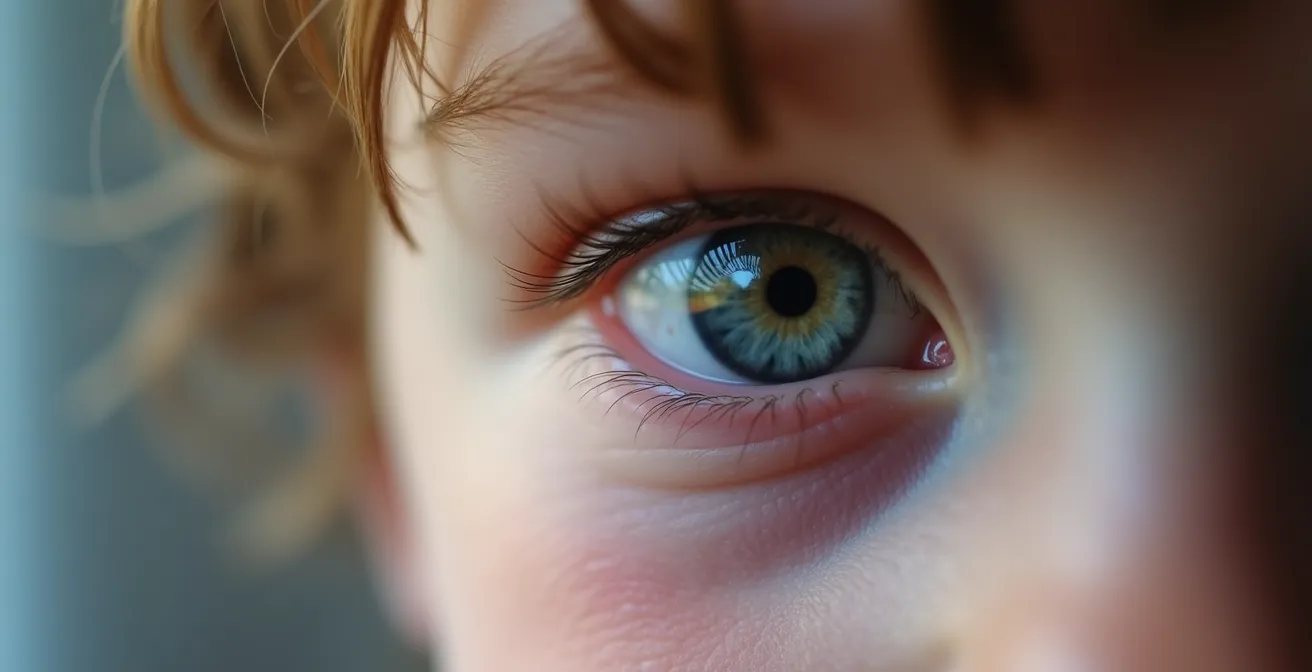
Two physical signs in children that parents often worry about are persistent dark circles under the eyes and the accumulation of abdominal fat. While they may seem unrelated, both can be direct results of the systemic stress caused by sleep-disordered breathing. The purplish, puffy circles often called “allergic shiners” are not necessarily due to allergies. They are caused by venous pooling—the congestion of blood in the delicate under-eye area due to poor oxygenation and sinus blockage, both hallmarks of chronic mouth breathing.
Simultaneously, the struggle to breathe at night puts the body in a constant fight-or-flight mode, leading to chronically elevated levels of the stress hormone, cortisol. High cortisol signals the body to store fat, particularly in the abdominal region. Furthermore, this physiological stress impacts how the body processes sugar. Boston Medical Center research indicates that children with sleep-disordered breathing show increased insulin resistance, a precursor to metabolic issues and obesity. The child may also be less physically active due to daytime fatigue, further contributing to weight gain.
These are not merely “growing pains.” They are visible manifestations of a body under significant physiological duress. The dark circles point to poor oxygenation, while the belly fat points to a hormonal imbalance driven by stress. Both trace back to the same root cause: a compromised airway and the resulting poor-quality sleep.
Key Takeaways
- Mouth breathing is not a habit but a clinical sign of a compromised airway, triggering a systemic stress response.
- Poor breathing quality directly disrupts hormonal regulation, affecting everything from bladder control (bedwetting) to stress hormones (cortisol) and metabolism (insulin resistance).
- Symptoms like dark circles, anxiety, and stomach aches are often the physical and emotional manifestations of a body struggling for oxygen at night.
Stomach Aches and Anxiety: Is Your Child Sick or Just Worried?
When a child frequently complains of stomach aches and seems unusually anxious, it’s easy to assume the cause is either a gastrointestinal bug or purely emotional worry. However, both can be direct consequences of a dysfunctional breathing pattern. Mouth breathing often leads to a condition called aerophagia, which is the medical term for excessive air swallowing. This swallowed air gets trapped in the stomach and intestines, causing bloating, gas, and significant discomfort that a child experiences as a stomach ache. The issue isn’t what they’ve eaten, but how they’re breathing.
Case Study: The Aerophagia Connection
An analysis reported by WebMD highlights the direct link between mouth breathing and aerophagia, which causes bloating and pain often perceived as anxiety. This is supported by pediatric studies where children reporting stomach discomfort were guided through 5 minutes of deep, nasal “belly breathing” exercises. In 70% of cases, the children reported immediate relief, strongly suggesting the pain was caused by trapped air from dysfunctional breathing rather than a primary gastrointestinal problem.
This physiological stress is then interpreted by the brain as emotional anxiety. As airway specialist Dr. Michael Gelb explains, the root of the problem is often the breathing itself:
Poor sleep from mouth breathing is often the ‘egg’ – it creates a physiological stress state with high cortisol and poor gut function that then manifests as the emotional experience of anxiety and physical stomach aches.
– Dr. Michael Gelb, Airway & TMJ Specialist
The anxiety and the stomach ache are not separate issues; they are two sides of the same coin, both minted by the body’s struggle for air. Correcting the breathing pattern can often resolve these seemingly psychological or digestive problems by addressing their true physiological origin.
Recognizing that mouth breathing is a clinical sign—not a personality quirk—is the most critical step a parent can take. This shift in perspective moves you from a passive observer to a proactive advocate for your child’s health. The next logical step is to seek a professional evaluation to identify the root cause of the dysfunctional breathing, whether it’s allergies, enlarged tonsils, or an orofacial myofunctional issue. Schedule a consultation with your pediatrician armed with your observations and audio logs to begin the process of restoring your child’s natural ability to breathe and sleep soundly.
Frequently Asked Questions About Breathing and Sleep Aids
Can sound machines mask important breathing symptoms?
Yes, white noise and pink noise can mask the audible evidence of snoring or labored breathing, potentially delaying parents’ awareness of sleep-disordered breathing problems.
Should parents turn off sound machines periodically?
Experts recommend having ‘silent nights’ without the machine to do audio spot-checks on children’s natural breathing patterns, especially if mouth breathing is suspected.
Is reliance on sound machines covering up deeper issues?
Sound machines should be viewed as temporary aids. If a child cannot sleep without them, it may indicate poor sleep quality from underlying issues like mouth breathing or airway obstruction.