
Expressive reading isn’t about practicing different voices; it’s the natural result of a child truly understanding and picturing the story.
- Robotic reading is often a symptom of ‘surface-level’ decoding, not a lack of effort or talent.
- Strategies that build an ‘internal movie’—like playing detective and using sensory details—are more effective than performance drills.
Recommendation: Shift your focus from correcting your child’s tone to sparking their imagination about the world within the book.
You hear it from the other room—the sound of your child reading aloud. The words are correct, the pace is steady, and you feel a swell of pride. But as you listen closer, a flicker of confusion follows. Each word is pronounced perfectly, yet the delivery is flat, mechanical, almost… robotic. It’s the voice of a GPS giving directions, not a character embarking on a thrilling adventure. This gap between technical skill and emotional expression, known as reading prosody, is a common hurdle for young readers.
The usual advice often involves performance-based fixes: “Read it like you’re surprised!” or “Let’s focus on the exclamation points!” While helpful, these suggestions treat the symptom, not the cause. They ask a child to put on an actor’s mask without ever handing them the script’s soul. The robotic reading isn’t a failure of voice; it’s a sign of a disconnect from meaning. The child is decoding words, but they aren’t building a world inside their mind.
But what if we flipped the script entirely? What if expressive reading wasn’t a skill to be drilled, but a natural, spontaneous byproduct of deep comprehension? This guide is your backstage pass to transforming your child from a word-caller into a storyteller. We will abandon the director’s chair that demands a certain performance and instead become a fellow artist, helping them paint the scenes, hear the sounds, and feel the emotions hidden between the lines. It’s time to stop coaching the voice and start building the internal world that gives it a reason to sing.
This article will guide you through a series of creative, drama-inspired strategies. We’ll explore how to turn reading into a detective game, direct a movie inside the mind, and have conversations that unlock the heart of a story, moving your child from sounding like Siri to sounding like themselves, fully immersed in the narrative.
Table of Contents: Unlocking Your Child’s Expressive Reading Voice
- The Detective Reader: How to Read Between the Lines?
- Speed Reading vs. Deep Reading: Which One Matters for 4th Grade?
- The “What If” Method: Discussing Books Without interrogating Your Child?
- Headings and Captions: Why Kids Skip the Most Important Parts of Science Books?
- Mental Movies: How to Teach Your Child to Picture the Story?
- First the Corners: How to Teach Puzzle Strategy systematically?
- Beyond “Because”: How to Turn a Simple Answer Into a Deep Discussion?
- Beginning, Middle, End: How to Help Your Child Finish a Story?
The Detective Reader: How to Read Between the Lines?
The first step in moving beyond robotic reading is to transform your child from a passive word-decoder into an active meaning-maker. A story is not just a string of words; it’s a puzzle box filled with clues. Our job is to give our children the tools to become “textual detectives,” investigators who hunt for what the author *doesn’t* say directly. This is the art of inference, the foundation of all deep comprehension. When a child learns to connect the textual dots, the characters and events come alive, demanding a voice filled with curiosity, surprise, and understanding.
This investigative approach makes reading an engaging quest rather than a chore. At Stillmeadow Elementary in Connecticut, reading coach Elke Blanchard has seen remarkable success by reframing reading this way. She teaches students to actively find textual clues and blend them with their own life experiences. In her classroom, children become partners in investigation, working together to understand why a character acted a certain way, using evidence from the book to support their theories. This process of active inquiry is the engine of internal world-building.
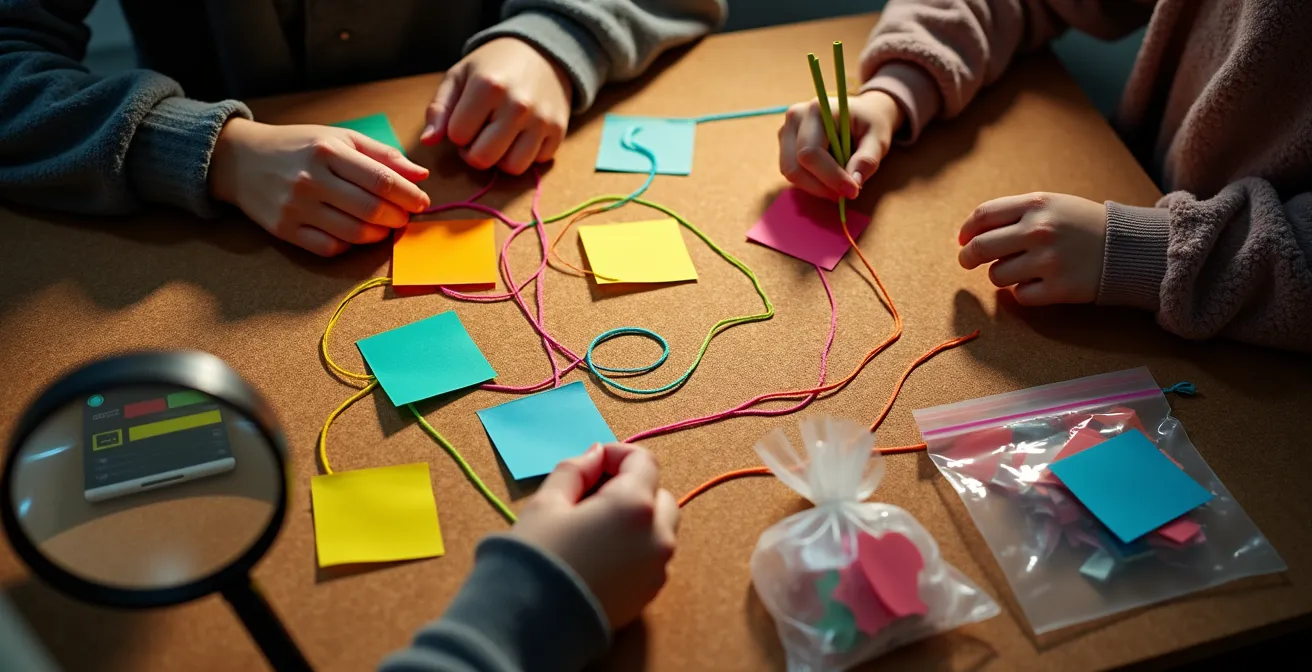
As you can see, creating a visual map of the story turns abstract ideas into a concrete puzzle. This detective work is what breathes life into the words on the page. Instead of just reading “The boy slammed the door,” the detective-reader asks, “Why? Was he angry? Scared? In a hurry?” The voice naturally follows the conclusion. To build this skill, you need a systematic method for finding and interpreting clues.
Your Detective’s Toolkit: The Inference Audit
- It Says: What are the exact words or facts the text provides? (e.g., “The character’s eyes were wide.”)
- I Say: What do I already know from my own life about this? (e.g., “People’s eyes get wide when they are surprised or scared.”)
- And So: Combine the text clue with your knowledge to make an inference. (e.g., “And so, the character is probably feeling surprised or scared.”)
- Practice with Pictures: Use wordless picture books to practice this method, focusing purely on visual clues without the pressure of decoding.
- Hunt for Contradictions: Look for moments when a character says one thing but does another. This is often where the richest clues are hidden.
Speed Reading vs. Deep Reading: Which One Matters for 4th Grade?
In the race to meet reading benchmarks, parents often fixate on speed. We celebrate when our child’s words-per-minute rate climbs, seeing it as a sign of progress. Indeed, fluency is a critical milestone; the typical reading fluency progression shows a jump from around 30 words per minute in first grade to over 100 by the end of second. But fluency is a bridge, not a destination. For a 4th grader, the question is no longer “How fast can you read?” but “How deeply can you think?” A robotic, fast reading of a chapter is less valuable than a slower, more thoughtful reading that sparks an internal movie.
Think of it like driving. Speed reading is like cruising on a highway—you get a general sense of the landscape, but the details are a blur. It’s useful for quickly scanning a science chapter for a specific fact. Deep reading, however, is like taking a scenic backroad. You drive slower, you stop to admire the view, you notice the small details—the color of a flower, the expression on a farmer’s face. This is the mode needed for rich narratives, complex characters, and emotional scenes. It is in these pauses and moments of reflection that emotional resonance is born, which in turn shapes an expressive voice.
Helping your child understand that they have different “gears” for reading is empowering. It’s not about labeling one as “good” and the other as “bad,” but about teaching them to be strategic readers who choose the right tool for the job. The following comparison can help clarify when to hit the gas and when to enjoy the scenery.
| Aspect | Speed Reading (Skimming) | Deep Reading |
|---|---|---|
| Purpose | Quick fact-finding for homework | Understanding complex stories |
| Speed | 150+ words per minute | 80-100 words per minute with pauses |
| Best For | Simple descriptions, familiar topics | Dialogue, emotional scenes, new concepts |
| Comprehension Level | Surface understanding | Deep meaning and inference |
| Mental Engagement | Scanning for keywords | Creating mental movies |
The “What If” Method: Discussing Books Without interrogating Your Child?
The post-reading discussion. It often starts with good intentions but quickly devolves into a quiz: “Who was the main character? Where did the story take place? What happened at the end?” This interrogation-style chat can make reading feel like a test, adding pressure and sucking the joy out of the experience. To foster an expressive reader, we need to shift from quizzing to wondering. The “What If” method is a playful, creative way to explore a story’s world without any right or wrong answers, opening the door to genuine conversation.
Instead of asking recall questions, you pose imaginative scenarios. “What if the villain was actually the hero?” “What if the story took place on Mars instead of in a castle?” These questions invite your child to become a co-creator of the story, to play within its sandbox. This creative exploration strengthens their understanding of plot, character, and theme in a low-stakes, joyful way. It builds the internal world of the story by encouraging them to furnish it with their own ideas.
Case Study: The Power of Role-Reversal
Research and practice show that when parents flip the dynamic and let their children ask the questions, engagement skyrockets. In one approach, children who are tasked with leading the book discussion for just five minutes demonstrate better comprehension and feel a greater sense of ownership over their reading. This simple role-reversal removes the pressure of being “tested” and naturally models what thoughtful questioning looks like. The child moves from being the student to being the discussion leader, a powerful shift in mindset.
This approach isn’t about getting the “right” answer; it’s about stretching the imagination. By exploring alternative paths the story could have taken, your child develops a deeper appreciation for the path the author chose. Here are some “What If” prompts to get your creative conversations started:
- What if the story took place in our neighborhood instead?
- What if the main character had your personality? What would change?
- What if the problem was solved with magic instead of with courage?
- What if you could add one character from another book to help—who would it be and why?
- What if the ending happened at the beginning? How would the story unfold?
Headings and Captions: Why Kids Skip the Most Important Parts of Science Books?
When a child opens a non-fiction book, especially a dense science text, their eyes often glaze over. They may try to read it like a storybook, starting at the first word and plowing through to the end, ignoring all the helpful signposts the author has provided. These signposts—headings, subheadings, captions, diagrams, and bolded words—are called text features. They are the book’s built-in GPS, designed to guide the reader through complex information. Skipping them is like trying to assemble furniture without looking at the instructions.
Kids often skip these features because they haven’t been taught how to use them as tools. They see them as decoration, not direction. However, teaching a child to read these features first is a powerful comprehension strategy. It provides a mental map of the topic before they even start reading the main text, creating a framework to hang new information on. In fact, research on reading comprehension strategies demonstrates that students who use text features effectively show 40% better comprehension of informational texts. This isn’t just about finding facts; it’s about understanding how ideas are organized and connected.

We can reframe the reading of non-fiction as a “reconnaissance mission.” Before diving into the paragraphs, the child’s job is to be a scout, mapping out the territory. This quick, 5-minute preview activates their prior knowledge and sets a purpose for reading, transforming a potentially overwhelming task into a manageable and engaging one. The mission is simple: gather as much intelligence as possible from the text features before reading the main report.
Here is a simple, timed mission plan you can use with any non-fiction book or chapter:
- Scan all headings and subheadings first (30 seconds): What are the big ideas?
- Look at all images and read their captions (2 minutes): What do the pictures show me?
- Find and read all bolded words (1 minute): What are the key vocabulary terms?
- Check any sidebars or fact boxes (1 minute): What extra interesting details are there?
- Make three predictions about the main ideas (30 seconds): What do I think I will learn?
Mental Movies: How to Teach Your Child to Picture the Story?
We’ve arrived at the heart of the matter, the director’s studio of the mind. Robotic reading happens when words remain just words. Expressive, emotional reading happens when those words ignite a vibrant, multi-sensory film inside the reader’s head. Our most important job as reading coaches is to help our children become the directors of their own mental movies. When a child isn’t just reading about a dark forest, but is *seeing* the twisted trees, *hearing* the snap of a twig, and *feeling* the cold night air, their voice will naturally fill with the appropriate awe, fear, or excitement.
This isn’t an abstract talent; it’s a skill that can be taught through “sensory scaffolding.” The idea is to consciously prompt your child to engage their five senses as they read. After a particularly descriptive paragraph, pause and ask: “Close your eyes. What do you *see* in that scene? What sounds might you *hear*? Can you *smell* anything, like damp earth or baking cookies? What might the character *feel* on their skin—the scratchy wool of a sweater or the warmth of the sun?”
Fluency is a bridging process to comprehension. The effect size of bridging processes, including vocabulary and fluency, are substantially larger than the effect size for word decoding alone.
– Nell Duke, Kelly Cartwright, and Matt Burns, Active View of Reading Research, 2023
This quote from leading literacy experts underscores our core idea: the bridge from robotic fluency to true comprehension is built with tools like visualization. This focus on sensory details makes the abstract tangible.
Case Study: The Five Senses Snapshot Technique
Teachers who implement the ‘Five Senses Snapshot’ technique find that their students’ comprehension and story recall improve dramatically. By regularly practicing how to describe what they see, hear, smell, feel, and even taste in key story moments, students learn to transform the flat text on a page into a rich, three-dimensional mental experience. This multi-sensory engagement is what forges a deep, personal connection to the story, making it memorable and meaningful.
First the Corners: How to Teach Puzzle Strategy systematically?
Sometimes, the best way to teach a complex skill is through a simple, hands-on metaphor. For a child struggling to see how the pieces of a story fit together, there’s no better teaching tool than a jigsaw puzzle. Most kids intuitively understand that you don’t just dump a thousand puzzle pieces on the table and start connecting them randomly. There’s a strategy: find the corners, build the frame, sort the pieces by color or pattern, and then fill in the middle. This same systematic approach can be directly applied to reading comprehension.
Teaching your child to see a book as a puzzle reframes the act of reading. It’s no longer about getting from beginning to end, but about figuring out how the author put the whole thing together. The “corner pieces” of a book are the most obvious clues: the title, the cover art, and the summary on the back. The “edge pieces” are the chapter beginnings and endings that connect the major events. “Sorting by color” is like tracking a specific character’s journey or a recurring theme throughout the narrative. When a child learns this strategic approach, they gain a powerful sense of control and understanding over the text.
This puzzle-solving mindset empowers the reader, giving them a plan of attack for any book they encounter. It demystifies the structure of a story and makes comprehension a manageable, step-by-step process. The translation from puzzle strategy to reading strategy is surprisingly direct and easy for a child to grasp.
| Puzzle Strategy | Reading Equivalent | How to Apply |
|---|---|---|
| Find corner pieces | Read title & back cover | Get the framework of the story |
| Sort by color | Identify characters vs. setting | Organize story elements mentally |
| Look for patterns | Notice repeated themes | Track what keeps appearing |
| Connect edge pieces | Link chapter to chapter | See how events connect |
| Fill in the middle | Understand details | Add depth to basic plot |
Beyond “Because”: How to Turn a Simple Answer Into a Deep Discussion?
As a child’s comprehension grows, our conversations about books should grow with them. Too often, we stop at the first layer of understanding. We ask, “Why was the character sad?” and we get a simple answer: “Because he lost his toy.” End of discussion. To cultivate deep thinking and, by extension, more nuanced and expressive reading, we need to learn how to dig deeper. We need to go beyond the first “because.”
A powerful technique borrowed from engineering and business is the “Five Whys.” The goal is to ask “Why?” multiple times to move past the surface-level symptom and uncover the root cause. This method is incredibly effective for exploring character motivation and theme in literature. It trains a child’s brain to look for a chain of causality, which is the very backbone of storytelling. A reader who understands the deep, hidden motivations of a character is far more likely to voice that character with genuine emotion.
Case Study: The “Five Whys” Technique in Reading
When teachers apply the ‘Five Whys’ to reading discussions, they see a marked development in their students’ analytical skills. A conversation might start with a simple observation: “The character was sad.” The teacher then asks, “Why was he sad?” “Because he lost his toy.” “Why was that toy so important to him?” “Because his grandma gave it to him.” “Why did that make it special?” “Because his grandma lives far away.” “Why does that matter?” “Because he misses her.” Suddenly, a simple story about a lost toy becomes a profound story about love and loneliness.
Another powerful strategy is for you, the parent, to model your own thinking process. This is called a “think-aloud.” Instead of asking questions, you simply narrate your own thoughts as you read a passage. This gives your child a direct window into what active, thoughtful reading looks like. It’s like being a sports commentator for your own brain.
Here are some sentence starters to help you model a “think-aloud” for your child:
- “At first, I thought…” (Shows initial reaction)
- “But then I noticed…” (Demonstrates re-evaluation based on new clues)
- “This reminds me of…” (Connects the story to personal experience)
- “The evidence for this is…” (Models using the text to support an idea)
- “Now I’m wondering…” (Encourages ongoing curiosity)
Key Takeaways
- Expressive reading is an outcome of deep comprehension, not a separate skill to be drilled.
- Transform reading from a passive task into an active investigation by teaching inference skills, like playing detective with the text.
- Encourage the creation of a “mental movie” by prompting your child to imagine the story’s sights, sounds, smells, and feelings.
Beginning, Middle, End: How to Help Your Child Finish a Story?
One of the most frustrating sights for a parent is a stack of half-read books on a nightstand. We want our children to experience the satisfaction of finishing a story, of following a narrative arc from its beginning, through its middle, to its end. But forcing a child to trudge through a book they despise is counterproductive. It teaches them that reading is a chore, a task to be endured rather than enjoyed. This struggle is real for many families, as recent literacy research shows that only 28% of children aged 8-18 read daily in 2023, a 26% decrease since 2005. In this landscape, fostering a love for reading is more important than enforcing a rule.
The solution, paradoxically, might be to give your child permission to quit. The key is to do it strategically. Nancy Pearl, a renowned librarian, created the “Rule of 50.” If you’re over 50 years old, you give a book 100 pages minus your age. For kids, a simpler version works wonders: give a book 50 pages. If, after 50 pages, the story hasn’t grabbed you, you are free to put it down, guilt-free, and choose another. This approach gives children a sense of agency and control over their reading lives. It teaches them to be discerning consumers of stories, not just passive recipients.
Case Study: The “50-Page Rule” Success Story
Schools and families that implement the ’50-Page Rule’ often report a surprising outcome: children end up finishing *more* books, not fewer. When the pressure to finish every single book is removed, children feel empowered. They spend their precious reading time on stories that genuinely capture their imagination, leading to deeper engagement and a higher likelihood of reaching the final page. This sense of agency is crucial for building a lifelong reading habit, as it ensures that reading time is associated with pleasure and discovery, not duty.
Ultimately, our goal isn’t just to get a child to the end of a single book; it’s to foster a relationship with reading that lasts a lifetime. The strategies we’ve discussed—from playing detective to directing mental movies—all work toward this goal. They make reading a dynamic, creative, and personal act. When a child is truly engaged, when the internal world-building is in full swing, finishing the story is no longer a question of “if,” but an urgent need to know “what happens next?”
Begin this new chapter today. Pick up a book not to hear a performance, but to discover a world together. Your role isn’t critic, but co-explorer. When you spark the world inside their head, the voice will follow, filled with all the color, emotion, and life that a great story deserves.