
In summary:
- Stop forcing the abstract concept of “sharing” on young children; it often backfires and creates more conflict.
- Teach “turn-taking” instead. It’s a concrete, rule-based skill that respects a child’s sense of ownership and reduces power struggles.
- Your role is not to be a referee, but a social skills coach, turning playground conflicts into teachable moments.
- Focus on building a child’s internal “social toolkit” to handle rejection, dominance, and shyness with resilience.
The scene is familiar to any parent: your child is happily playing with a toy when another child approaches and wants it. The immediate, almost instinctual parental response is to command, “You need to share.” This well-intentioned advice often leads to tears, frustration, and a power struggle that leaves everyone feeling worse. You’re left wondering if you’re raising a selfish child, while your kid just feels like their fun was arbitrarily taken away. This cycle repeats on playdates, at the park, and during sibling squabbles, making you question the very foundation of playground etiquette.
The common wisdom suggests that sharing is a virtue we must instill early on. But what if this core belief is flawed? What if “sharing” is an abstract concept that toddlers and preschoolers are developmentally incapable of truly grasping? The real issue isn’t a lack of generosity; it’s a conflict of skills. We’re asking children to perform a complex social-emotional task before they have the tools for the job. This is where the pragmatic, powerful concept of turn-taking comes in. It’s not just a semantic switch; it’s a fundamental shift in perspective.
This guide moves beyond the simple “sharing vs. turn-taking” debate. We will reframe your role from playground referee to a pragmatic social skills coach. The true goal is to use these inevitable conflicts as a curriculum for life, equipping your child with an internal social toolkit. We’ll provide a framework for transforming high-stress social scenarios—from playground rejection and bossy behavior to the anxieties of joining a new group—into concrete opportunities for building genuine emotional intelligence and resilience.
This article breaks down the most common social challenges parents face. You’ll find pragmatic coaching strategies for each scenario, helping you guide your child toward confident and competent peer interactions.
Summary: Sharing vs. Turn-Taking: A Parent’s Coaching Manual
- The 3-Step Rule: When to Step In and When to Let Them Fight?
- Quiet or Scared: Should You Push Your Child to Join the Group?
- The “You Can’t Play” Moment: How to Coach Your Child Through Rejection?
- Bossy vs. Leader: How to Guide a Dominant Child Respectfully?
- Scripting Social Starts: How to Help an Autistic Child Say Hello?
- Optimizing Playdates: Cooperative Games vs. Parallel Play
- The Participation Trophy Debate: Does It Help or Hurt Resilience?
- How to Teach Collaboration to a Solo-Player Child Without Tears?
The 3-Step Rule: When to Step In and When to Let Them Fight?
The urge to jump in and solve every squabble is powerful. But constant intervention robs children of the chance to develop their own conflict-resolution skills. The core confusion often stems from a developmental mismatch. A national parent survey revealed a major disconnect, with 43% of parents expecting sharing by age 2, even though the neurological and emotional capacity for this skill truly solidifies closer to ages 3.5 to 4. Forcing it earlier is like asking a child to run before they can walk. It creates frustration, not generosity.
Instead of refereeing, think of your role as a communications facilitator. As Adele Faber and Elaine Mazlish note in “Siblings Without Rivalry,” the goal is not to settle the argument but “to open the blocked channels of communication.” When children are unable to express their needs verbally or are emotionally overwhelmed, a parent’s calm presence can provide the necessary social scaffolding to de-escalate the situation. This doesn’t mean solving the problem for them; it means giving them the tools to solve it themselves.
So when do you act? Adopt a simple triage assessment. First, assess for safety. If there’s any risk of physical harm, you intervene immediately and separate them. Second, evaluate skill level. Can they talk it out, or are they pre-verbal and hitting? If they lack the words, you can “sportscast” for them: “You really want the red block, and Sarah has it now.” Third, check the emotional state. If they are too dysregulated to listen, it’s time for a co-regulation break, not a lecture on sharing. Only when they are calm can problem-solving begin.
Quiet or Scared: Should You Push Your Child to Join the Group?
Watching your child hover at the edge of a group, looking hesitant, can be painful. Your instinct might be to nudge them forward, saying, “Go on, go play!” But it’s crucial to first distinguish between quiet observation and genuine fear. Many children are “slow to warm up” and use observation as a valid strategy to understand group dynamics before engaging. This is a sign of social intelligence, not a deficit. Pushing them can increase their anxiety and make them feel that their natural temperament is wrong.
While most shyness is a personality trait, it’s also important to be aware of when it might be more. A 2024 systematic review found that 4.7% of children experience social anxiety disorder, which involves a persistent fear of social situations. If your child’s hesitation is accompanied by significant distress, physical symptoms, or avoidance of all social settings, it’s worth discussing with a pediatrician or child development expert. For most children, however, the hesitation is temporary and manageable with the right support.
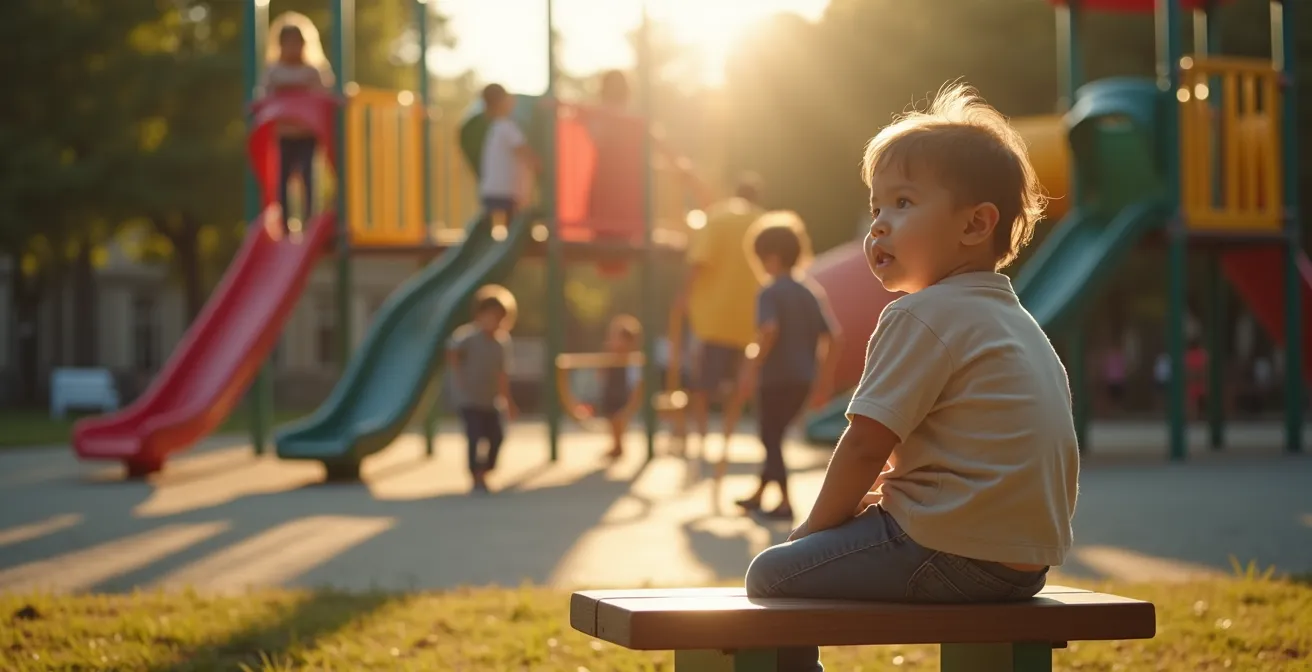
Instead of pushing, act as a safe bridge to the group. The “Observer to Participant Scaffolding” model is highly effective. Sit with your child and “sportscast” the activity from a distance: “Look, they’re building a tower. It’s getting so tall! That girl just added a blue block.” This co-observation validates their approach and helps them decode the social cues without pressure. Research confirms that turn-taking requires trust, and children are often more willing to engage with a trusted adult as a buffer first. By acting as this bridge, you help them identify low-risk entry points for participation when they feel ready, reinforcing their autonomy and building their social toolkit.
The “You Can’t Play” Moment: How to Coach Your Child Through Rejection?
Hearing another child say “You can’t play with us” is like a gut punch for both child and parent. Our protective instinct is to either vilify the other child (“They’re being mean”) or dismiss our child’s pain (“Just find other friends”). Both responses are harmful. They either teach our child to blame others or to suppress their own valid feelings of hurt. This moment is a critical piece of the “conflict-as-curriculum”—a prime opportunity to build resilience and emotional literacy.
Your first job is not to fix the situation, but to provide pragmatic empathy. Get on your child’s level, make eye contact, and validate the emotion: “Wow. That must have really hurt your feelings.” Resisting the urge to immediately solve the problem creates a safe space for your child to feel their emotions without judgment. This act of co-regulation is the foundation upon which problem-solving can be built. Only after the feeling is acknowledged can you empower them by asking questions like, “What do you think you’d like to do now?” This transfers agency back to the child.
Comparing ineffective and effective responses highlights the shift from fixing to coaching. Dismissing feelings or forcing inclusion teaches dependency, while validating and empowering teaches self-advocacy and resilience.
| Harmful Responses | Helpful Responses |
|---|---|
| “Just find other friends” | “That must have really hurt your feelings” |
| “They’re being mean” | “What do you think you’d like to do now?” |
| “You don’t need them” | “Sometimes people need space, and that’s okay” |
| Forcing inclusion | “Let’s find something fun while they play” |
| Dismissing feelings | “It’s hard when friends say no” |
Your Action Plan: The AER Model for Handling Rejection
- Acknowledge: Get on your child’s level, make eye contact, and validate their feelings without judgment. Say, “I saw that. It’s so hard when friends say no.”
- Empower: After validating, ask open-ended questions to return a sense of control. “What would help you feel better right now?” or “What are our choices?”
- Redirect: Help them brainstorm alternative activities or find other playmates. The goal is to move from a feeling of powerlessness to one of possibility.
- Follow-up: Later, when emotions are calm, check in. “Remember at the park today? That was tough. What could we try next time that happens?”
- Practice: Use dolls or stuffed animals to role-play rejection scenarios during calm moments. This builds the muscle memory for a resilient response.
Bossy vs. Leader: How to Guide a Dominant Child Respectfully?
If your child is the one dictating the rules, assigning roles, and directing all the play, you might worry they’re being “bossy.” But it’s more productive to reframe this behavior as emerging leadership skills that simply lack refinement. These children often have a strong vision and high energy, which are valuable traits. The challenge is to channel that directive energy into collaborative leadership, rather than squashing it. Telling them to “stop being so bossy” is an attack on their personality; coaching them on *how* to include others is a lesson in skill-building.
One of the most effective ways to teach this is through structured, cooperative activities where success depends on group effort. For example, research shows that tabletop role-playing games can be a powerful tool. In these games, a child with strong ideas learns that they must persuade and collaborate with their teammates to succeed, transforming their directives into questions and suggestions. This shift from giving commands to building consensus is the hallmark of a true leader.

The key is to focus on the “how” not just the “what.” It’s not just about distributing toys, but how you do it. As a 2022 study in the journal *Cognition* found, children perceive distributors who take the time to count out items as fairer than those who don’t. This highlights a child’s innate sense of procedural justice. You can coach your dominant child on this by saying, “I love your idea for the game. How can we make sure everyone has an important job?” or “That’s a great plan. Let’s ask Liam what he thinks about that idea.” This teaches them to consider others’ perspectives, turning a potential social liability into a genuine strength.
Scripting Social Starts: How to Help an Autistic Child Say Hello?
For a neurodivergent child, especially an autistic child, the seemingly simple act of initiating play can be a monumental hurdle. The unwritten rules of social engagement are often confusing and overwhelming. Pushing them to “just go say hi” ignores the genuine processing and sensory challenges they may face. In fact, according to CDC data from 2022-2023, 11% of children ages 3-17 have diagnosed anxiety, a condition that frequently co-occurs with autism and can make social initiation even more daunting. The key is not to force neurotypical behavior but to provide a clear, predictable “menu” of options that honors their communication style.
This is where social scripting and visual supports become invaluable parts of their social toolkit. Instead of one “right” way to start an interaction, you can co-create a list of low-pressure entry points. This empowers the child with choice and reduces the cognitive load of having to invent a social strategy in the moment. The goal is connection, not conformity, and there are many paths to get there.
Work with your child to build their personal “Menu of Social Initiation Options.” This might include:
- Non-verbal options: A special wave, a pre-arranged high-five, or a fist bump can serve as a complete greeting.
- Object-based options: Offering a toy, holding up a cool rock, or simply showing something interesting can be an effective way to open a channel for interaction.
- Parallel play option: This is a powerful, low-demand strategy. A child can say, “I’m playing with cars here,” which is a statement, not a question, inviting others to watch or join without pressure.
- Visual cue option: Using picture cards that show “hello,” “my turn,” or “want to play?” can bridge the gap when verbal communication is difficult.
- Scripted verbal option: Practice one or two simple, pre-approved phrases like, “Hi, I like your truck,” or “Can I build with you?”
Optimizing Playdates: Cooperative Games vs. Parallel Play
The goal of a playdate isn’t always intense, interactive play. Especially for toddlers and younger children, simply playing *alongside* a peer, known as parallel play, is a crucial developmental stage. During parallel play, children are acutely aware of each other. They observe, mimic, and learn social cues from a safe distance. Forcing them into cooperative games before they are ready can lead to conflict over toys and territory. The best playdates are often those that provide space for both parallel and cooperative play to happen organically.

To set the stage for success, start with activities that support parallel play. Set out individual portions of playdough, separate bins of blocks, or art supplies for each child. This removes the immediate need to negotiate over resources. As they get comfortable, you can introduce an element of cooperation. A study on social skills found significant improvements in cooperation when children engaged in asymmetrical cooperative play. This is where children contribute different skills to a shared goal. For example, one child can build a castle with blocks while the other draws the flag to go on top. Both are working on the “castle project” but using their own skills and materials.
Think of yourself as the environment designer. Your job is to create a “yes space” where conflict is minimized and connection is encouraged. This might mean having a quiet corner with books for a child who needs a break, as well as a more active area for building or imaginary play. By offering a variety of activity zones, you allow children to move between parallel and cooperative play based on their energy and comfort levels, building a more robust and flexible social toolkit.
The Participation Trophy Debate: Does It Help or Hurt Resilience?
The debate over participation trophies touches a nerve because it gets to the heart of how we teach children about success and failure. Critics argue they create a sense of entitlement and devalue real achievement. Proponents claim they encourage effort and keep kids engaged in activities. As with most parenting dilemmas, the answer is nuanced and highly dependent on the child’s developmental stage. A pragmatic approach avoids the all-or-nothing-argument and instead asks: “What is the goal of this award at this specific age?”
As child development experts point out, context is everything. For very young children (under 6), a participation trophy isn’t about achievement; it’s a concrete memento of a positive social experience. A toddler or preschooler can’t grasp the abstract concept of “winning a season,” but they can hold a small trophy and remember the fun they had with their friends. In this context, the award reinforces the joy of participation. However, as children get older and develop the capacity for self-assessment, the focus should shift to celebrating specific, individual effort and demonstrated improvement, rather than just showing up.
A more powerful tool for building resilience than any trophy is normalizing failure. One of the best ways to do this is to create a “Family Failure Resume.” This reframes mistakes from something to be ashamed of into something to be analyzed and learned from. The process is simple but profound:
- At a weekly family meeting, have each person share one “mistake of the week.”
- Parents must model this by sharing their own professional or personal failures.
- Celebrate the learning derived from the mistake: “What did we discover from this?”
- Use reframing language, replacing “I can’t” with “I haven’t yet,” and “failing” with “learning.”
Key Takeaways
- Your primary role is a coach, not a referee. Use conflicts as a curriculum to build your child’s “social toolkit.”
- Turn-taking is a concrete, teachable skill; “sharing” is an abstract concept that is often developmentally inappropriate for young children.
- Validate feelings first (empathy), then empower your child to find their own solutions (resilience).
How to Teach Collaboration to a Solo-Player Child Without Tears?
Some children are naturally drawn to solo play. They can spend hours building intricate worlds, drawing, or reading on their own. While this capacity for deep focus is a strength, they can struggle when required to collaborate in a group. Forcing them into chaotic, unstructured group play can feel overwhelming and lead to meltdowns. The key to teaching collaboration to a solo-player is to provide structure and clarity, respecting their need for defined roles and predictable outcomes.
Recent research offers a powerful clue: a 2024 study found that strong symbolic counting skills were the biggest predictor of fair sharing behavior. This suggests that children who are good at one-to-one correspondence and understanding discrete units are better equipped for the give-and-take of collaboration. For a solo-player, this translates to a need for clear tasks. When given specific, project-based roles like “Chief Engineer” of the block tower or “Quality Inspector” for the puzzle, they thrive. These role-based collaboration scenarios provide the framework they need to participate, leveraging their strength in focused tasks within a group context.
Another highly effective strategy is to create “shared enemy” cooperative scenarios. This reframes the dynamic from competing against each other to teaming up against an external challenge. The “enemy” can be the clock, the mess, or an imaginary problem. This turns collaboration into a game with a common goal.
- The Floor is Lava: Work together to move all the stuffed animals to the “safe” couch.
- Beat the Timer: Team up to complete a puzzle or clean up toys before an alarm sounds.
- Rescue Mission: Collaborate to “save” toys from an imaginary danger, like a dragon or a flood.
Ultimately, shifting your mindset from enforcing “sharing” to coaching “turn-taking” and other social skills is a game-changer. It transforms you from a stressed-out referee into an empowered coach, ready to turn every playground squabble into a powerful lesson in resilience, empathy, and true social competence. The next step is to start practicing these techniques in low-stakes situations at home.