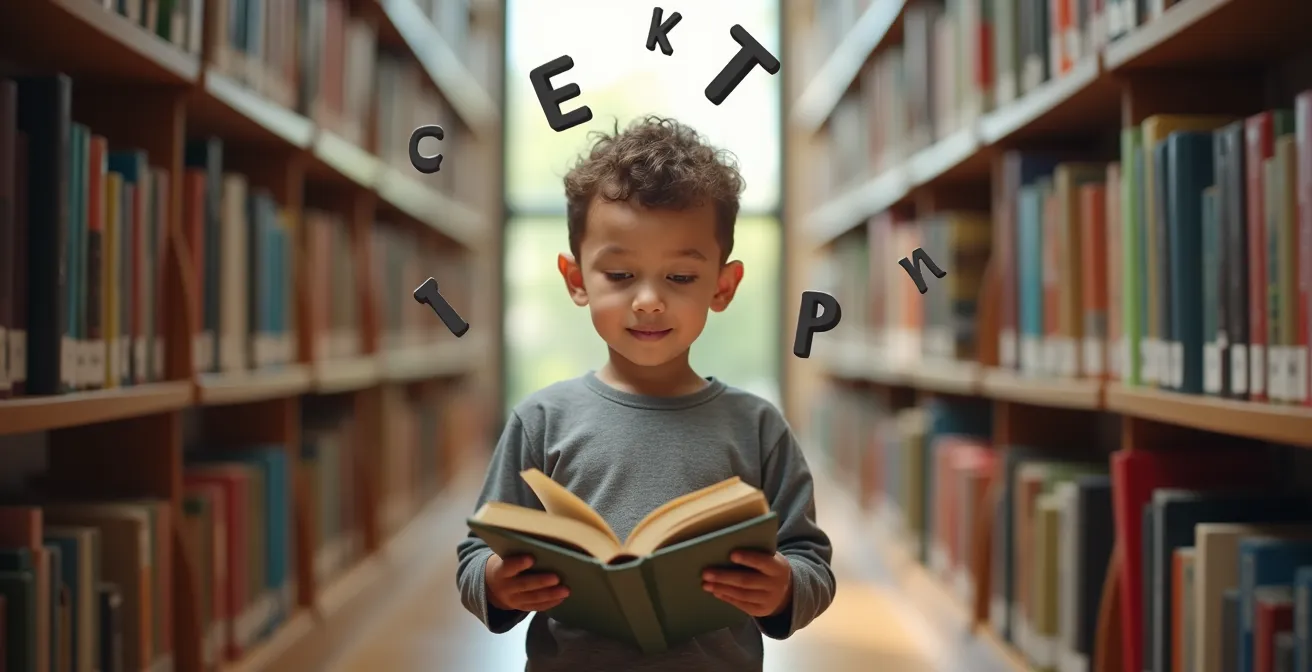
Contrary to popular belief, children do not learn to read by memorizing word shapes or guessing from pictures; they learn by building specific neural pathways that connect sounds to letters.
- The “three-cueing system” (guessing from context or pictures) trains the brain for weak reading habits and undermines the development of automatic word recognition.
- True reading fluency comes from orthographic mapping—a process where systematic phonics allows the brain to permanently store words for instant retrieval.
Recommendation: Shift your focus from “how many words does my child know?” to “can my child accurately decode words they have never seen before?” This is the true measure of a developing reader.
As a parent, you may have noticed a perplexing phenomenon. Your child can “read” their favorite book perfectly, pointing to each word with confidence. Yet, when presented with the same word on a flashcard or in a different book, they are completely stumped. Or perhaps they substitute “pony” for “horse” because of the picture on the page. This is a classic sign of a child who has memorized a book, not a child who is reading. They are using pictures and context as a crutch, a strategy often encouraged by well-meaning but outdated teaching methods.
These methods, often bundled under the umbrella of “Balanced Literacy,” promote the idea that children can use multiple cues—pictures (visual), sentence structure (syntax), and meaning (semantic)—to guess unfamiliar words. This approach fundamentally misunderstands the neuroscience of literacy. Reading is not a natural process like learning to speak. It is an acquired skill that requires explicit, systematic instruction to rewire the brain. The reliance on guessing actively damages a child’s ability to build the neural architecture required for fluent, independent reading.
This article will serve as a corrective, technical guide. We will dismantle the fallacy of guessing and demonstrate why systematic phonics is not just one method among many, but the foundational, evidence-based engine of literacy. We will explore the mechanical processes of how the brain learns to read, from the physical act of letter formation to the cognitive feat of blending sounds into words. By understanding the “why” behind the science of reading, you can become a more effective advocate for your child and guide them away from frustration and towards true reading mastery.
To navigate this essential topic, this article breaks down the core components of learning to read. We will address common symptoms of reading difficulty and provide a clear, evidence-based framework for understanding the mechanics of literacy.
Summary: Sight Words vs. Phonics: Why Guessing Based on Pictures Is Not Reading?
- b vs. d Confusion: When Is Letter Reversal a Red Flag for Dyslexia?
- Sandpaper and Shaving Cream: Why Touching Letters Helps the Brain?
- Why You Should Keep Reading to Your Child Even After They Can Read?
- Robot Talk: A No-Prep Game to Teach Blending Sounds?
- The “I Hate Reading” Phase: How to Overcome Phonics Frustration?
- Why Core Strength Affects Handwriting Legibility?
- Why Skipping Lines in Reading Is Actually a Coordination Issue?
- Hearing Before Seeing: Why You Can’t Read What You Can’t Hear?
b vs. d Confusion: When Is Letter Reversal a Red Flag for Dyslexia?
Letter reversals, particularly with ‘b’ and ‘d’, are a common source of anxiety for parents. It’s often one of the first “symptoms” they worry might indicate dyslexia. However, in the early stages of literacy (typically through age seven), these reversals are developmentally normal. A young brain is still learning that orientation matters for letters in a way it doesn’t for objects; a chair is a chair no matter which way it faces, but a ‘b’ flipped becomes a ‘d’. The brain needs time and practice to solidify these distinctions.
The issue becomes a potential red flag when it persists past the first or second grade, especially when coupled with other difficulties. These include trouble breaking words down into sounds (poor decoding), a history of speech and language delays, or difficulty remembering letter sounds. Dyslexia is a language-based learning disability; it is not, as commonly believed, a visual problem of seeing letters backward. As leading researcher Sally Shaywitz, MD, clarifies, this is a persistent myth.
one of the most enduring misconceptions is that dyslexic children see letters and words backwards and that reversals (writing letters and words backwards) are an invariable sign
– Sally Shaywitz, MD, Brainspring Store article on Letter Reversals and Dyslexia
Therefore, a child reversing ‘b’ and ‘d’ does not automatically signal dyslexia. It more often signals a need for more explicit, systematic, and multisensory instruction to help solidify the motor plan for forming each letter and connecting it to its unique sound. Consistent practice writing the letters while verbalizing the sound and formation steps (e.g., “b: bat then ball,” “d: donut then stick”) is far more effective than simply pointing out the error.
Sandpaper and Shaving Cream: Why Touching Letters Helps the Brain?
The use of tactile materials like sandpaper letters, shaving cream, or sand trays is a hallmark of many structured literacy programs. This “multisensory” approach is often presented as a uniquely powerful teaching method. The underlying principle is sound: engaging multiple senses can strengthen learning pathways. However, the efficacy is not in the material itself, but in how it forces focused attention and builds motor memory. When a child traces a letter ‘s’ in sand, their brain is simultaneously receiving visual, kinesthetic, and tactile feedback. This builds a robust mental and physical representation of the letter shape.
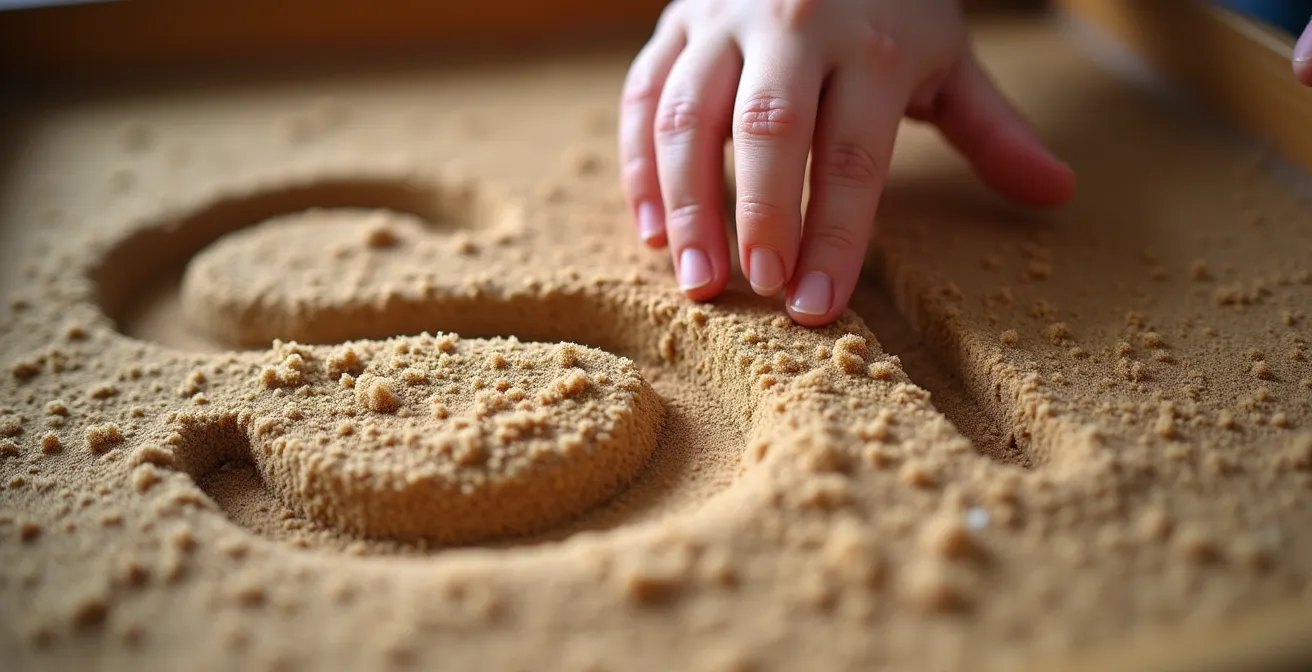
This process helps create a strong “motor plan” for letter formation, which is directly linked to automatic letter recognition. It slows the child down and forces them to attend to the specific path of the letter, from its starting point to its end. This is the opposite of a quick glance. Interestingly, while the practice is widely used, the “multisensory” label itself may not be the magic ingredient. A recent Education Week analysis reveals that interventions merely labeled ‘multisensory’ didn’t consistently produce better results than other structured programs. The key takeaway is that the benefit comes from the structured, repetitive, and focused nature of the activity, which helps to cement letter shapes and sounds in the brain.
So, while shaving cream can be a highly engaging tool, its true value lies in providing a medium for focused, repetitive practice that links the physical feeling of a letter’s shape to its visual form and its sound. It’s an effective technique for building the foundational automaticity needed for fluent reading.
Why You Should Keep Reading to Your Child Even After They Can Read?
Once a child begins to decode words independently, many parents reduce or stop reading aloud to them, assuming the job is done. This is a critical mistake. Reading to your child serves a completely different, yet equally important, function than their own reading practice. When your child is decoding, they are using significant cognitive load to sound out words. Their reading material is necessarily simpler, matched to their current phonetic knowledge. Reading aloud to them, however, allows you to expose their brain to something entirely different: complex language.
You can read books with sophisticated sentence structures (syntax) and advanced vocabulary (what educators call Tier 2 words) that are years beyond their independent reading level. This process fills their “auditory lexicon.” You are pre-loading their brain with the sounds and meanings of thousands of words they will eventually encounter in print. When they finally have the decoding skills to read the word “magnificent,” they will recognize it instantly because they’ve heard you say it. This bridges the gap between decoding and comprehension. The goal of reading, after all, is not just to say the words, but to understand them.
Skilled readers process known words faster than they can process a picture of the object the word represents. This is the result of orthographic mapping, where the brain has stored tens of thousands of words for instant retrieval. Reading aloud to your child builds the rich vocabulary database that makes this mapping process possible. It exposes them to the joy and wonder of complex stories, keeping their motivation high while their own decoding skills are still developing.
Action Plan: Supporting Phonics Learners with Read-Alouds
- Select books with sophisticated syntax and Tier 2 vocabulary above the child’s current decoding level.
- Pre-load their ‘auditory lexicon’ with complex words they will eventually learn to decode.
- Use separate, decodable texts containing targeted high-frequency words for their independent practice.
- Encourage the application of phonics knowledge when they encounter new words during their own reading.
- Maintain a balance between exposure to challenging vocabulary via read-alouds and practice with decodable materials.
Robot Talk: A No-Prep Game to Teach Blending Sounds?
“Robot talk” is a simple, effective, and fun way to practice a critical pre-reading skill: phoneme blending. When you say a word in a slow, segmented, robotic voice—”c-a-t”—and your child can blend those sounds together to say “cat,” they are demonstrating a foundational level of phonemic awareness. This ability to manipulate the individual sounds in spoken words is not just a party trick; University of Iowa research confirms that phonemic awareness is critical for word reading and highly predictive of a child’s later reading and spelling ability.
This skill is purely auditory. It happens in the dark, with eyes closed. It is the necessary precursor to phonics. Phonics is the system that maps those sounds (phonemes) onto written letters (graphemes). A child who cannot hear the three distinct sounds in “cat” will have an incredibly difficult time understanding why the letters c-a-t represent that word. Robot talk directly trains this blending skill.
However, it is crucial to understand that phonemic awareness activities in isolation have a ceiling of effectiveness. While games like robot talk are an excellent starting point, the ultimate goal is to connect those sounds to print. Research is increasingly clear that phonemic awareness instruction is most powerful when it is integrated with letters. Instead of just saying “sh-o-p,” you should be showing your child the letters s-h-o-p as you make the sounds. This integration helps the child understand the alphabetic principle—the idea that letters represent sounds in a systematic way. This is where the auditory skill becomes a reading skill. Activities that involve moving letter tiles to build words are a perfect next step after mastering auditory-only games like robot talk.
The “I Hate Reading” Phase: How to Overcome Phonics Frustration?
When a parent hears their child say “I hate reading,” it’s heartbreaking. This statement is rarely about the act of reading itself; it’s almost always a cry of frustration stemming from a mismatch between the child’s ability and the demands of the task. Very often, this phase is the direct result of being taught to read using guessing strategies. A child who is told to look at the picture, check the first letter, and “think what word would make sense” is being asked to perform a complex, unreliable sleight of hand, not to read.
This approach overloads their working memory and leads to frequent errors, which in turn causes frustration and erodes confidence. In a poignant reflection, teacher Margaret Goldberg described the consequences of her old teaching methods:
I did lasting damage to these kids. It was so hard to ever get them to stop looking at a picture to guess what a word would be. It was so hard to ever get them to slow down and sound a word out because they had had this experience of knowing that you predict what you read before you read it
– Margaret Goldberg, APM Reports – How a flawed idea is teaching millions of kids to be poor readers
The antidote to this frustration is empowerment through systematic instruction. When a child is taught phonics systematically, they are given a reliable code. They learn that print is not a mystery to be solved with guesswork, but a code to be cracked. This builds confidence and agency. Research consistently shows that this approach is most effective when started early; the 2025 National Reading Panel update shows the effect size of systematic phonics is nearly double in kindergarten (d = 0.55) compared to its impact after first grade (d = 0.27). Overcoming the “I hate reading” phase means replacing guessing with decoding, and frustration with the satisfaction of a code successfully cracked.

Why Core Strength Affects Handwriting Legibility?
It may seem disconnected, but a child’s ability to sit upright and stable in their chair is directly linked to their ability to form letters on a page. The principle at play is proximal stability for distal mobility. This means that stability in the core of the body (the trunk, shoulders, and hips) is required for controlled, precise movements in the extremities (the hands and fingers). A child with a weak core has to expend significant mental and physical energy just to keep their body from slumping over the desk.
This postural struggle creates a high cognitive load. The brain is so occupied with the gross motor task of staying upright that it has fewer resources available for the fine motor task of handwriting. The result is often messy, inconsistent letter formation, poor spacing, and a “hooked” or inefficient pencil grasp as the child tries to stabilize their hand against the paper. They may also fatigue very quickly, leading to frustration and avoidance of writing tasks.
Improving core strength through activities like animal walks (bear crawls, crab walks), playing on swings, or climbing at the playground can have a surprisingly direct impact on handwriting. When the trunk is stable, the shoulder can provide a solid base for the arm, the arm for the wrist, and the wrist for the fingers. This frees up the brain to focus on the complex cognitive and motor sequencing of forming letters, retrieving them from memory, and arranging them to spell words. In short, legible handwriting doesn’t start in the hand; it starts in the core.
Why Skipping Lines in Reading Is Actually a Coordination Issue?
When a child frequently loses their place, skips lines, or re-reads the same line, parents often assume it’s a problem of inattention. While that can be a factor, it is more often a symptom of poor visual tracking, a habit that can be inadvertently trained by improper reading instruction. The act of reading requires the eyes to move in a series of smooth, controlled, left-to-right sweeps, jumping from word to word (saccades) and then returning to the start of the next line. Systematic phonics instruction inherently trains this process.
Because phonics requires a child to look at letters sequentially to decode a word, it reinforces the necessary left-to-right eye movement. In contrast, instruction that encourages guessing from pictures or word shape has the opposite effect. It encourages the eyes to jump around the page, looking for clues. The eyes might dart from the text to the picture and back again, disrupting the smooth sweep needed for tracking. This can create a habit of erratic eye movements, making it difficult to maintain one’s place on a page of dense text.
The following table, based on principles of visual processing in reading, illustrates how different approaches impact the development of eye movement patterns. It highlights how sequential scanning is a learned skill reinforced by phonics, as also suggested by an analysis of multisensory impacts on reading habits.
| Approach | Eye Movement Pattern | Impact on Line Tracking |
|---|---|---|
| Systematic Phonics | Sequential left-to-right scanning | Builds consistent tracking habits |
| Sight Word/Guessing | Whole-word shape recognition | May reinforce skipping patterns |
| Picture Cues | Visual scanning of images | Diverts attention from text line |
Using a simple tool like a reading ruler or even a blank index card to isolate one line of text at a time can be a powerful intervention. It reduces the visual clutter and provides an external support for the eyes, allowing the brain to focus its full resources on the task of decoding rather than the task of “keeping my place.” It helps retrain the eyes to move in the coordinated, systematic way that fluent reading requires.
Key Takeaways
- Reading is a skill built through systematic instruction, not a natural ability acquired through exposure or memorization.
- Guessing from pictures or context (the three-cueing system) actively trains poor reading habits and undermines the brain’s ability to achieve automatic word recognition.
- Phonological awareness (the ability to hear and manipulate sounds) is the critical auditory foundation upon which all phonics instruction is built.
Hearing Before Seeing: Why You Can’t Read What You Can’t Hear?
The most fundamental principle of the science of reading is this: a child cannot read a word they cannot first process auditorily. The entire alphabetic system is based on the concept that written symbols (graphemes) represent spoken sounds (phonemes). If a child’s brain cannot isolate the three sounds in the spoken word “ship”—/sh/, /i/, /p/—then the printed letters s-h-i-p will be meaningless squiggles. This foundational skill is called phonological awareness.
Instruction must begin here, in the world of sound. Activities like clapping syllables, identifying rhyming words, and, most importantly, segmenting and blending phonemes are not just fun games; they are essential neurological training. However, this auditory-only instruction has its limits. A 2024 Texas A&M meta-analysis found that struggling readers stopped benefiting from purely auditory phonemic awareness instruction after about 10 hours. Progress reignited only when letters were added to the instruction.
This finding is critical. The goal is not just to be good at manipulating sounds; the goal is to read. Therefore, as soon as a child can orally blend and segment simple words, that skill must be immediately tethered to print. The auditory processing part of the brain must be connected to the visual processing part. As reading researcher Tiffany Peltier puts it, the distinction between the activity and the goal is paramount.
If you teach phonemic awareness, students will learn phonemic awareness, which isn’t the goal. If you teach blending and segmenting using letters, students are learning to read and spell
– Tiffany Peltier, FutureEd – New Reading Research Shows the Power of Connecting Letters and Sounds
This is the essence of orthographic mapping. It is the process of the brain linking the sound sequence of a word to its letter sequence, creating a permanent, instantly retrievable mental file. This cannot happen without a strong foundation in hearing the sounds first.
Frequently Asked Questions on Sight Words vs. Phonics: Why Guessing Based on Pictures Is Not Reading?
Is line skipping always a sign of visual tracking problems?
Not necessarily. While poor visual tracking can cause line skipping, it may also be a coping mechanism for children struggling with phonetic decoding who resort to guessing strategies.
How do reading rulers help with phonics instruction?
Reading rulers isolate single lines of text, reducing the cognitive burden of ‘keeping your place’ and allowing the brain to focus fully on the complex task of phonetic decoding.
When should parents be concerned about visual tracking issues?
If line skipping persists beyond early reading stages and is accompanied by letter reversals or difficulty with systematic decoding, it may indicate need for vision therapy or specialized reading support.