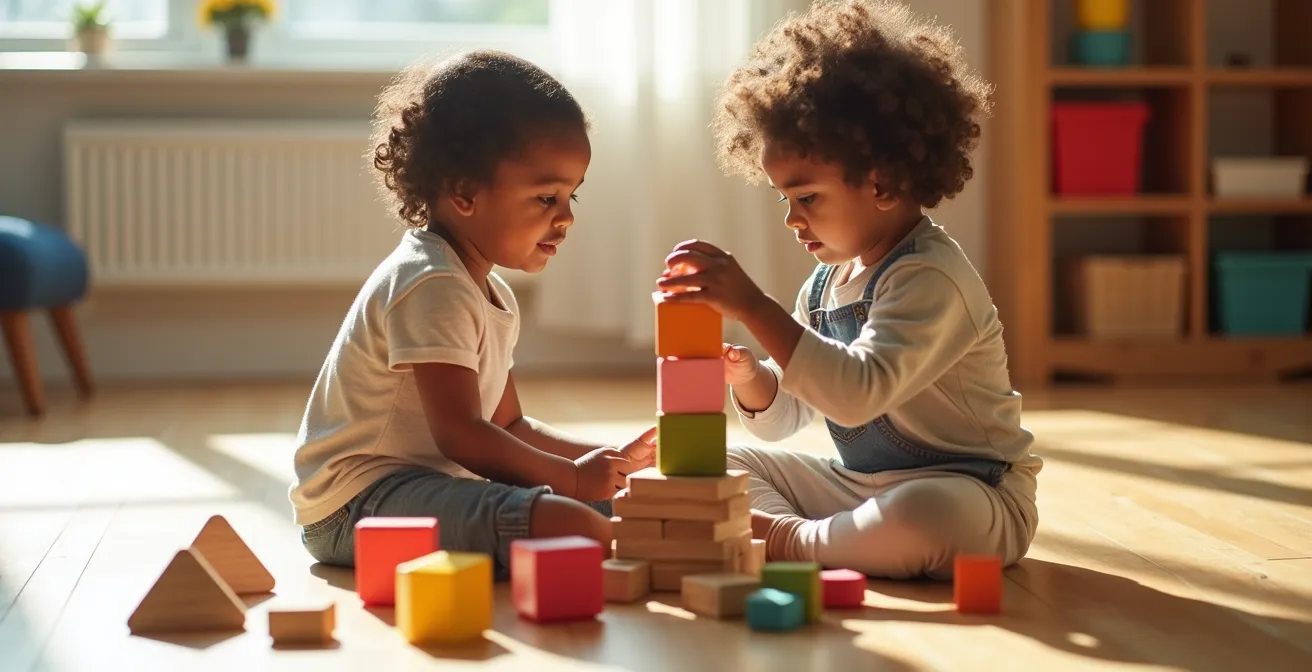
In summary:
- Spatial reasoning is a foundational skill for future math and science success, and it can be taught playfully through everyday activities.
- Focus on teaching the *strategy* behind an activity (like packing a bag or solving a puzzle), not just completing the task.
- Use specific spatial language (‘rotate’, ‘parallel’, ‘next to’) to make invisible mental processes visible to your child.
- Frame mistakes, like a falling tower, as exciting “physics discoveries” rather than failures to encourage resilience and curiosity.
- Systematic routines, like using a “launch pad” for school bags, build organizational skills and reinforce spatial memory.
As a parent, you’re constantly looking for ways to give your child an edge, especially when it comes to the building blocks of math and science. You’ve heard that spatial reasoning—the ability to think about objects in three dimensions and draw conclusions with limited information—is a superpower for future engineers, architects, and scientists. The default solution often seems to be educational apps and games, turning a tablet into a digital block set. But these often miss the most crucial element: the rich, tactile feedback of the real world.
While screen-based games have their place, they can’t replicate the feeling of a block’s weight, the friction of two puzzle pieces not quite fitting, or the real-world consequence of a poorly balanced tower. The common advice to “play with blocks” or “do puzzles” is a good start, but it’s like telling someone to “use a hammer” without explaining what a nail is. It misses the fundamental strategy, the “why” behind the “what.” This guide is different. It’s about turning your home into a vibrant, screen-free “spatial reasoning gym.”
What if the key wasn’t in the toys you buy, but in the thinking process you teach? We’re going to explore how to make the invisible mental strategies of spatial problem-solving—the very logic that makes a game like Tetris so compelling—visible and playful for your child. By reframing everyday chores and classic games as fun “spatial algorithms,” you can build their mental rotation and visualization skills organically. This article will show you how packing a suitcase, navigating a map, and even cleaning up can become powerful lessons in geometry and physics, setting a strong foundation for a lifetime of confident problem-solving.
In this guide, we’ll break down practical, playful strategies you can use immediately. We’ll explore everything from the surprisingly profound lessons of packing a bag to the engineering secrets hidden in a simple triangle, giving you the tools to become your child’s first and best math coach.
Summary: Tetris for Toddlers: How to Teach Spatial Reasoning Without Screens?
- Why Packing a Suitcase Predicts Future Engineering Success?
- How to Teach a 5-Year-Old to Navigate a Mall Map?
- Jigsaw Puzzles or 3D Models: Which Builds Better Mental Rotation?
- The Gender Gap: How to Prevent “I’m Bad at Geometry” in Girls?
- First the Corners: How to Teach Puzzle Strategy systematically?
- The “Launch Pad” System: Why Packing Bags at 8 PM Saves Your Morning?
- The Triangle Secret: Why Engineering Loves Pyramids?
- Towers That Fall: How to Teach Gravity and Balance to a 4-Year-Old?
Why Packing a Suitcase Predicts Future Engineering Success?
Packing a suitcase or even a simple lunchbox seems like a mundane chore. For a child, however, it’s a high-stakes game of real-world Tetris. This simple task is a masterclass in spatial optimization: the process of fitting a variety of objects with different properties (size, shape, weight, rigidity) into a container with maximum efficiency. It’s the same fundamental skill an engineer uses to pack components into a smartphone or a logistics expert uses to load a cargo plane. When you teach a child to pack, you’re not just teaching them a life skill; you’re teaching them a “spatial algorithm.”
The process forces them to engage in complex mental actions. They must visualize the empty space, mentally rotate objects to see how they might fit, and consider properties like weight (heavy shoes at the bottom). They learn about part-to-whole relationships, understanding that how they place one item directly affects the space available for all other items. This is not abstract; the feedback is immediate. If the toy car doesn’t fit, the lid won’t close. This kind of physical debugging—trying, failing, and trying again—builds problem-solving resilience far more effectively than a digital “try again” button.
By framing packing as a fun challenge or a puzzle, you transform it from a chore into a cognitive workout. You’re giving them a concrete, hands-on experience with the principles of volume, mass, and strategic planning. The child who learns to “debug” their overstuffed backpack today is practicing the same thought process they might one day use to design a more efficient system or solve a complex engineering problem.
How to Teach a 5-Year-Old to Navigate a Mall Map?
Handing a mall map to a five-year-old might seem premature, but it’s a perfect opportunity to teach one of the most critical spatial skills: translating a 2D representation into a 3D world. This is the magic of mapping, and it’s a skill that requires practice. The goal isn’t just to get from the entrance to the toy store; it’s to help your child build a mental model of their environment and then connect that model to a symbolic drawing. This develops the ability to see the world from a different perspective—a bird’s-eye view—which is fundamental to geometry and navigation.
A key strategy is to start small and build up. Before you even look at a formal map, you can create one together. A fantastic case study from the Education Development Center showed that preschoolers’ navigation skills improved significantly when they followed a structured curriculum. A key finding was that children who first built a 3D block model of their own room showed much better abilities when later asked to draw a 2D map of it. This 3D-to-2D priming exercise makes the abstract concept of a map concrete and personal.
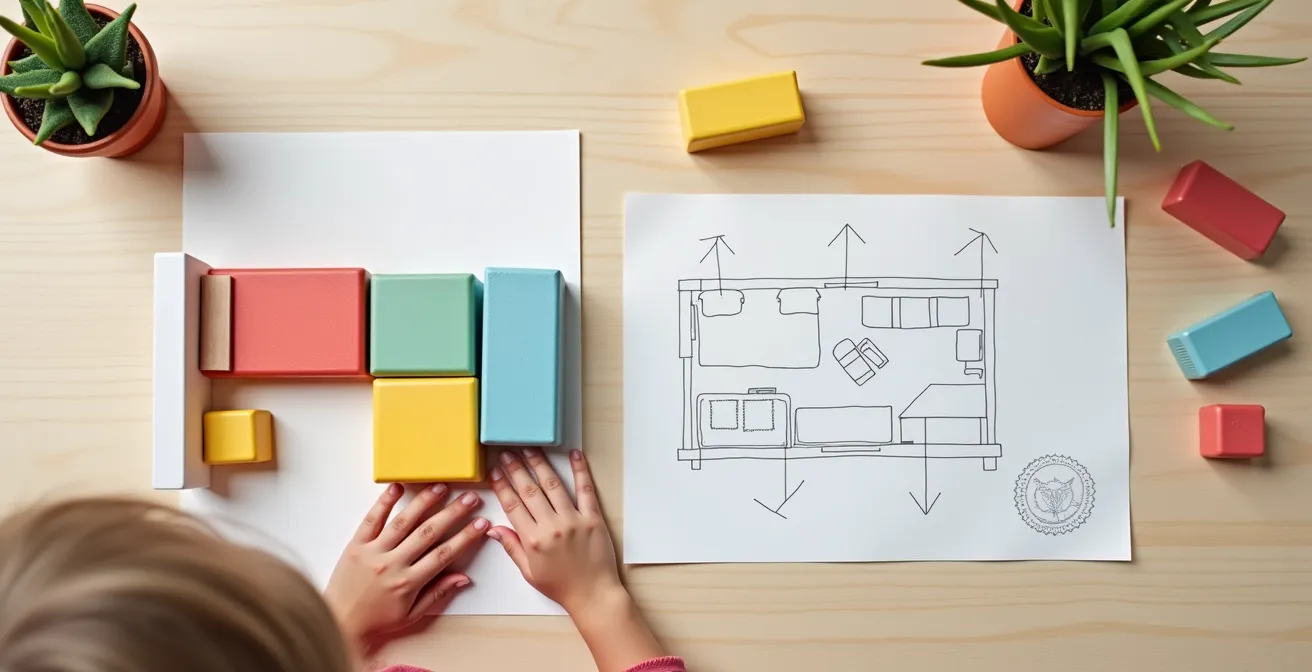
As the image above illustrates, this process of moving between a physical model and a drawn map is where the learning happens. At the mall, you can put this into practice. Start by orienting the map with your surroundings. “We are here, at this big red star. The fountain is in front of us. Can you find the fountain on the map?” By asking questions and having them point the way, you are making them the navigator. You are teaching them to use a tool to visualize space and plan a path, a skill essential for everything from reading blueprints to coding a robot.
Jigsaw Puzzles or 3D Models: Which Builds Better Mental Rotation?
In the world of spatial toys, jigsaw puzzles and 3D building blocks like LEGOs are titans. Both are fantastic for cognitive development, but they train slightly different aspects of spatial reasoning. Understanding their unique strengths allows you to use them more effectively. Jigsaw puzzles are the undisputed champions of 2D mental rotation and pattern recognition. A child learns to analyze a shape and its orientation, mentally flipping and turning it to see if it matches an empty space. This is a focused, single-plane challenge.
3D models, on the other hand, introduce a higher cognitive load by requiring 3D mental rotation and spatial assembly. When building with blocks, a child isn’t just matching a shape to a hole; they are constructing a stable structure in three-dimensional space. They must consider the object from multiple viewpoints simultaneously: front, back, top, and sides. This builds a more robust understanding of part-to-whole relationships in a 3D context.
So, which is better? The answer isn’t one or the other, but both, in sequence. Puzzles are a great starting point for younger toddlers, while 3D models offer a more complex challenge as they grow. The following table, based on insights from child development research, breaks it down:
| Aspect | Jigsaw Puzzles | 3D Models (Lego/Blocks) |
|---|---|---|
| Primary Skill | 2D rotation & pattern recognition | 3D rotation & spatial assembly |
| Cognitive Load | Lower – single plane focus | Higher – multiple perspectives |
| Age Recommendation | Start at 3-4 years | Introduce at 4-5 years |
| Parent Narration Impact | Critical for shape matching | Essential for part-whole understanding |
Ultimately, the most significant learning factor isn’t the toy itself, but your interaction with it. As cognitive scientist Dr. Nora Newcombe notes in a review on Parenting Science, the parent’s role is transformative:
The key cognitive leap happens when a parent verbalizes the action: ‘Let’s try rotating this piece,’ or ‘What if we flip it over?’ This makes the mental process explicit.
– Dr. Nora Newcombe, Parenting Science Research Review
By narrating the strategy, you are giving your child the vocabulary for their own internal monologue, turning a simple game into an explicit lesson in problem-solving.
The Gender Gap: How to Prevent “I’m Bad at Geometry” in Girls?
The phrase “I’m bad at math” is a tragically common refrain, and it often has roots in early childhood experiences with spatial tasks. Unfortunately, a persistent gender gap in spatial skills exists and, if left unaddressed, can have long-term consequences, discouraging girls from pursuing STEM fields. The key to closing this gap isn’t about biology; it’s about environment, language, and encouragement. Shockingly, research from Emory University reveals that the gender gap in mental rotation triples in size from elementary school to the end of adolescence. This indicates that the gap is largely a product of social and educational factors, which means we as parents have the power to change it.
One of the most powerful tools is language. Studies show that parents, often unconsciously, use more spatial words (like ‘tall,’ ‘curvy,’ ‘edge,’ ‘rotate’) when talking to boys. Making a conscious effort to provide equal spatial language exposure to all children is a critical first step. Use rich, descriptive words during play. Instead of “put that block there,” try “place the long, rectangular block parallel to the blue one.” This gives girls the same rich vocabulary to build their internal spatial models.
Another crucial strategy is to shift how you offer praise. Praising innate talent (“You’re a natural builder!”) can be counterproductive, as it implies skills are fixed. If a child praised for being “naturally good” later struggles, they may conclude they’ve lost their “gift.” Instead, praise the strategy and the effort. Say, “That was clever how you used the corner piece to make the wall stronger,” or “I love how you kept trying different ways to make the tower balance.” This reinforces a growth mindset, teaching that skills are built through persistence and clever thinking, not innate talent. By creating a supportive environment that values strategy over “natural ability,” you can help prevent the “I’m bad at geometry” mindset before it ever takes root.
First the Corners: How to Teach Puzzle Strategy systematically?
Watching a toddler tackle a jigsaw puzzle can be a mix of heartwarming and frustrating. They often grab a piece and try to jam it into random spots. While this trial-and-error has some value, teaching a systematic approach—a “puzzle heuristic”—can dramatically accelerate their learning and build powerful problem-solving habits. The “corners first” rule is the most well-known, but it’s just the first step in a complete mental algorithm. By teaching this system, you’re not just helping them solve a puzzle; you’re giving them a transferable framework for breaking any large, complex problem down into smaller, manageable parts.
The process starts with sorting and classification, a foundational skill in all sciences. Instead of facing a chaotic pile of 100 pieces, they first create order. They build the frame, which provides structure and boundaries for the rest of the problem. Then, they move to clustering by color or pattern, another form of data organization. This transforms the task from a search for one specific piece out of many to a much simpler search within a small, pre-sorted group. It teaches efficiency and strategic thinking.
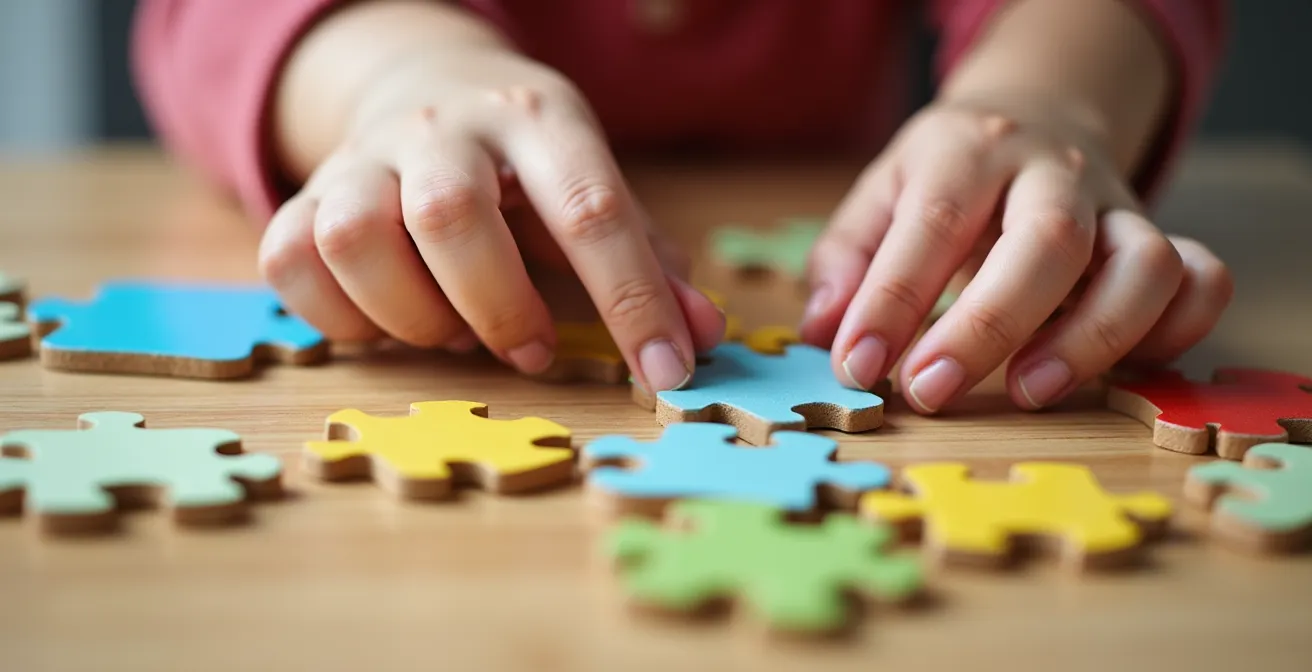
One of the most advanced, yet teachable, strategies is focusing on negative space. Instead of just looking at the piece in their hand, encourage them to look at the exact shape of the hole they need to fill. As the image shows, tracing that empty space with a finger makes the abstract target concrete. This mental flip—from focusing on the object to focusing on the void—is a sophisticated cognitive leap that is highly valuable in art, design, and science.
Your Action Plan: The 5-Stage Puzzle Heuristic
- Framing: Start by finding all the edge pieces. Coach your child to look for the “one flat side” characteristic. Once collected, identify the four corner pieces (two flat sides) and use them to build the puzzle’s border.
- Clustering: With the frame complete, work together to sort the remaining pieces into smaller piles based on dominant color or distinct patterns. “Let’s make a pile for all the blue sky pieces and another for the red barn pieces.”
- Shape-Matching: Pick a piece from a cluster and analyze its “tabs” (the parts that stick out) and “blanks” (the indented parts). Verbalize the process: “This piece needs a home with one tab on the left and a blank on the top.”
- Negative Space Thinking: Point to an empty spot within the frame. Ask, “What shape is this hole? Let’s find a piece that looks just like that empty spot.” Have them trace the hole with their finger.
- Scan and Isolate: Before rummaging through a pile, help them define what they’re looking for. “We need a red piece with a pointy tab on the side.” This teaches them to form a mental image first, then search.
The ‘Launch Pad’ System: Why Packing Bags at 8 PM Saves Your Morning?
The frantic morning scramble for a missing shoe, a library book, or a backpack is a universal parenting headache. The “Launch Pad” system is a simple yet profoundly effective spatial solution to this daily chaos. It’s a designated spot near your main exit where everything needed for the next day—backpacks, shoes, coats, lunchboxes—is gathered the night before. This isn’t just about being organized; it’s about creating an external memory system that reduces cognitive load for the entire family, especially for young children.
Kids aren’t great at holding abstract lists in their heads. But they are fantastic at understanding spatial relationships. The Launch Pad outsources the “remembering” to the environment itself. The child doesn’t need to recall where their backpack is; it’s always in the same physical location. This consistency creates a powerful spatial anchor. Research on morning routines is clear on the benefits. A study highlighted by the NAEYC found that implementing a designated launch pad space reduced morning preparation time by 40% in families with young children. The system works because it’s visual, physical, and predictable.
To make it even more effective for pre-readers, create a visual checklist with pictures instead of words. A simple drawing of a backpack, a lunchbox, and a water bottle empowers them to take ownership of the process. You can even make them the “Launch Pad Manager,” responsible for checking that everything is in its place before bed. This not only saves your sanity in the morning but also teaches responsibility, sequencing, and the powerful concept that organizing physical space can make life run more smoothly. It’s a daily, practical lesson in systems thinking.
The Triangle Secret: Why Engineering Loves Pyramids?
Why are so many strong things—bridges, construction cranes, bicycle frames—made of triangles? This isn’t an accident; it’s a fundamental secret of engineering. Introducing your child to the “magic” of the triangle is a fantastic way to teach core principles of physics and geometry with simple building blocks. When you push on the corner of a square made of sticks, it easily squishes into a diamond shape (a parallelogram). It deforms because the angles can change without the sides breaking.
A triangle, however, is a rigid shape. Once its three sides are connected, its angles are fixed. It cannot change its shape unless one of its sides is bent or broken. This property, called structural rigidity, means that when you apply force to a triangle, that force is distributed down its sides to its base. This makes it incredibly strong and stable. A pyramid is simply a collection of triangles, making it one of the most stable structures humans can build. This is why a wide, triangular base is essential for a tall, stable block tower.
You can demonstrate this concept easily without any toys at all. Ask your child to stand with their feet together and give them a gentle push on the shoulder; they’ll wobble. Then, ask them to stand with their feet apart, creating a wide triangular base with the floor. When you push them now, they are far more stable. They are physically experiencing the strength of the triangle. Once they understand this principle, they will start seeing it everywhere: in roof structures, playground equipment, and even in a slice of pizza. It’s a simple, powerful piece of “secret knowledge” that connects their block play directly to the real world of engineering.
Key Takeaways
- Everyday tasks like packing and tidying are powerful opportunities to teach spatial optimization and strategic thinking.
- The parent’s role is to verbalize the mental strategy behind a task, using specific spatial language to make the thought process explicit.
- “Failures” like a falling tower are the most valuable learning moments; frame them as exciting scientific discoveries.
Towers That Fall: How to Teach Gravity and Balance to a 4-Year-Old?
CRASH! The magnificent tower your four-year-old spent ten minutes constructing comes tumbling down. The typical reaction is frustration, maybe even tears. But as a math educator, I see this as the single most important moment in the entire play session. A fallen tower isn’t a failure; it’s a successful experiment that has just produced a fascinating piece of data. This is where you teach the most valuable lesson of all: how to learn from mistakes. This is the heart of the scientific method and the essence of physical debugging.
Your job is to reframe the event immediately. Instead of “Oh no!” try an excited, curious “Interesting! What just happened?” As researcher Dr. Ashley Lewis Presser suggests, your language is key. In her work with the Education Development Center, she advises parents to treat it as a discovery:
When a tower falls, the parent’s job is to reframe it with curiosity, not disappointment: ‘Interesting! We just discovered a rule of physics. What did we learn?’
– Dr. Ashley Lewis Presser, Education Development Center Research
This simple shift in tone turns a moment of disappointment into a puzzle. Was the tower too tall and skinny? Was the base too narrow? Were the big blocks on top instead of the bottom? By asking these questions, you are guiding your child through a root cause analysis. You can even test one variable at a time. “What if we build the exact same tower, but this time on the hard floor instead of the carpet?” This teaches them to isolate variables, form a hypothesis, and test it—the core loop of all scientific and engineering progress.
You can even use their own body as a model. Ask them to lean forward slowly. At what point do they have to put a foot out to stop from falling? That point is their center of gravity moving outside their base of support. A falling tower does the exact same thing. By celebrating the crash and investigating the “why,” you are teaching resilience, critical thinking, and the fundamental laws of gravity and balance in the most joyful and memorable way possible.
Start today by viewing your home through this new lens. See the laundry basket not as a chore, but as a lesson in volume, and the grocery bags as a puzzle in weight distribution. By playfully narrating these “spatial algorithms,” you can transform everyday moments into the powerful, screen-free foundation of your child’s future math success.