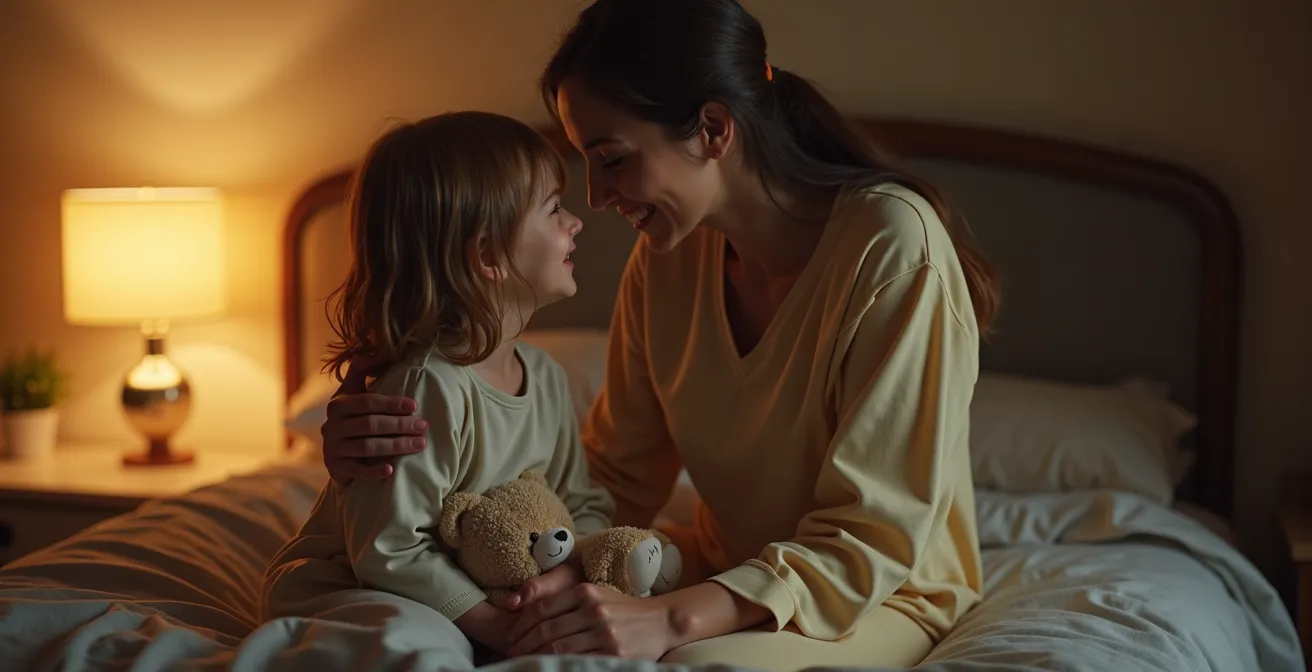
The key to ending bedtime battles isn’t enforcing sleep, but methodically guiding your child’s body and mind through a physiological “off-ramp” from activity to rest.
- A specific drop in core body temperature, triggered by a warm bath followed by a cool room, is a powerful biological sleep signal.
- Gradually dimming lights 90 minutes before bed allows for natural melatonin production, the hormone that governs sleepiness.
- Switching from interactive screens to passive audiobooks helps the brain downshift from active engagement to a state conducive to sleep.
Recommendation: Instead of viewing the hour before bed as a chore, see it as a strategic sequence of sensory cues designed to make sleep the natural, inevitable conclusion to the day.
It’s a scene familiar to countless parents: the clock strikes bedtime, and suddenly a child who was drooping with fatigue minutes ago is now a bundle of frenetic energy, bouncing off the furniture. These “bedtime zoomies” are not a sign of defiance, but often a symptom of being overtired and lacking a clear bridge from the high stimulation of the day to the quiet calm of night. For parents of energetic or hyperactive children, this nightly struggle can feel overwhelming, especially when common advice like “just have a routine” proves insufficient. In fact, some research indicates that up to 30% of toddlers have trouble sleeping, a problem that can persist without the right approach.
The solution is not to fight this energy, but to skillfully channel it down a “sensory off-ramp.” This involves moving beyond a simple checklist of tasks and understanding the powerful physiological triggers that govern sleep. The key is to create a 60-minute wind-down period that systematically reduces stimulation and signals to your child’s body and brain that sleep is approaching. This article will deconstruct that hour, providing a calm, methodical guide to each step. We will explore how temperature, light, sound, and boundaries work together not to force sleep, but to make it the most logical and welcome next step for a busy little body.
This guide breaks down the essential components of an effective wind-down routine. By understanding the science behind each step, you can create a predictable and calming pre-sleep ritual that works with your child’s biology, not against it.
Summary: The 60-Minute Wind-Down: How to Stop the “Zoomies” Before Bed?
- Warm Bath, Cool Room: Why This Temp Drop Triggers Sleepiness?
- The “Storyteller Voice”: How to Read Aloud to Induce Drowsiness?
- Dimming the House: At What Hour Should Overhead Lights Go Off?
- The “One More Water” Game: How to Set Boundaries on Bedtime Requests?
- Audiobooks vs. Tablets: Which Device Actually Helps Kids Fall Asleep?
- Travel Sleep Rules: Strict Routine or Flexible Flow for Vacation Sanity?
- Blackout Curtains: Are They Necessary for Nap Time in Summer?
- Mouth Breathing vs. Nose Breathing: Which One Ruins Sleep Quality?
Warm Bath, Cool Room: Why This Temp Drop Triggers Sleepiness?
One of the most powerful and misunderstood tools in the parental sleep arsenal is the bath. It’s often seen as a simple cleaning ritual, but its true power lies in its ability to manipulate core body temperature—a primary regulator of the circadian rhythm. Sleep initiation is closely associated with a drop in core body temperature. A warm bath (around 98-104°F or 36-40°C) an hour or so before bed doesn’t make a child sleepy because it’s warm; it works because of what happens *after*. The warm water draws blood to the surface of the skin (vasodilation), and when the child gets out into a cooler room, that heat rapidly dissipates, causing a drop in their core body temperature. This drop mimics the natural temperature decline that occurs before sleep, sending a potent “time for bed” signal to the brain.
To maximize this effect, the timing and environment are crucial. The process isn’t instantaneous; research shows that peripheral vasodilation starts approximately 100 minutes before the body’s ideal sleep onset. Therefore, starting the bath about 60-90 minutes before the desired bedtime is ideal. The post-bath environment is just as important. The bedroom should be cool, ideally between 65-70°F (18-21°C). This temperature difference enhances the speed of the cool-down, strengthening the sleep-inducing signal. Think of it not just as a bath, but as the deliberate creation of a thermal cascade that guides your child’s biology towards rest.
For a more structured approach, consider the following protocol:
- Run bath water to a warm, not hot, temperature of 98-104°F (36-40°C).
- Keep the bath time relatively short, around 10-15 minutes, to avoid it becoming a stimulating playtime.
- While the child is in the bath, ensure the bedroom is pre-cooled to the target temperature.
- After the bath, pat them dry gently and dress them in light, breathable cotton pajamas to allow for continued heat dissipation.
The “Storyteller Voice”: How to Read Aloud to Induce Drowsiness?
Reading a bedtime story is a classic part of the routine, but its effectiveness in inducing drowsiness has less to do with the plot and more to do with the delivery. A “storyteller voice” is a specific technique that uses vocal cadence to down-regulate a child’s active, chattering nervous system. For a child who is hyperactive or “bouncing off the walls,” your calm, rhythmic voice acts as an external regulator, a process known as co-regulation. Their system unconsciously mirrors your calm, helping them transition from a state of high alert to one of rest.
To achieve this, shift from an expressive, character-filled “daytime” reading voice to a hypnotic, monotonous “nighttime” voice. This involves three key changes:
- Pace: Slow down significantly. Pause longer at commas and even longer at periods. The goal is to create a slow, predictable rhythm.
- Pitch: Lower the pitch of your voice slightly. Deeper tones are generally perceived as more calming and less stimulating than higher, more excited pitches.
- Volume: Gradually decrease your volume as the story progresses. By the final pages, you should be speaking in a near-whisper, forcing the child to quiet their own body and mind to hear you.
This technique transforms storytime from an entertainment activity into a guided meditation. It removes the cognitive load of following a complex plot and instead provides a soothing, repetitive auditory input that lowers heart rate and encourages the mind to drift.

The book itself becomes secondary to the sound of your voice. Choose familiar, simple stories that don’t have major cliffhangers or exciting plot twists. The goal isn’t to find out what happens next, but to be lulled by the rhythmic predictability of your narration. This vocal technique is a powerful, non-verbal way of communicating to your child’s nervous system that the world is slowing down, it is safe, and it is time for sleep.
Dimming the House: At What Hour Should Overhead Lights Go Off?
Light is the most powerful environmental cue for regulating our internal body clock, or circadian rhythm. Bright, overhead light, particularly in the blue spectrum, signals to the brain that it’s daytime and suppresses the production of melatonin, the hormone that makes us feel sleepy. For a sensitive child, walking from a brightly lit living room into a dark bedroom is a jarring transition that the brain can’t process instantly. The wind-down requires a gradual “sunset” inside the home to allow melatonin to rise naturally.
As a general rule, all bright overhead lights should be turned off approximately 90 minutes before the desired bedtime. This is the point where the “sensory off-ramp” truly begins. The home should be lit only by low-wattage, warm-toned lamps, ideally placed below eye level. This change in lighting signals a phase shift in the day’s activities. This isn’t just about the bedroom; it’s about transforming the entire living space into a calm-down zone. Dimming the house is a non-negotiable step because it addresses the very root of sleep signaling at a hormonal level. As sleep psychologist Dr. Jessee Dietch notes, this gradual approach is essential.
Our brains and bodies aren’t a lightswitch. You can’t just go from being up and alert and active all day to asleep immediately.
– Dr. Jessee Dietch, Behavioral sleep psychologist, Oregon State University
This quote perfectly captures the essence of the wind-down. According to experts, you should gradually lower lighting for 90 minutes as this signals the body to produce melatonin. This transition period allows the brain to register the changing conditions and begin the biological processes for sleep. It replaces the abrupt “lights out” battle with a gentle, cooperative descent into darkness, making the final step into a dark bedroom feel like a natural conclusion rather than a sudden confinement.
The “One More Water” Game: How to Set Boundaries on Bedtime Requests?
The endless requests for one more drink, another story, or a trip to the bathroom after lights out are a classic bedtime stalling tactic. While frustrating, this “game” is often not about defiance but about anxiety or a need for control in the face of separation. A high-energy child’s mind can race in the quiet darkness, and these requests are a way to prolong connection with a parent. The most effective way to counter this is not with stricter punishments, but with proactive and predictable boundaries set *before* the child is in bed.
The best tool for this is a visual checklist. Before the wind-down begins, create a simple chart with pictures or icons for each step of the routine: bath, pajamas, brushing teeth, last drink of water, one story, final hug and kiss. As each task is completed, let the child physically check it off or move a magnet. This method has several benefits. It externalizes the routine, making the “checklist” the authority figure instead of you. It provides a clear, visual representation of what’s coming, which reduces anxiety for kids who thrive on predictability. Most importantly, it clearly defines the end.
Once the last item is checked off, the routine is officially over. When the child then asks for “one more thing,” you can calmly refer them back to the chart: “I see that we already had our last drink of water, it’s checked off on our list. Now it’s quiet time.” This approach removes the emotion and negotiation from the interaction. You are no longer saying “no”; you are simply upholding the agreement you both walked through. It empowers the child by giving them a role in the process while simultaneously creating a firm, predictable boundary that fosters a sense of security, allowing their mind to finally rest.
Audiobooks vs. Tablets: Which Device Actually Helps Kids Fall Asleep?
In the digital age, it’s tempting to use a device as part of the wind-down. However, not all screens are created equal, and the distinction between them is critical for sleep quality. The core issue is the difference between active engagement and passive listening. Tablets, with their interactive games, bright colors, and touch-based controls, demand a high level of cognitive engagement. They require the brain to make choices, solve problems, and process rapid visual stimuli, all of which are antithetical to a sleepy state. Furthermore, the blue light emitted from these screens is a well-documented inhibitor of melatonin production.
The table below clearly outlines why a dedicated audio player is a far superior choice for a wind-down routine.
| Feature | Audiobooks/Audio Players | Tablets |
|---|---|---|
| Blue Light Exposure | None | High – disrupts melatonin |
| Brain Activity | Passive listening | Active engagement |
| Sleep Latency | Shorter | Longer |
| Recommended Devices | Toniebox, Yoto Player | Not recommended |
| Auto-shutoff | Yes – sleep timer | Requires manual setting |
Audiobooks, delivered via a simple, screen-free audio player, promote a state of passive listening. Like the “storyteller voice,” they provide a gentle, rhythmic auditory input without requiring any interaction from the child. The brain can relax and follow the narrative without being stimulated into an active state. Devices like a Toniebox or Yoto Player are designed specifically for this purpose: they are tactile and child-friendly but lack the stimulating screens and open internet access of a tablet. They also typically feature sleep timers, allowing the story to shut off automatically after the child has drifted off.
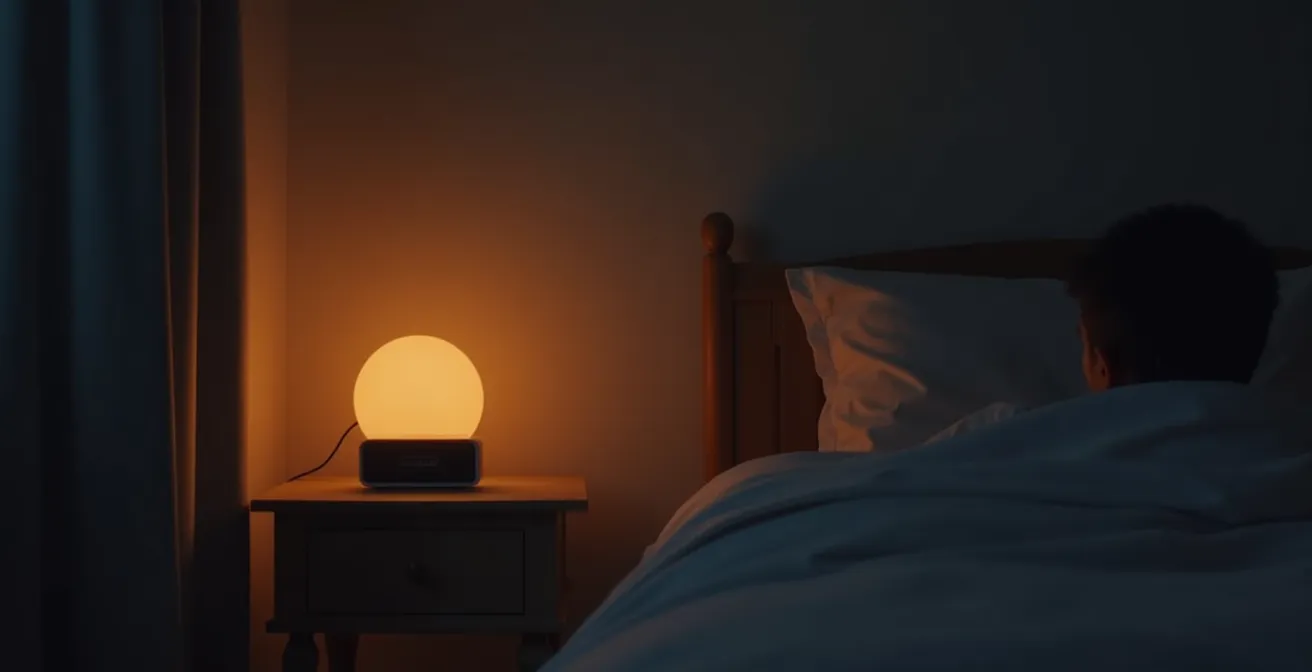
Choosing an audiobook over a tablet is a strategic decision to encourage a cognitive downshift. It honors the child’s desire for a story or distraction but delivers it in a format that guides their brain toward sleep rather than away from it. It’s a clear case where the medium is just as important as the message.
Travel Sleep Rules: Strict Routine or Flexible Flow for Vacation Sanity?
Vacation is a time for fun and breaking rules, but for a child who thrives on routine, it can be a recipe for sleep disaster. The temptation is to either abandon the routine entirely or try to replicate it with military precision, both of which often lead to stress. The most successful approach is a middle path: the 80/20 rule. This principle suggests that you aim to keep 80% of the core sleep cues consistent, while allowing 20% flexibility for the realities of travel. This provides enough familiarity to make the child feel secure, without making the parents feel like prisoners of the schedule.
The key is to identify your “portable sleep anchors”—the most powerful, transportable elements of your home routine. These are the sensory cues that most strongly signal “sleep” to your child. This might be the familiar scent of their sleep sack, the specific white noise sound they listen to, or the same two or three bedtime books. These anchors create a consistent “sleep bubble” no matter where you are. The 20% flexibility comes in with timing. While you should aim to keep bedtime within a 30-60 minute window of the usual time, the 80/20 rule allows for a later night for a special event without derailing everything.
The focus should be on recreating the *sequence* of events, even if the timing is slightly off. If your routine is bath-pajamas-book-bed, maintain that order religiously. This predictability is what tells their body and brain that, despite the new environment, the same rules of sleep apply. Upon arriving at your destination, setting up the sleep zone immediately with these anchors can make a huge difference for the first night.
Your Action Plan: Portable Sleep Anchors Checklist
- Pack child’s specific sleep sack or favorite blanket.
- Download the same white noise sounds used at home onto a phone or portable device.
- Bring a few familiar, lightweight bedtime books or have a lullaby playlist ready.
- Set up the designated sleep space with these familiar items immediately upon arrival.
- Aim to maintain bedtime within a consistent 30-minute window of the normal schedule.
Blackout Curtains: Are They Necessary for Nap Time in Summer?
For daytime naps, especially during the long, bright days of summer, creating a dark environment is crucial for signaling to the brain that it’s time to sleep. Light is a powerful stimulant, and a sun-drenched room can make it nearly impossible for a child to wind down. Blackout curtains are an extremely effective tool for this, as they can block up to 99% of incoming light, essentially tricking the brain into producing sleep-inducing melatonin, even in the middle of the afternoon.
However, is total darkness always the answer? For some children, especially those prone to night fears, a pitch-black room can be more frightening than comforting. In these cases, a very dim, warm-toned nightlight can provide a sense of security without significantly disrupting sleep. For long daytime naps, some experts also caution that complete darkness can confuse the circadian rhythm, potentially blurring the line between nap time and nighttime. The goal is a room that is “dark enough for sleep,” not a sensory deprivation chamber. For most children, making the room as dark as possible for a 1-2 hour nap is highly beneficial.
What if you’re traveling or don’t want to install permanent curtains? There are many excellent portable darkness solutions. Travel blackout blinds with suction cups can be attached to any window. Static-cling window films can be cut to size and easily applied and removed. For older children who are comfortable with it, a soft, child-friendly sleep mask can also be a great option. The key takeaway is that while the method can vary, the principle remains: reducing light exposure is one of the most direct ways to encourage daytime sleep when the sun is still out.
Key Takeaways
- The transition to sleep is a biological process, not a behavioral choice. A successful wind-down works with the body’s natural rhythms.
- The three primary physiological triggers you can control are temperature (a cool-down), light (a gradual dimming), and sound (a rhythmic, calming voice).
- Predictability is security. Visual checklists and consistent routines remove anxiety and the need for stalling tactics.
Mouth Breathing vs. Nose Breathing: Which One Ruins Sleep Quality?
While we focus on external factors like light and sound, one of the most overlooked saboteurs of sleep quality is happening right under (or in) the nose: the way a child breathes. Humans are designed to be nasal breathers, especially during sleep. Nose breathing filters, warms, and humidifies air, and it also promotes the production of nitric oxide, which improves oxygen circulation. Mouth breathing, on the other hand, is a sign of an obstruction and is associated with lower-quality, more fragmented sleep.
When a child breathes through their mouth at night, it can lead to snoring, a dry mouth, and an increased number of “micro-arousals” that disrupt the sleep cycle. The body has to work harder to get the same amount of oxygen, preventing the child from sinking into the deep, restorative stages of sleep. This can result in a child who seems to sleep for 8-10 hours but wakes up irritable, groggy, and as if they haven’t slept at all. Chronic mouth breathing can be caused by several issues, including enlarged tonsils or adenoids, allergies causing nasal congestion, or a deviated septum.
As a parent, you can become a sleep detective. Observing your child while they sleep is the first step. Does their mouth fall open? Can you hear them snoring or making gasping sounds? Do they seem restless? Answering these questions can provide valuable clues.
- Check for snoring or noisy breathing during sleep.
- Look for drool on the pillow in the morning.
- Notice if the child wakes with a dry mouth or bad breath.
- Observe for restless sleep or frequent position changes.
- Watch for dark circles under the eyes, sometimes called “allergic shiners”.
- Monitor for daytime symptoms like irritability or difficulty concentrating.
If you notice several of these signs, it’s a strong indication that mouth breathing may be compromising their sleep. This isn’t just a minor habit; it’s a potential health issue that warrants a discussion with your pediatrician or an ENT (ear, nose, and throat) specialist. Addressing the root cause of mouth breathing can be one of the single most transformative changes you can make for your child’s sleep quality and overall well-being.
Ultimately, creating a successful wind-down is an act of observation and calibration. By understanding the core principles of temperature, light, sound, and breathing, you can move from a state of nightly conflict to one of cooperative calm, methodically guiding your child across the bridge from a busy day to a peaceful sleep.