
Most advice for disorganized teens fails because it tries to fix the teen, not their environment. The real key is to act as their temporary ‘External Frontal Lobe’.
- Your teen’s brain is still under construction; their planning and organization skills are among the last to fully mature.
- Effective strategies offload cognitive work onto the environment (e.g., ‘Launch Pads’) rather than demanding more mental effort.
Recommendation: Stop the nagging and rescue cycles. Instead, start co-designing simple, visual systems that reduce friction and make organization the easiest choice.
The frantic morning search for keys. The forgotten lunch sitting on the counter. The homework assignment that was “definitely done” but never turned in. If this sounds like a typical Tuesday at your house, you’re not alone. Parenting a disorganized teen can feel like a daily battle against chaos, leaving you frustrated, exhausted, and wondering where you went wrong. You’ve probably tried the standard advice: buy them a planner, tell them to “just write it down,” or set up a complex system of rewards and punishments. Yet, the backpack remains a black hole and the to-do lists gather dust.
The common approach is to treat disorganization as a character flaw—a sign of laziness or defiance. This leads to power struggles and erodes your teen’s confidence. But what if the issue isn’t their character, but their cognitive development? The part of the brain responsible for planning, prioritizing, and managing time—the prefrontal cortex, or the brain’s CEO—is the very last part to fully mature. Expecting them to operate like a seasoned executive is like asking a construction site to function as a finished skyscraper.
Here’s the shift in perspective that changes everything: stop trying to fix your teen’s brain and start acting as their external support system. This guide is built on a structured, hopeful approach from an executive function coach. We will explore why your teen’s brain works the way it does and provide concrete strategies to build environmental scaffolds. Your role is to become their temporary “External Frontal Lobe,” architecting a world where planning and organization are the path of least resistance.
We’ll move beyond generic tips to explore the science of the adolescent brain, compare tangible tools, and reframe concepts like motivation and failure. By the end, you’ll have a practical framework for coaching your teen’s developing ‘CEO Brain’ towards independence, transforming daily chaos into structured calm.
Summary: A Practical Guide to Your Teen’s CEO Brain
- Why Your 15-Year-Old Still Can’t Remember Their Keys?
- Checklists vs. Apps: Which Tool Actually Helps ADHD Brains?
- Motivation is a Myth: Why Discipline Systems Work Better for Homework?
- The Rescue Trap: Why Bringing Forgotten Lunches Hurts Executive Growth?
- Visual Timers: How to Make “10 Minutes” Real for a Child?
- How to Make a Morning Chart That a 3-Year-Old Can Follow Independently?
- Chore Charts vs. Zones: Which System Works for ADHD Families?
- The Sunday Summit: How to Run a Family Meeting That Isn’t Boring?
Why Your 15-Year-Old Still Can’t Remember Their Keys?
Your teen’s inability to remember their keys isn’t a personal failing; it’s a matter of neurobiology. The prefrontal cortex, the brain’s command center for executive functions like planning, working memory, and self-regulation, is still a major work in progress. While it feels like they should have mastered these basic life skills by 15, the science tells a different story. In fact, recent large-scale research shows executive functions stabilize to adult levels between 18-20 years old. Until then, you are dealing with a brain that is structurally and functionally different from your own. Expecting them to “just remember” is like expecting a car with an incomplete engine to win a race.
This is where the concept of the “External Frontal Lobe” comes in. Your role isn’t to nag or punish, but to provide the external structure their internal brain is still building. You do this through a process called cognitive offloading—transferring the mental work of remembering onto the physical environment. Instead of relying on their working memory, you create a system that does the remembering for them. One of the most effective ways to do this is by creating a “Launch Pad” right by the main exit of your home.
This designated zone acts as a physical, visual checklist for everything they need before leaving. It’s not just a hook for a backpack; it’s a complete system designed to minimize thinking. Here’s how to build one:
- Designate a Zone: Choose a small, specific area by the door everyone uses to leave.
- Install Hooks: Place hooks at your teen’s eye level for their keys and backpack. The same spot, every single day.
- Create a Charging Station: This is the *only* place where phones and other essential devices are charged overnight.
- Use a Basket: Add a small, clearly labeled basket for items like a wallet, transit pass, or student ID.
- Add a Visual Checklist: Mount a simple, graphical checklist above the area showing the essential items: Backpack, Phone, Keys, Wallet, Lunch.
By making the environment do the heavy lifting, you reduce decision fatigue and make the desired behavior automatic. You are not just helping them find their keys; you are providing the environmental scaffolding they need to function successfully while their own “CEO brain” matures.
Checklists vs. Apps: Which Tool Actually Helps ADHD Brains?
When it comes to organization tools, the debate between analog and digital is constant. Parents often push for digital apps, assuming that a tech-native generation will naturally adopt them. However, for a brain struggling with executive functions, especially one with ADHD traits, the “best” tool is the one with the least friction. The choice between a paper checklist and a digital app isn’t about old-school vs. new-school; it’s about understanding the specific cognitive load each one creates.
Digital apps excel at task initiation. The friction to enter a new task is low, and they can provide reminders that cut through the “time blindness” many teens experience. However, they are a double-edged sword. The very device meant to organize them is also their biggest source of distraction. A simple notification can derail a homework session entirely. Paper checklists, on the other hand, demand more effort to set up but are masters of focus maintenance. There are no notifications on a piece of paper. The physical act of crossing something off provides a tangible hit of dopamine that a screen animation can’t always replicate.
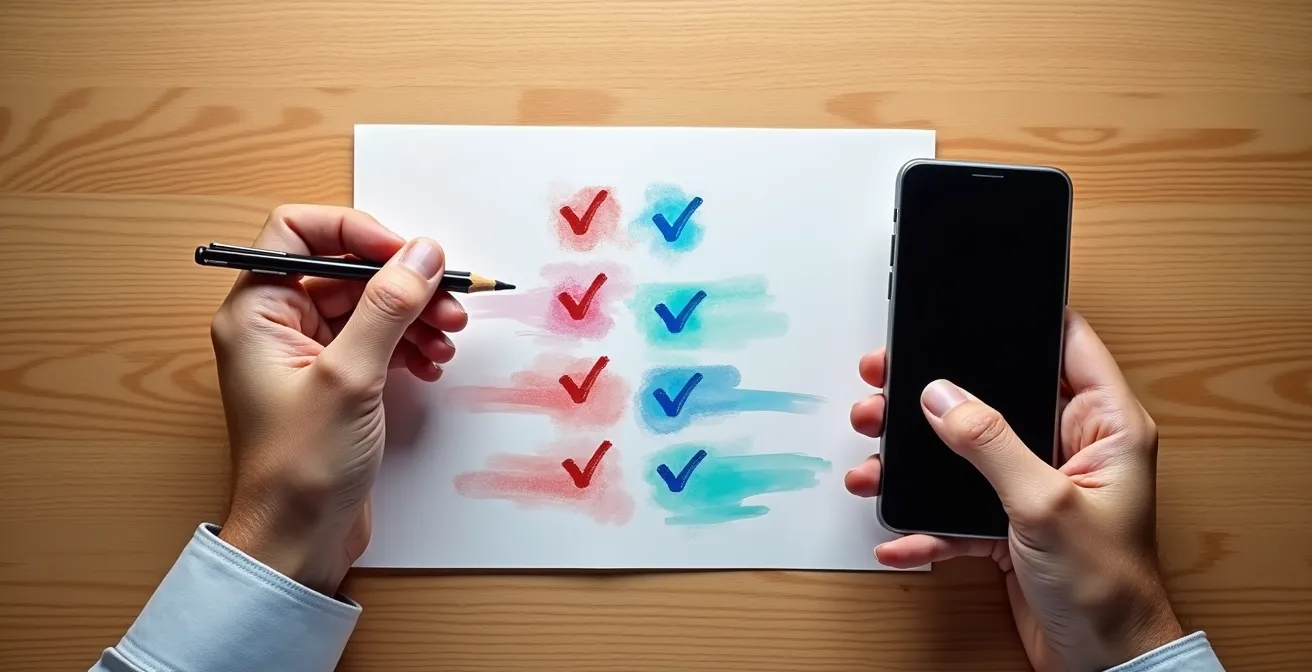
The key is to co-design the system with your teen. Research shows that when teens are involved in creating their own organizational systems, they become active co-pilots in their development. Don’t impose a system; present the options as a strategic choice. A hybrid approach often works best: use an app for capturing quick reminders and scheduling future events, but use a paper checklist for a specific, focused work block, like tonight’s homework.
| Aspect | Paper Checklists | Digital Apps |
|---|---|---|
| Friction Level | High (manual setup required) | Low (quick entry) |
| Focus Maintenance | High (no digital distractions) | Low (notifications, app switching) |
| Dopamine Response | Physical satisfaction of crossing off | Gamified animations and rewards |
| Best For | Task completion, deep work | Task initiation, reminders |
| Customization | Limited but tangible | Extensive but complex |
Motivation is a Myth: Why Discipline Systems Work Better for Homework?
“If you would just apply yourself!” It’s a phrase born of pure parental frustration. We see our teen’s potential and can’t understand their lack of motivation to do their homework. But here’s a counter-intuitive truth: for the adolescent brain, motivation isn’t something you can will into existence. It’s a fleeting emotion, not a reliable resource. Waiting for motivation to strike is a losing strategy. A structured discipline system, on the other hand, works *with* their brain’s unique wiring, not against it.
The teenage brain’s reward system is in hyperdrive. It craves immediate gratification, and the delayed reward of a good grade in six weeks simply can’t compete with the instant dopamine hit of a video game or social media notification. In fact, neuroscience research indicates teenage brains experience rewards as 30% more intense than either child or adult brains. This makes the pull of distractions incredibly powerful. Instead of fighting this, you can leverage it using a strategy called “Temptation Bundling.”
Temptation bundling is a system that links an activity they *want* to do with a task they *have* to do. It’s not a reward for a good job; it’s a simple if-then rule that makes the desired activity contingent on completing the necessary one. This removes the need for motivation and replaces it with a clear, predictable structure. It turns their biggest distractions into the very engine that drives their productivity.
Your Action Plan: Implementing Temptation Bundling
- Identify Wants: List your teen’s most desired activities (e.g., gaming, watching YouTube, scrolling TikTok).
- Pair with Have-Tos: Link each “want” activity with a specific academic task (e.g., 30 minutes of math homework).
- Create If-Then Rules: Establish clear, non-negotiable rules. “IF you complete your math worksheet, THEN you get 30 minutes of gaming time.”
- Use a Timer: Enforce the boundaries strictly. When the “want” time is up, it’s up. This builds self-regulation.
- Track and Adjust: Monitor the success rate weekly. If a pairing isn’t working, collaborate with your teen to find a more compelling bundle.
The Rescue Trap: Why Bringing Forgotten Lunches Hurts Executive Growth?
Your phone buzzes at 11:30 AM. It’s a text from your teen: “I forgot my lunch again.” Your parental instinct screams, “I have to fix this!” You drop what you’re doing, grab the lunch bag, and drive to the school. You’ve saved the day. But in the long run, you’ve done more harm than good. This is the “Rescue Trap,” and it’s one of the biggest unknowing saboteurs of executive function growth.
Every time you rush to deliver a forgotten item—be it a lunch, a textbook, or gym clothes— you are robbing your teen of a crucial learning opportunity. The uncomfortable feeling of having to navigate the school office to ask for lunch money, or explaining to a teacher why an assignment is missing, is not a punishment. It is a natural consequence. These low-stakes failures are the very experiences that build and strengthen the neural pathways for planning and problem-solving. When you consistently rescue them, you prevent that essential brain wiring from happening.
Think of it like a muscle. To get stronger, a muscle needs to experience resistance. Your teen’s planning and foresight “muscles” need the resistance of natural consequences to develop. By removing the consequence, you are essentially telling their brain, “Don’t worry about remembering, someone else will handle the fallout.”
Case Study: The Power of Manageable Challenges
The Center on the Developing Child at Harvard University emphasizes that for healthy brain development, adolescents need to experience and overcome manageable challenges. When parents consistently shield them from the consequences of their disorganization, they prevent the brain from learning to anticipate problems and plan ahead. Allowing a teen to experience the minor inconvenience of a forgotten lunch is not neglect; it’s a vital, real-world lesson that teaches them to connect their actions (or inaction) to a tangible outcome, which is a cornerstone of executive function.
Escaping the rescue trap requires a shift in your role from “rescuer” to “coach.” A coach doesn’t play the game for the athlete. A coach helps them analyze the mistake (“Why do you think you forgot your lunch today?”) and strategize for the next time (“What could we put in your Launch Pad to help you remember?”). It’s a harder, but far more effective, path to independence.
Visual Timers: How to Make “10 Minutes” Real for a Child?
“We’re leaving in ten minutes!” To you, it’s a clear and specific instruction. To a child or teen with developing executive functions, “ten minutes” can be a meaningless, abstract concept. Many struggle with “time blindness,” an inability to sense the passage of time. They don’t procrastinate to defy you; they genuinely cannot feel the difference between five minutes and thirty. This isn’t a flaw that will magically disappear, as the frontal brain region responsible for executive function isn’t fully developed until the mid-twenties.
To bridge this gap, you need to stop talking about time and start showing it. Visual timers are a powerful tool for cognitive offloading, making the abstract concept of time a concrete, physical reality. They don’t just count down; they provide a constant, ambient visual representation of how much time is left. This externalizes the time-keeping function that their internal brain struggles with, reducing anxiety and improving transitions.

However, not all visual timers are created equal. The right tool depends on the task and the child’s age. A timer for a focused homework session has a different purpose than one for a quick transition, like getting shoes on. Choosing the correct timer is a form of environmental engineering, tailoring the support to the specific challenge.
| Timer Type | Best Use Case | Visual Mechanism | Age Range |
|---|---|---|---|
| Time Timer | Homework focus sessions | Red disk shrinks as time passes | 8-18 years |
| Sand Timer | Quick transitions (2-5 min) | Sand flowing downward | 3-10 years |
| Color-changing Clock | Morning/bedtime routines | Background color shifts by time zone | 5-12 years |
| Light-up Timer | Break intervals | LED lights countdown | 10-16 years |
How to Make a Morning Chart That a 3-Year-Old Can Follow Independently?
While this article focuses on teens, the principles of building executive function start much, much earlier. Understanding how to create a system for a preschooler provides a masterclass in environmental scaffolding. The goal for a three-year-old is the same as for a fifteen-year-old: to offload the mental work of remembering a sequence of tasks onto a simple, visual, external system. For a pre-reader, this means a chart that uses pictures, not words, and involves physical interaction.
A static checklist that you point to is not enough. The key to success is kinesthetic learning—the act of physically moving something to signify completion. Research shows that children who physically move task cards from a “To Do” column to a “Done” column show significantly better adherence to routines. This multi-sensory experience provides immediate dopamine feedback and helps encode the habit much more effectively than just looking at a chart. It’s the physical act that wires the brain.
Creating this system is a simple weekend project that pays dividends in morning sanity. The goal is 100% independence. Your child should be able to “read” the chart and complete the routine without you uttering a single reminder. Here’s how you build it:
- Photograph the Tasks: Take photos of *your child* doing each step of the morning routine (e.g., eating breakfast, brushing teeth, putting on shoes). Using photos of them is crucial for ownership.
- Print and Laminate: Print the photos (a 4×6 size is great for little hands) and laminate them for durability.
- Create the Board: On a piece of poster board, create two columns labeled “To Do” and “All Done.”
- Add Velcro: Attach velcro dots to the back of each photo card and to both columns on the board.
- Place at Eye Level: Hang the chart near their bedroom door or in the kitchen, at a height they can easily reach.
This system works because it eliminates cognitive load. There’s no sequence to memorize. The next task is simply the top card in the “To Do” column. This foundational approach teaches the core loop of task management—see task, do task, mark task complete—that will scale with them as they grow.
Chore Charts vs. Zones: Which System Works for ADHD Families?
The traditional chore chart is often a source of immense frustration in families, especially those with ADHD-wired brains. It presents a list of discrete, sequential tasks that must be initiated, tracked, and completed—a process that requires a huge amount of executive function. Task initiation is often the highest hurdle. A chore like “Vacuum the living room on Monday” can feel so overwhelming that it never gets started. For these families, a shift from chore charts to a Zone-Based System can be revolutionary.
Instead of assigning specific tasks, you assign responsibility for a “zone.” The teen isn’t responsible for “taking out the trash,” “wiping the counter,” and “unloading the dishwasher.” They are responsible for the Kitchen Zone. Their job isn’t a list of actions; it’s to maintain a certain state: “The kitchen is clean and ready for the next meal.” This fundamentally changes the cognitive load. They are no longer tracking a dozen small tasks; they are monitoring one area.
This approach is far more compatible with the ADHD brain. It reduces decision fatigue because the “what” is flexible. If they have a burst of energy, they can deep clean the whole zone. If they are low on energy, they can do the bare minimum to maintain the state. It shifts the focus from a rigid schedule of tasks to ambient maintenance, which feels less daunting and allows for more autonomy.
| System Aspect | Traditional Chore Charts | Zone-Based System |
|---|---|---|
| Task Type | Sequential, specific tasks | Ambient maintenance |
| Cognitive Load | High (multiple steps to track) | Low (one area to monitor) |
| ADHD Compatibility | Challenging (task initiation barrier) | Better (reduced decision fatigue) |
| Example | ‘Vacuum living room Mondays’ | ‘Keep living room floor clear’ |
| Flexibility | Rigid schedule | Adapt to energy levels |
Key Takeaways
- Your teen’s disorganization is often a symptom of their developing prefrontal cortex, not a character flaw.
- Effective support means acting as an “External Frontal Lobe,” using environmental systems to offload cognitive work.
- Allowing for low-stakes failures (like a forgotten lunch) is crucial for building the neural pathways for planning and problem-solving.
The Sunday Summit: How to Run a Family Meeting That Isn’t Boring?
If you just announced, “We’re having a family meeting!” your teen’s eyes probably glazed over. The traditional family meeting often feels like a lecture in disguise. But what if you reframed it as a “Sunday Summit”—a weekly, 20-minute executive board meeting for “Family, Inc.”? This strategic shift in language and structure transforms a dreaded chore into an empowering experience where your teen isn’t a subordinate to be managed, but a junior executive to be coached.
The key to success is structure and role-playing. By giving your teen an executive role, such as the rotating “CEO” of the week, you allow them to practice the very meta-cognitive skills they need to develop: time management, facilitating discussion, and summarizing action items. Studies of families who use this approach report as much as 75% higher engagement from teens. It short-circuits power struggles by putting everyone on the same team, working together to solve the company’s “challenges.”
This isn’t a free-for-all complaint session. It’s a tightly run meeting with a clear agenda, tracked on a large whiteboard for all to see. The structure provides the scaffolding, while the rotating roles provide the opportunity for growth. Here’s the framework:
- Rotate the “CEO”: The CEO (which can be a teen or even pre-teen) is responsible for running the meeting and keeping it on time.
- Set a Strict Time Limit: Use a visual timer. 20 minutes, maximum. This forces efficiency and respects everyone’s time.
- Start with a “Praise Round”: Each person gives a specific, genuine piece of praise to another family member for something they did that week.
- Move to “Problem Presentation”: Anyone can bring up a challenge, but it must be framed as a problem to solve, not a complaint against a person.
- Collaborative “Solution Storming”: Everyone contributes ideas. The CEO facilitates and ensures no idea is shot down initially.
- End with “Action Items”: The CEO summarizes the agreed-upon solutions and clarifies who will do what, and by when.
The Sunday Summit is the culmination of the “External Frontal Lobe” philosophy. It’s the space where you transition from being the primary support system to being a chairman of the board, guiding and mentoring the next generation of leadership in your family.
By shifting your perspective from “fixing a problem teen” to “coaching a developing brain,” you can replace the daily battles with collaborative problem-solving. Start today by choosing one system—a Launch Pad, a Temptation Bundle, or the Sunday Summit—and implement it together. This structured, hopeful approach is the most effective way to help your teen build the CEO Brain they will need for a successful life.