
The long-held belief in a “30-million-word gap” is misleading; conversational quality, not sheer quantity, is the real engine of a child’s cognitive growth.
- Interactive dialogue—specifically back-and-forth “conversational turns”—activates key brain regions for language far more than passive listening does.
- Strategic language tools, such as debating, exploring word nuances, and using context clues, build a flexible and robust vocabulary that boosts comprehension.
Recommendation: Shift your focus from simply “talking more” to architecting richer, more interactive conversations at home using specific, teachable techniques.
For decades, a single, staggering statistic has haunted conscientious parents: the “30-million-word gap.” The 1992 study by Hart and Risley suggested that children from lower-income families hear 30 million fewer words by age three than their more affluent peers, creating a cognitive deficit that was hard to overcome. This created a societal narrative focused on sheer volume, leading to an understandable parental anxiety to fill every moment with talk. We were told to narrate our grocery shopping, describe every passing cloud, and essentially become non-stop broadcasters for our children.
While the intention was noble, this focus on quantity often overlooked a more critical factor. More recent studies have since questioned the original figure, with one replication suggesting the gap may be closer to 4 million words. This correction isn’t just a numerical adjustment; it’s a fundamental shift in understanding. The true catalyst for a child’s intellectual development isn’t a tsunami of words, but the quality and structure of the conversations they engage in. It’s about building a robust conversational architecture at home.
The real difference lies not in how many words a child *hears*, but in how many they are invited to *use*. It’s the back-and-forth, the struggle to find the right word, the joy of being understood, and the challenge of defending an idea. This article moves beyond the myth of the word count. We will deconstruct the specific, actionable strategies that transform everyday talk—at the dinner table, in the car, or over a comic book—into a dynamic cognitive training ground that genuinely expands your child’s intelligence.
To see how a child’s brain responds not just to words, but to the speed and efficiency of language processing, the following experiment provides a compelling visual. It demonstrates that quality language exposure helps children understand words faster, a crucial skill for reading and learning.
To help you build this new conversational toolkit, this guide is structured around practical techniques. We will explore how to turn language into a game, encourage precision, foster debate, and leverage surprising resources to build a rich vocabulary and a sharper mind. The following sections offer a roadmap to raising not just a talker, but a thinker.
Summary: From Word Gaps to Conversational Strategies
- The “Alien Word” Game: Teaching Kids to Guess Meaning From Context?
- Banned Words: How to Stop Your Child From Saying “Good” and “Bad”?
- Beyond “Pass the Salt”: How to Debate Topics with a 7-Year-Old?
- Why Comic Books Count: Expanding Vocabulary Through Graphic Novels?
- Greek and Latin Roots: The Cheat Code for SAT Vocabulary?
- Beyond “Fine”: 3 Questions That Replace “How Was School?”
- The “And Then” Trap: Why Kids Can’t Edit Their Own Stories?
- Reading Robots: How to Stop Your Child From Sounding Like Siri?
The “Alien Word” Game: Teaching Kids to Guess Meaning From Context?
One of the most powerful and sustainable vocabulary-building skills isn’t memorization; it’s deduction. When a child encounters an unknown word, their first instinct shouldn’t be to ask, “What does that mean?” but to become a “word detective,” hunting for clues in the surrounding text. This is the essence of using context clues, a skill that transforms passive reading into an active investigation. Frame it as the “Alien Word” game: when you find a word you don’t know, pretend it’s from another planet and you must figure out its meaning from the human words around it.
This approach builds cognitive flexibility and resilience. It teaches children that they have the tools to solve linguistic puzzles on their own. Research confirms this is more effective than isolated drills. A study on vocabulary acquisition found that combining context clues with exercises like semantic gradients—where students analyze shades of meaning—is highly effective. This dual approach helps students not only guess a word’s meaning but also understand its nuanced relationship to other words, bridging the gap between knowing a word and truly comprehending it.
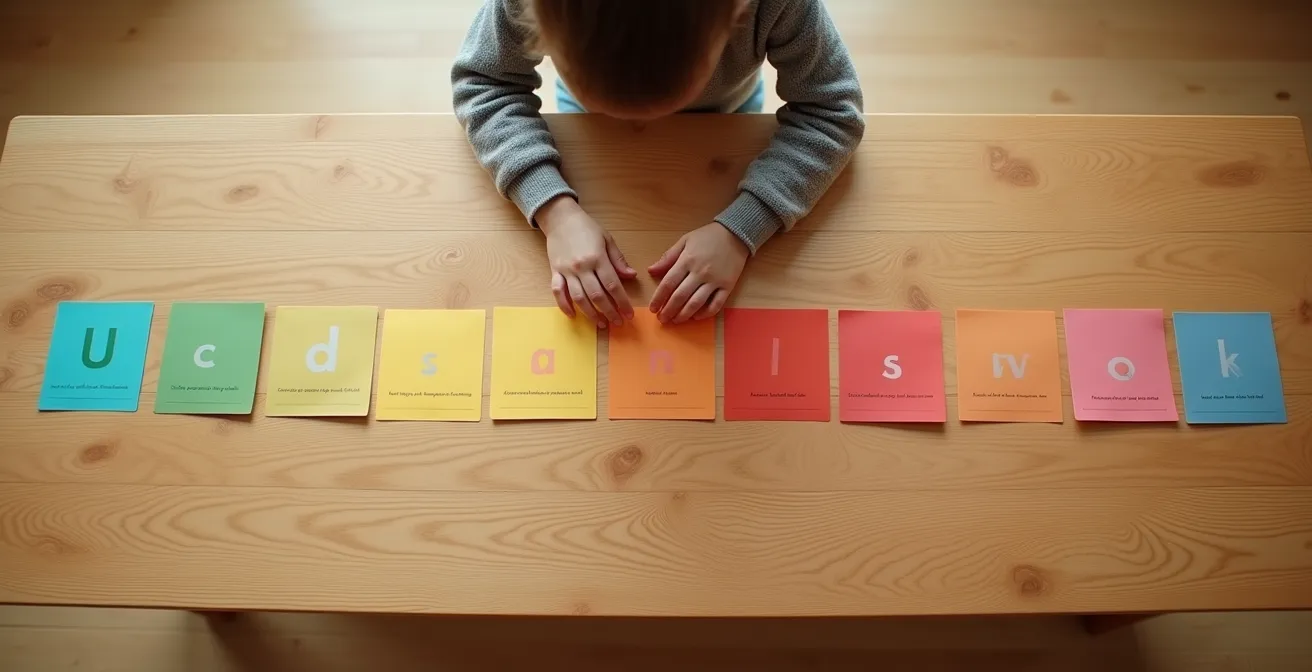
As the image above illustrates, arranging words along a spectrum (like ‘walk,’ ‘stroll,’ ‘jog,’ ‘sprint’) makes abstract nuances tangible. This hands-on activity helps children visualize that words have different intensities and connotations. It’s a powerful way to move from a black-and-white understanding of language to one that appreciates its infinite shades of gray. This method provides the mental scaffolding needed to decipher complex texts independently later on.
Banned Words: How to Stop Your Child From Saying “Good” and “Bad”?
Words like “good,” “bad,” “sad,” and “happy” are conversational dead ends. They are vague, overused, and they shut down the opportunity for deeper expression and connection. When a child says a movie was “good,” you learn almost nothing. Was it thrilling? Hilarious? Heartwarming? To build a rich vocabulary, we must gently guide children toward semantic nuance—the art of choosing the precise word for the occasion. A fun way to do this is to create a playful “banned words” list for the family, challenging everyone to replace these generic terms with more descriptive alternatives.
This isn’t about restriction; it’s about expansion. By pushing past the easy words, we encourage children to explore the vast landscape of language. As one expert in the field notes, this practice is fundamental to effective communication. In an article on vocabulary, Top Teaching Tasks explains:
By learning about the different meanings and connotations of words, learners can express themselves more precisely and choose the most appropriate words to convey their intended message.
– Top Teaching Tasks, Teaching Semantics to Increase Vocabulary
To make this practical, a “word upgrade” chart can be a powerful visual tool. Instead of just banning “good,” you provide a menu of exciting alternatives. This turns a correction into a creative choice, empowering the child as a more sophisticated communicator.
| Basic Word | Emotion Category | Upgraded Options | Sensory Alternative |
|---|---|---|---|
| Good | Positive | Spectacular, delicious, thoughtful, excellent | Warm, fragrant, smooth, melodious |
| Bad | Negative | Terrible, disappointing, frustrating, inadequate | Bitter, rough, jarring, cold |
| Sad | Emotional | Melancholy, grieving, disappointed, dejected | Heavy, gray, hollow, quiet |
| Happy | Emotional | Ecstatic, content, joyful, pleased | Light, bright, bubbly, warm |
Beyond “Pass the Salt”: How to Debate Topics with a 7-Year-Old?
The dinner table can be so much more than a place for refueling; it can be a gymnasium for the mind. The most potent force behind the findings of the original “word gap” study wasn’t passive hearing, but active engagement. It’s the back-and-forth of conversational turns that builds brains. Research from MIT confirms this, showing that children who experienced more conversational turns showed greater activation in Broca’s area, the brain’s language production center. One of the best ways to generate these turns is through low-stakes, fun debates.
You don’t need to tackle geopolitics. The topic can be as simple as “Should we get a pet cat?” or “Is summer better than winter?” The goal is to teach the structure of an argument. A simple and effective framework is the CER model: Claim, Evidence, and Reasoning. This provides the cognitive scaffolding for logical thought.
- Claim: The child states their position clearly (e.g., “We should get a pet cat”).
- Evidence: They provide a fact or piece of information to support it (e.g., “Cats are more independent than dogs”).
- Reasoning: They explain how the evidence supports the claim (e.g., “This means we wouldn’t have to walk it when we’re at school”).
Teaching them to also “steel-man” the opposing view—stating the other side’s best argument fairly—is an advanced skill that fosters empathy and critical thinking. A “Dinner Debate Jar” with fun topics can make this a regular and anticipated family ritual, transforming mealtime into a vibrant exchange of ideas.
Why Comic Books Count: Expanding Vocabulary Through Graphic Novels?
For too long, a cultural bias has relegated comic books and graphic novels to a lower tier of literature, dismissed as “easy reading.” This assumption is not only outdated but factually incorrect. From a vocabulary perspective, comics are surprisingly dense. Research has revealed that comic books average 53.5 rare words per thousand, compared to 30.9 for children’s books and even slightly more than the 52.7 found in adult books. Words like “retaliate,” “invulnerable,” and “cataclysmic” are commonplace in superhero tales, exposing children to rich vocabulary in a highly engaging context.
The power of graphic novels lies in their dual-coding. They require the brain to process text and images simultaneously, a complex cognitive task. As one study on visual narratives explains, this isn’t a shortcut; it’s a different kind of deep reading. Students must make inferences from the art—interpreting a character’s expression, the passage of time between panels, and the mood set by the color palette—and synthesize that information with the written text. This process strengthens inferencing skills, which are crucial for all forms of reading comprehension.

Furthermore, the format of graphic novels provides natural contextual support for difficult vocabulary. When a character says they feel “melancholy,” the accompanying illustration of them slumped over with a blueish tint provides an immediate visual anchor for the word’s meaning. This makes vocabulary acquisition feel less like a chore and more like part of an immersive story, proving that powerful learning can and should be joyful.
Greek and Latin Roots: The Cheat Code for SAT Vocabulary?
As children move into higher grades, they encounter a barrage of complex, multi-syllable words in science, history, and literature. Trying to memorize each one is an inefficient, uphill battle. The “cheat code” to unlocking this advanced vocabulary lies in understanding its architecture: Greek and Latin roots. A huge portion of English academic language is built from these ancient blocks. Teaching a child that “aud” means “to hear” gives them a key to unlock not just “audience” but “auditory,” “audition,” and “inaudible.” It’s a strategy of leverage, teaching one concept that unlocks dozens of words.
This isn’t about dry etymology lessons. It can be a hands-on game of discovery, connecting ancient roots to the modern world a child already knows. They’ll be thrilled to learn that “Nike” comes from the Greek goddess of victory, or that “video” comes from the Latin for “I see.” This approach builds metalinguistic awareness—the ability to think about and reflect on the nature of language itself.
| Root Family | Meaning | Academic Words | Tech/Brand Examples |
|---|---|---|---|
| Vid/Vis | See | Visual, vision, evidence | Video, Visa, Vision Pro |
| Aud | Hear | Auditory, audience, audition | Audio, Audible, Audi |
| Port | Carry | Transport, portable, export | Portal, Port (USB), Airport |
| Graph/Gram | Write | Paragraph, diagram, grammar | Instagram, Graphic, Telegraph |
To put this into practice, you can gamify the learning process to make it memorable and engaging for the whole family.
Your Action Plan: Building a Word-Root Family Tree
- Color-Code the Roots: Assign different colored blocks or sticky notes to common roots (e.g., ‘port’ = red, ‘trans’ = blue, ‘sub’ = green).
- Build Physical Words: Have children physically construct words like ‘transport’ or ‘submarine’ by combining the colored blocks, making the concept of word-building tangible.
- Group Related Families: Create a chart grouping roots with similar meanings, like ‘graph/gram’ (to write) and ‘scrib/script’ (to write), to show how different roots can do similar jobs.
- Connect Roots to Brands: Make a game of finding roots in modern brand names: Amazon (from a tribe of female warriors), Audio (from ‘audire’, I hear), or Volvo (from ‘volvere’, I roll).
- Create a “Root Family Tree”: Draw a large tree on a poster board. Put a powerful root like ‘port’ (carry) on the trunk and have children add “branch” words like ‘report,’ ‘import,’ ‘portable,’ and ‘support.’
Beyond “Fine”: 3 Questions That Replace “How Was School?”
The most common question parents ask after school—”How was your day?”—is also the least effective. It’s a closed door that is almost always met with a one-word answer: “Fine.” This response provides no information, generates no conversational turns, and misses a crucial opportunity for connection and language development. To open the door, you need to ask better, more specific, and more inviting questions. The key is to move away from generic inquiries and toward prompts that require a story, an emotion, or a detail.
Instead of the broad, unanswerable “How was your day?”, try targeting specific slivers of their experience. This signals that you are genuinely interested not just in a summary, but in the texture of their life. It gives them a concrete starting point for a narrative, making it easier for them to share. These questions should be open-ended and curiosity-driven, designed to elicit more than a simple yes or no.
Here are three powerful alternatives to “How was school?”:
- “What was a moment today that made you laugh?” This question focuses on a positive emotion. It’s low-pressure and often leads to a fun story about a friend or a funny incident, opening the door to more conversation.
- “What was something that challenged your brain today?” This reframes the idea of “hard work” into a positive “challenge.” It celebrates effort over outcome and can reveal what they’re learning, where they’re struggling, or what they find interesting.
- “Who did you sit with at lunch, and what did you talk about?” This is a gentle way to inquire about their social world. It focuses on connection and can provide insight into their friendships, social dynamics, and the everyday topics that are on their minds.
These questions work because they aren’t an interrogation; they are an invitation. They show your child that you care about the small, specific moments that make up their day, fostering both a stronger connection and a richer conversational environment.
The “And Then” Trap: Why Kids Can’t Edit Their Own Stories?
Listen to a young child tell a story, and you’ll likely hear a recurring phrase: “And then… and then… and then…” They are listing events in chronological order, but they are not yet telling a story. This is the “And Then” Trap. A story is not just a sequence of events; it’s a chain of cause and effect powered by a narrative engine. This engine is the “why” behind the “what”—the motivations, consequences, and connections that link events together. Children fall into the trap because they haven’t yet developed the linguistic tools to express these complex relationships.
To help them escape, we need to explicitly teach them the transition words that build a narrative engine. Words like “because,” “therefore,” “meanwhile,” and “despite this” are the gears of storytelling. They signal relationships between ideas: cause and effect, contrast, and simultaneity. Practicing sentence construction with these words shows a child how a simple change can dramatically alter a story’s meaning and flow.
This skill is deeply connected to inference, a sophisticated comprehension skill. As educators point out, sequential art in comics is an excellent tool for this, as it forces the reader to infer what happens between the panels. By asking “Why did he do that?” or “What happened right before this?” you are training their brain to look for the narrative engine. Here are some ways to practice this skill:
- Introduce “storytelling magnets” with transition words on them: Meanwhile, As a result, Suddenly, Despite this. Have them build stories using the magnets.
- Practice the “movie trailer” technique: Challenge them to retell a five-minute story in 30 seconds. This forces them to identify the most crucial cause-and-effect moments.
- Constantly ask “why?” after each event in their story to encourage them to build cause-and-effect connections.
By giving them these tools, you’re not just improving their storytelling. You’re teaching them how to organize their thoughts, understand causality, and build a more coherent and logical view of the world.
Key Takeaways
- Quality Over Quantity: The most significant factor in a child’s cognitive growth is the architectural quality of conversation—the back-and-forth turns, not the raw number of words heard.
- Conversation as a Skill: Effective communication is not innate; it’s a set of teachable skills. Parents can act as coaches, providing tools for precision, logic, and narrative structure.
- Embrace Diverse Sources: Rich vocabulary and complex ideas are found in surprising places. Graphic novels, etymological roots, and even family debates are powerful, engaging learning tools.
Reading Robots: How to Stop Your Child From Sounding Like Siri?
A child can correctly pronounce every word in a sentence and still fail to understand its meaning. This happens when they read like a robot, in a flat, monotonous tone devoid of expression. This mechanical reading, known as lacking prosody, is a major red flag for comprehension issues. Prosody is the music of language—the rhythm, stress, and intonation that carry a huge portion of a sentence’s meaning. Is a statement a question, a command, or a joke? The prosody tells us.
Teaching prosody is about teaching a child to read for meaning, not just for pronunciation. It requires them to think ahead, anticipate the emotion or intent of the text, and use their voice as an instrument. We can teach them that punctuation marks are “road signs for their voice.” A comma is a brief pause, a question mark makes their voice go up, and an exclamation point adds a burst of energy. This reframes grammar from a set of boring rules to a practical guide for expressive reading.
To make this tangible, try these techniques:
- Practice “emotional reading”: Have your child read the same simple sentence (“I’m going to the store”) as if they are angry, excited, secretive, or scared. This isolates prosody as a variable.
- Use “paired reading”: You read a sentence with full expression, and your child immediately echoes you, mimicking your tone and rhythm.
- Teach punctuation as voice commands: Periods are stop signs, commas are yield signs, question marks are voice ramps, and exclamation points are “press the gas” pedals for energy.
Ultimately, fostering expressive reading brings us back to the central theme: it’s the richness of the linguistic experience, not the mere quantity of words, that matters. By focusing on the music, emotion, and structure of language, we give our children the keys to true, deep comprehension, making them fluent readers instead of just robotic decoders.
The journey to raising an intelligent, articulate child is not a race to a 30-million-word finish line. It is the patient, daily practice of building a better conversational architecture. The next step is not to overhaul every conversation, but to choose one small technique from this guide—perhaps banning the word “good” at dinner tonight, or trying one new question after school—and start there. The most profound changes begin with a single, well-chosen word.