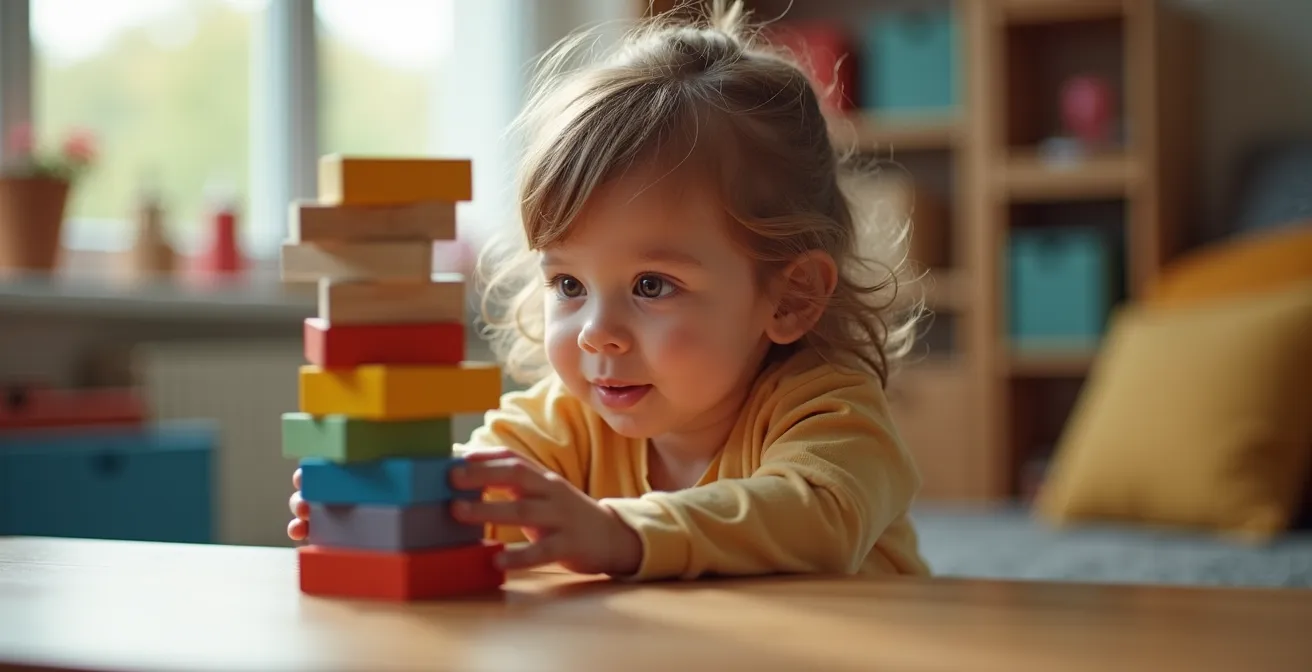
The key to teaching physics isn’t explaining abstract concepts; it’s reframing every toppled tower from a “failure” into a “data point.”
- Building activities are simple experiments that reveal invisible forces like gravity and compression.
- Focusing on hands-on exploration and guided questions after a collapse creates deep, intuitive understanding.
Recommendation: Adopt the mindset of a “Chief Engineer” guiding a “Junior Engineer” to analyze why things fall, not just celebrating the crash.
When a carefully constructed block tower comes crashing down, a 4-year-old’s typical reaction is a mix of surprise, frustration, and sometimes, delight. As a parent, our instinct is often to say, “Oops! Let’s build it again.” But what if that collapse wasn’t a failure? What if it was valuable data? As a structural engineer, I see every wobble and fall as a physical lesson. The blocks are communicating the laws of physics—gravity, stability, and balance—in the most direct way possible. We just need to learn how to translate.
The common approach is to demonstrate gravity by dropping an apple. But this is abstract. The real learning happens during play, and recent educational research shows that exploratory play provides children with a much richer understanding of STEM concepts than passive observation. Instead of just stacking blocks, we can turn playtime into a series of simple, hands-on engineering experiments. You don’t need a degree in physics; you just need to shift your perspective from “playmate” to “Chief Engineer,” guiding your little one to discover these principles for themselves.
This guide abandons generic advice and instead provides a series of engineering-focused “experiments” you can conduct with a simple set of blocks. We will explore why a wide base is critical, how simple shapes create immense strength, and how to master balance with counterweights. By the end, you’ll learn to ask the right questions, transforming every fallen tower from a mess on the floor into a breakthrough moment of scientific discovery.
To help you and your “Junior Engineer” begin your structural explorations, this article breaks down core physics principles into a series of hands-on activities. Follow along to turn your living room into a laboratory for intuitive learning.
Summary: A Structural Engineer’s Playbook for Block Building
- Why the Base Must Be Wider: Explaining Stability with Couch Cushions?
- Paper Bridges: How to Hold a Textbook with Just One Sheet of Paper?
- The Triangle Secret: Why Engineering Loves Pyramids?
- The Top-Heavy Mistake: Why Your Skyscraper Keep Tipping Over?
- Counterweights: How to Balance a lopsided Creation?
- Why Specific Kits Kill Creativity Compared to Plain Blocks?
- Theory vs. Practice: Why Hands-On Fails Without Reflection?
- Tetris for Toddlers: How to Teach Spatial Reasoning Without Screens?
Why the Base Must Be Wider: Explaining Stability with Couch Cushions?
The first rule of any stable structure, from the Egyptian pyramids to a toddler’s block tower, is the same: start with a wide, heavy base. This isn’t just a good idea; it’s a direct response to the force of gravity. Gravity constantly pulls every part of a structure straight down. A wide base gives these forces a larger area to distribute themselves over, making the structure far less likely to tip. This is the principle of stability.
To make this tangible for a child, forget the blocks for a moment. Use couch cushions. Ask your child to stand on one foot on a single cushion. They’ll wobble. Now, ask them to stand with their feet spread wide apart on two or three cushions. They’ll feel instantly more stable. You can explain, “See? A wider base helps you fight the wobble.” This physical experience of stability is far more powerful than a verbal explanation.
One of the fundamental pedagogical strategies for teaching STEM in the early years is using real-life experience and hands-on exploration in a child-centered learning process.
– MDPI Education Journal, STEM Education in Early Years: Challenges and Opportunities
Now, return to the blocks. Build two towers side-by-side: one a single, narrow column, and the other starting with a large 4×4 block base. Give each a gentle push near the top. The narrow tower will topple immediately. The wide-based tower will resist. You’ve just conducted a controlled experiment demonstrating that a wider foundation is the key to defeating the “tipping force.”
This simple test isn’t just about building; it’s about giving a physical name and feeling to an invisible force, establishing the first and most critical rule of structural engineering.
Paper Bridges: How to Hold a Textbook with Just One Sheet of Paper?
How can something as flimsy as paper support something as heavy as a book? This experiment brilliantly demonstrates two fundamental engineering forces: tension (a pulling or stretching force) and compression (a pushing or squishing force). A flat sheet of paper has no structure to resist these forces, so it bends easily under the slightest weight.
But by changing its shape, we can give it incredible strength. Place two stacks of books about six inches apart. Lay a single sheet of paper across them to form a “bridge.” Place a small toy on it; the bridge collapses. Now, take the same sheet of paper and fold it into a tight zigzag, like an accordion. Place this corrugated paper bridge across the same gap. It will now easily support the toy, and likely a much heavier object, like a textbook.
This simple change introduces structural integrity. The folds create a series of triangles that distribute the book’s weight. The top of each fold is under compression, while the bottom is under tension. Together, they resist bending and give the paper its newfound strength.
Structural Engineering Concepts in Preschool Physics
Educators have had remarkable success using this exact experiment. By creating zigzag folds in paper, children as young as 3-5 were able to build bridges that supported books weighing up to 2 pounds. This hands-on activity led to excited discoveries about how shape affects strength, effectively introducing the concept of corrugated design and structural integrity through pure, hands-on exploration.
The visual contrast between the flat paper and the folded paper is a powerful lesson. It shows that material alone isn’t what makes something strong; it’s how that material is shaped and structured to manage forces. It’s a foundational concept behind everything from cardboard boxes to steel I-beams in skyscrapers.
This experiment proves that even the most delicate materials can achieve immense strength through smart design, a lesson that applies far beyond the playroom.
The Triangle Secret: Why Engineering Loves Pyramids?
After discovering that shape impacts strength, the next question is: what is the strongest shape? The answer is the triangle. This is not an opinion; it’s a geometric fact. A triangle is a uniquely rigid shape. If you push on the corner of a square made of straws, it will easily deform into a diamond. But if you push on the corner of a triangle, it holds its shape because its sides brace each other.
This principle of triangulation is why you see triangles everywhere in construction: in the frames of bicycles, the trusses of bridges, the support structures for roofs, and even in the iconic design of the Eiffel Tower. Each triangle distributes force evenly across its three sides and three corners, making it incredibly stable and resistant to deformation.
You can demonstrate this easily. If you have building toys with sticks and connectors, build a square and a triangle. Let your child test the “wobble factor” of each. The square will be flimsy, while the triangle will be rock-solid. This hands-on comparison is far more effective than any drawing. It is no surprise that a 2023 study found that 75.16% of early childhood educators determined that STEM concepts like this were extremely appropriate for preschool-aged children.
This table from Bright Horizons, a resource on early childhood education, breaks down the concept in a simple, testable way.
| Shape | Stability Level | Real-World Examples | Kid-Friendly Test |
|---|---|---|---|
| Square | Low – Deforms easily | Picture frames, windows | Push on straw square – it wobbles! |
| Triangle | High – Stays rigid | Bicycle frames, roofs, swing sets | Push on straw triangle – no wiggle! |
| Circle | Medium – Rolls away | Wheels, balls | Try to stack circles – they roll! |
When your child is building, encourage them to “see the triangles.” If they build a square wall, show them how adding a diagonal piece (creating two triangles) makes the wall instantly stronger. They are now thinking like an engineer, using geometry to add structural integrity.
By learning to leverage the power of the triangle, your child moves from simply stacking to strategically engineering their creations for maximum strength and stability.
The Top-Heavy Mistake: Why Your Skyscraper Keep Tipping Over?
Every object has a “center of gravity,” which you can think of as its balance point. For a structure to be stable, its center of gravity must be low and directly above its base of support. When you build a tower that is narrow at the bottom and wide or heavy at the top, you are raising the center of gravity, making it inherently unstable. This is the “top-heavy mistake,” and it’s the most common reason block skyscrapers come crashing down.
Children are natural physicists. As they jump from play equipment, dangle from a tree, or topple a block structure, they’re learning about the world through play.
– Debbie Hoppy, Bright Horizons Education and Curriculum Director
You can help your child feel this concept. Have them hold a heavy book down by their waist, then lift it high above their head. They will feel less stable with the weight up high. This is because they have raised their own combined center of gravity. A tower experiences the same thing. When the center of gravity moves too high or shifts outside the base, gravity wins, and the tower tips over.
Instead of seeing this as a failure, frame it as the tower “sending a message.” The message is: “My center of gravity is too high!” This reframes the experience into a problem-solving challenge. How can we lower the center of gravity? By rebuilding with the biggest, heaviest blocks at the bottom and the smallest, lightest blocks at the top. This is a fundamental principle of all structural design.
Your diagnostic checklist: Finding the tower’s balance point
- The Backpack Test: Have your child carry a heavy backpack low on their back, then high between their shoulders, to feel the difference in their own center of gravity.
- Find the ‘Tummy Button’: Gently try to balance the tower on your finger to find its approximate center point or “tummy button.” Mark it.
- Test the Tipping Point: Intentionally add blocks to the top one by one, counting how many it takes before the tower tips.
- Move Heavy Blocks Down: Rebuild the tower, but this time place the biggest and heaviest blocks at the very bottom.
- Celebrate the Feedback: Frame every collapse as useful “feedback” from the tower, not a mistake, asking “What did the tower tell us that time?”
By understanding the top-heavy mistake, children learn to anticipate the effects of gravity and build with intention, making conscious choices to keep their structures balanced and stable.
Counterweights: How to Balance a lopsided Creation?
Once your child masters basic stability, you can introduce a more advanced and exciting engineering concept: the counterweight. A counterweight is a weight used to balance a load or a force. You see them on large construction cranes, on elevators, and on see-saws at the playground. The principle is leverage: a lighter weight can balance a much heavier weight if it is placed further away from the central pivot point (the fulcrum).
The “See-Saw Science” experiment is a perfect way to demonstrate this. Place a pencil under the middle of a ruler to create a simple see-saw. Put a heavy toy car on one end. It will immediately tip. Now, challenge your child to balance the car by placing a much lighter eraser on the other side. They will quickly discover that placing the eraser near the center does nothing. They must slide it all the way to the far end to balance the car.
See-Saw Science: Teaching Leverage to Preschoolers
Using a simple ruler-and-pencil fulcrum, teachers have effectively introduced the concept of leverage. Children aged 4-5 successfully predicted and tested balance points, with a remarkable 90% able to explain that moving the lighter object “farther means stronger” after hands-on experimentation. This activity powerfully demonstrates how distance from a fulcrum can multiply force.
Now, apply this to block building. Challenge your junior engineer to build a structure that hangs off the edge of a table. It will, of course, fall. Then, ask: “How can we keep it from falling without holding it?” Introduce the idea of a counterweight. By placing heavy blocks on the part of the structure that is still on the table, they can balance the part that is hanging off. They are using the table edge as a fulcrum and the heavy blocks as a counterweight to create a cantilever, one of the most dramatic forms of structural engineering.
This experiment is a thrilling step up, moving from passive stability (a pyramid) to active, dynamic balancing. It teaches children that they can control and counteract the force of gravity through clever design.
Why Specific Kits Kill Creativity Compared to Plain Blocks?
In a world of hyper-specific building kits—”Build This Exact Spaceship”—the humble, plain wooden block can seem boring. But from an engineering and creative standpoint, it is infinitely superior. A kit with a 12-step instruction manual to build one specific model teaches a child to follow directions. A pile of generic blocks teaches a child to invent, problem-solve, and think like an engineer. The current educational trends in 2024 show a strong emphasis on integrating STEAM principles to foster exactly this kind of creativity and innovation.
A specific kit has a pre-defined problem and a single correct solution. There is no room for error, and therefore no room for discovery. The goal is to replicate the picture on the box. This is a closed-ended task. Plain blocks, by contrast, are open-ended. There is no right or wrong way to use them. A child might decide to build a bridge, a castle, or a garage for their toy cars. When a structure fails, they are not failing the instructions; they are simply discovering a boundary of physics.
Research consistently demonstrates the profound benefits of play in fostering creativity, problem-solving skills, and social-emotional development.
– Portobello Institute, Top Trends in Early Childhood Education 2024
This open-ended nature is the very essence of engineering. An engineer is not given a kit; they are given a problem (“we need to cross this river”) and a set of materials, and they must invent a solution. Plain blocks mirror this process perfectly. They encourage a child to form a hypothesis (“I think I can build a tower this tall”), test it, observe the results (it falls!), and then modify their design. This iterative cycle of design-test-redesign is the heart of all innovation, something a pre-packaged kit can never teach.
While kits can be fun, they are exercises in compliance. True creative and structural thinking is born from the limitless possibilities of a simple pile of blocks.
Theory vs. Practice: Why Hands-On Fails Without Reflection?
The hands-on building is the “practice,” but it’s only half of the learning equation. Without “theory”—or more accurately, reflection—the lesson is often lost. Just letting a child build and knock down towers without any discussion is a missed opportunity. The real engineering mindset is built in the moments *after* the crash, when you sit down together and analyze the “data.”
This is often the missing link for parents and even some educators. Research reveals that two-thirds of early childhood educators felt their own education hadn’t adequately prepared them to support STEM learning, which highlights why this step is so often skipped. The goal isn’t to lecture but to guide discovery with simple, open-ended questions. Instead of saying, “It fell because it was too tall,” ask, “What did we notice right before it fell? Did it wobble first?”
This process of guided reflection connects the physical action to a conceptual understanding. You are helping your child construct a mental model of how these invisible forces work. A powerful technique is to document the process. Before they build, ask, “What are you trying to build?” and perhaps sketch their idea. After it collapses, sketch what the rubble looks like. Then ask, “Where did it break first? At the bottom, or at the top?” This is a simplified form of forensic engineering, and it teaches scientific observation in a perfectly age-appropriate way.
The language you use is critical. Shift from “It broke” or “You made it fall” to “What did we discover?” or “What is the tower telling us?” This language removes any sense of personal failure and frames the collapse as an interesting, information-rich event. It transforms the experience from a test with a pass/fail grade into a scientific exploration where every outcome yields new knowledge.
By pairing hands-on practice with thoughtful reflection, you complete the learning cycle and empower your child not just to build, but to understand.
Key Takeaways
- Stability comes from a wide, heavy base that lowers a structure’s center of gravity.
- An object’s strength is determined more by its shape (like triangles or folds) than its material.
- Every collapse is a data point; analyzing why a structure fell is more important than the fall itself.
Tetris for Toddlers: How to Teach Spatial Reasoning Without Screens?
Spatial reasoning—the ability to think about objects in three dimensions and visualize them in your mind’s eye—is a critical skill for engineering, mathematics, and everyday life. While video games like Tetris are famous for building this skill, the physical world is a far richer training ground for a young child. In fact, as one research team notes, physics is about how the material world works, and that includes how a child’s own body moves and interacts with that world.
One of the best ways to teach this is through “Body Tetris.” This involves creating an obstacle course with furniture, pillows, and boxes. The child must figure out how to navigate the space: turning their body sideways to squeeze through a narrow gap between couch cushions, ducking under a table, or climbing over a pillow mountain. In doing so, they are intuitively learning about volume, orientation, and how their own shape relates to the shapes around them. They are solving a physical puzzle with their whole body.
Body Tetris: Full-Body Spatial Learning
Early childhood educators who implement “Body Tetris” activities using furniture forts have reported significant improvements in children’s spatial reasoning. By navigating through cushion gaps and under tables, children learn to rotate and adjust their bodies in 3D space. This full-body experience has been shown to translate directly to better block-building skills and enhanced puzzle-solving abilities, as they develop a more intuitive sense of how objects fit together.
This full-body understanding translates directly back to the block table. A child who has had to physically rotate their own body to fit through a space has a much better intuitive grasp of why a block needs to be rotated to fit in a specific spot in their tower. Other non-screen activities include classic shape-sorter toys, doing puzzles, and simply packing away toys into a toy box, which is its own daily exercise in spatial optimization. The goal is to make them aware of how things fit together, a fundamental skill for any budding engineer.
Start your first engineering experiment today and discover the physics hidden in your child’s toy box. By teaching them to see the world through the eyes of an engineer, you are giving them a set of problem-solving tools that will last a lifetime.
Frequently Asked Questions on a structural engineer’s guide to teaching physics with blocks
Why is reflection important after hands-on activities?
Reflection helps children construct understanding from their experiences, moving from physical exploration to conceptual understanding through guided discussion.
What’s the best way to document learning with young children?
Use simple drawings of ‘before’ and ‘after’ states, asking children to mark where breaks happened first. This introduces scientific observation in an age-appropriate way.
How can parents shift from failure-focused to discovery-focused language?
Replace ‘Why did it fail?’ with ‘What did we discover?’ This simple shift reframes the experience from a test to a scientific exploration.