
Contrary to popular belief, ending toddler meltdowns isn’t about enforcing a rigid, clock-based schedule. It’s about creating a predictable *sequence* of events that calms their brain’s constant “what’s next?” anxiety.
- An unpredictable day depletes a toddler’s limited capacity for emotional regulation, leading to the infamous late-afternoon “witching hour.”
- Focusing on a consistent order of activities (e.g., play, then lunch, then nap) provides security, even if the exact times vary.
Recommendation: Start by establishing just one or two non-negotiable “predictability anchors” in your day, like a consistent morning wake-up routine or a specific bedtime ritual, to build a foundation of stability.
It’s a scene familiar to millions of parents: the clock nears 5 PM, and a switch flips. The same child who was happily playing an hour ago is now a whirlwind of tears, demands, and inexplicable defiance. This daily phenomenon, often dubbed the “witching hour,” feels like an unavoidable part of life with a toddler. Parents are often told the solution is simple: “be consistent,” “stick to a schedule.” But this advice often fails in the face of real life—a missed nap, a late grocery run, or an unexpected visitor.
The problem is that we’ve been focusing on the wrong thing. We obsess over the hands of the clock, trying to force our chaotic lives into neat, hour-by-hour blocks. This approach misses the fundamental way a toddler’s brain experiences the world. For a young child, the world is a series of events, not a timetable. Their sense of security doesn’t come from knowing that lunch is at noon sharp; it comes from knowing that lunch *always* comes after playing outside. This is the “sequence over schedule” principle.
But what if the key to unlocking a calmer child and a more peaceful home wasn’t in a stricter schedule, but in a more predictable *sequence*? This guide moves beyond generic advice to explore the neuroscience of why toddlers thrive on predictability. It’s not just about managing behavior today; it’s about building the foundational planning skills—what we can call the “CEO Brain”—that will serve them for the rest of their lives. We’ll deconstruct how to build flexible-yet-stable routines, handle common disruptors like travel and nap transitions, and understand the long-term cognitive benefits of creating a predictable world for your child.
This article provides a complete framework for understanding and implementing effective routines, from the “why” behind their success to the practical “how” of daily life. Explore the sections below to master each aspect of building a stable and calming rhythm for your family.
Summary: Why Inconsistent Schedules Sabotage Toddler Behavior Before 5 PM?
- Why Knowing “What Comes Next” Reduces Meltdowns by 50%?
- How to Make a Morning Chart That a 3-Year-Old Can Follow Independently?
- Travel Sleep Rules: Strict Routine or Flexible Flow for Vacation Sanity?
- The Busy Trap: Signs Your 7-Year-Old Is Doing Too Many Activities
- When to Drop the Nap: The 3 Signs Your Toddler Is Ready for Quiet Time
- Audiobooks vs. Tablets: Which Device Actually Helps Kids Fall Asleep?
- Night Owl Kids: How to Shift Their Body Clock 15 Minutes at a Time?
- The CEO Brain: How to Teach Planning Skills to a Disorganized Teen?
Why Knowing “What Comes Next” Reduces Meltdowns by 50%?
A toddler’s brain is in a constant state of information gathering, trying to make sense of a world without a fully developed sense of time. This creates a persistent, low-level anxiety loop: “What is happening now? What comes next?” When a day is unpredictable, this loop runs on overdrive, consuming immense cognitive energy. This mental drain is a primary cause of meltdowns. The child isn’t being “bad”; their brain’s capacity for emotional regulation is simply depleted. Providing a predictable sequence of events short-circuits this anxiety. When a child knows that after breakfast, we always get dressed, their brain can relax its “what’s next?” vigilance and conserve that precious energy. This is why predictable patterns are more critical than rigid clock times.
The security that comes from routine is not just a feeling; it has profound developmental benefits. In fact, research from 2018 found that consistent bedtime routines support children’s overall development and sense of well-being. By knowing the flow of their day, toddlers gain a sense of control and mastery over their environment. This fosters independence and self-confidence. The key is to focus on the sequence of activities. For example, the pattern might be: wake up, have a bottle, play quietly, have breakfast. It doesn’t matter if this happens at 6:15 AM or 7:00 AM; the sequence itself is the anchor of security.
To implement this, use verbal cues and transition warnings. Saying, “In five minutes, we’re going to put the blocks away and get ready for our bath,” prepares the brain for the upcoming shift, preventing the jarring feeling of being suddenly pulled from an activity. This simple act of narrating the day builds trust and cooperation. It communicates that you are a reliable guide in their world, one who helps them understand what is coming next, effectively calming the storm before it even begins.
Ultimately, a predictable sequence acts as an external executive function, scaffolding the child’s developing brain and freeing up mental resources for learning, playing, and emotional connection.
How to Make a Morning Chart That a 3-Year-Old Can Follow Independently?
The abstract concept of a “morning routine” is meaningless to a three-year-old. They live in a concrete world of tangible objects and actions. A visual routine chart translates the sequence of events into a language they understand. The most effective charts are interactive, giving the child a physical role in the process. This transforms a list of parental commands into a game they can win. A simple and powerful method is the “To Do / Done” chart. This involves two columns where the child physically moves a picture card from the “To Do” side to the “Done” side upon completing a task like brushing teeth or getting dressed.
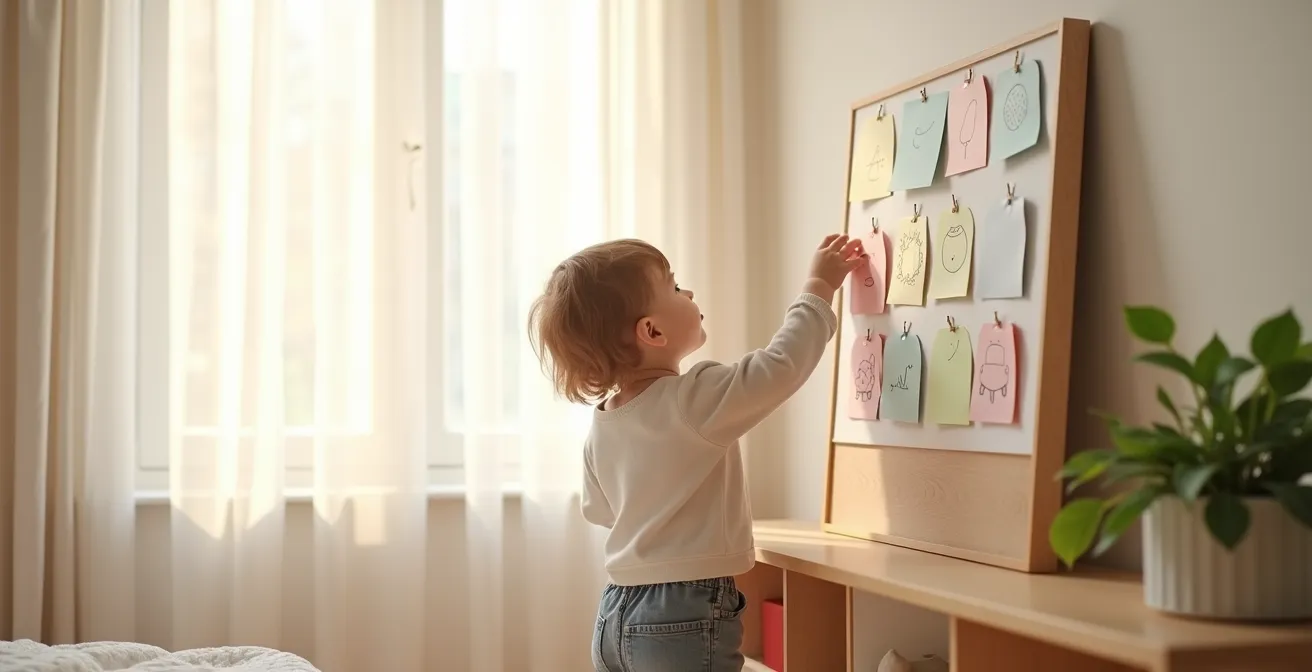
This physical act of moving the card provides a satisfying sense of accomplishment and makes their progress visible. One case study highlights a key to success: parents who co-created the chart with their children, letting them choose pictures and colors, reported that it doubled the effectiveness of the system. Involving the child in the creation process gives them ownership and makes it “their” chart, not just another rule from Mom or Dad. It’s also critical to start small. Instead of overwhelming them with a ten-step routine, begin with a single “keystone habit,” like getting dressed, and build from there once that is mastered.
The goal is to foster independence, not perfect compliance. The chart should be mounted at the child’s eye level, empowering them to check it themselves. Use clear, simple pictures or photos for each step: a picture of a toothbrush, a pair of pants, a bowl of cereal. This removes the need for constant verbal reminders, reducing parental nagging and increasing the child’s sense of autonomy. The chart becomes their personal guide to the morning, teaching them the fundamental skill of following a sequence, a cornerstone of executive function.
This simple tool does more than just organize the morning; it teaches a child how to organize their own actions, a skill that will serve them long after they’ve outgrown picture cards.
Travel Sleep Rules: Strict Routine or Flexible Flow for Vacation Sanity?
The thought of travel can fill parents with dread, fearing that one trip will derail weeks of hard-won routine. The common dilemma is whether to enforce the home routine with military precision or surrender to a “vacation mode” free-for-all. The most effective approach lies in the middle: a flexible flow anchored by a few non-negotiable rituals. This is the “Anchor Point Strategy.” Instead of trying to replicate the entire home schedule in a new environment, identify one or two core elements of your bedtime routine that are portable and deeply comforting to your child.
These anchors could be singing a specific lullaby, reading the same two books every night, or a special hug-and-kiss sequence. These rituals signal to the child’s brain, “Even though the room is different and the bed feels strange, this part is the same, so it’s safe to sleep.” Packing familiar sensory cues, like an unwashed crib sheet or a parent’s worn t-shirt, can also provide a powerful sense of security through the familiar scent of home. The goal isn’t to control the timing but to preserve the familiar sequence of bedtime activities. Even if bedtime is an hour later, maintaining the ‘bath, then pajamas, then books, then lullaby’ order keeps the brain’s “what’s next?” loop satisfied.
As one parent experienced, the key is to follow the routine as best as you can without forcing it. If the child is too stimulated by the new environment to sleep at 7:30 PM, fighting them will only create a negative association with the new sleep space. It’s more effective to allow for flexibility in timing while holding firm to the broad categories of activity. This preserves the feeling of security that routine provides, even in a novel environment. Upon returning home, it’s wise to schedule a “reset day” with low-key activities to allow everyone to decompress and fall back into the home rhythm without pressure.
This flexible approach respects the child’s need for predictability while acknowledging the reality of travel, ensuring vacation is a time for connection, not conflict.
The Busy Trap: Signs Your 7-Year-Old Is Doing Too Many Activities
In our culture of enrichment, it’s easy to fall into the “Busy Trap,” scheduling our children’s days with back-to-back activities—library, then a playdate, then the grocery store. We believe we are providing stimulation, but we are often inadvertently depleting their “emotional regulation fuel.” A pediatric occupational therapist, Jessica Rapp Irwin, documents that toddlers who have scheduled “white space”—unstructured, unscheduled downtime—show markedly improved emotional regulation. Her observations reveal that children with over-packed schedules consistently experience the late-afternoon crash, while those with built-in quiet periods demonstrate 40% fewer meltdowns. This “white space” is not wasted time; it’s essential processing time for the developing brain.
For a toddler, an inconsistent and unpredictable schedule is the mental equivalent of being over-scheduled. The brain becomes just as “busy” trying to figure out what’s happening next as it does when being rushed from one activity to another. This leads to the same burnout and emotional explosions. As one expert puts it:
An inconsistent, unpredictable schedule is the toddler’s version of being over-scheduled. Their brain is ‘busy’ trying to figure out the world, leading to the same burnout and meltdowns seen in older kids.
– Jessica Rapp Irwin, OTR/L, Rooted in Routine – Pediatric OT Guide
The signs of being over-scheduled in a seven-year-old might be obvious—complaining, fatigue, or a drop in school performance. In a toddler, the signs are more primal: increased fussiness, resistance to transitions, frequent meltdowns, and difficulty falling asleep. They are not trying to be difficult; they are communicating that their nervous system is overwhelmed. The solution is not more stimulation, but more predictability and more downtime. Protecting these quiet periods is just as important as scheduling enriching activities. It’s during these moments of quiet play or simply resting that the brain integrates experiences, solves problems, and recharges for the next engagement.
Building a healthy routine involves scheduling less, not more, and fiercely protecting the unstructured time that allows a child’s mind to rest and grow.
When to Drop the Nap: The 3 Signs Your Toddler Is Ready for Quiet Time
The transition away from a daily nap is one of the most challenging shifts in a toddler’s routine. Many parents drop it too soon, leading to a chronically overtired child and the return of the dreaded 5 PM meltdowns. There are three reliable signs that a child is truly ready to transition from a nap to a “quiet time”:
- Consistently Resisting the Nap: The child regularly plays or talks in their crib for the entire duration of naptime for over two weeks.
- Naptime Pushes Bedtime Too Late: When the child does nap, they are not tired at their regular bedtime and struggle to fall asleep until 9 PM or later.
- Sleeping Well at Night Without a Nap: On days when they accidentally miss their nap, they are still able to make it through the afternoon without significant meltdowns and sleep soundly through the night.
If these three signs are present, it’s time to replace the nap with a mandatory “quiet time.” This is not optional free play; it’s a structured period of rest. The key to a successful quiet time is creating a “toolbox” of special, calming activities that are reserved *only* for this period. This could include audiobooks, lacing cards, sticker books, or a special “quiet time sensory bin” filled with calming materials like dried beans or soft fabric scraps. The novelty and exclusivity of these activities make quiet time feel like a treat, not a punishment.

During this transition, it’s vital to adjust bedtime accordingly. Use metaphors toddlers can grasp, like explaining it’s “body battery recharge time.” Pay close attention to their cues. If they fall asleep during quiet time, it might mean they still need a nap, but perhaps a shorter one. If a nap happens after 3 PM, it’s wise to shift bedtime 30 minutes later to accommodate. Conversely, if the child only rests without sleeping during quiet time, you may need to move bedtime 15 minutes earlier to compensate for the lost daytime sleep. This transition requires patience and careful observation, ensuring the child’s “sleep tank” remains full.
Quiet time is not just a placeholder for a nap; it’s a new, valuable part of the daily rhythm that teaches a child the crucial life skill of how to be calm and rest their body, even when they aren’t sleeping.
Audiobooks vs. Tablets: Which Device Actually Helps Kids Fall Asleep?
In the modern parenting toolkit, screens are often a go-to for winding down. However, not all screens are created equal, and their impact on a child’s brain can be dramatically different, especially before sleep. The core difference lies in the “mode” they put the brain in. Tablets and videos activate an “engagement mode,” driven by fast-paced visuals, bright lights, and dopamine-releasing rewards that keep the brain actively focused and alert. This is the opposite of what’s needed for sleep onset.
In contrast, audiobooks or gentle podcasts promote a “disengagement mode.” With no visual stimulation, the brain is free to wander, process the day’s events, and drift naturally toward sleep. Reading with a parent is, of course, the gold standard, as it provides a “co-regulation mode” where the physical presence and soothing voice of the caregiver offer the ultimate sense of security. But for independent quiet time or as part of the bedtime ritual, audio content is a far superior choice to visual media. Parents report success using interactive, calming video content like Cosmic Kids Yoga 60-90 minutes *before* the bedtime routine begins, with lights dimmed, using it as a bridge from active play to quiet time. However, once the child is in bed, audio is king.
The following table, based on an analysis of children’s routines, breaks down the impact of each device.
| Device Type | Brain Mode | Sleep Impact | Best Use |
|---|---|---|---|
| Audiobooks | Disengagement mode | Promotes mind wandering and drift to sleep | Quiet time and bedtime with same content repeated |
| Tablets/Videos | Engagement mode (dopamine) | Active focus prevents sleep onset | Morning or early afternoon only |
| Parent Reading | Co-regulation mode | Physical presence provides ultimate security | Primary bedtime routine choice |
For a peaceful transition to sleep, the goal is to calm the brain, not captivate it. Choosing audio over video in the hour before bed is a simple switch that can have a profound impact on a child’s ability to fall asleep easily.
Night Owl Kids: How to Shift Their Body Clock 15 Minutes at a Time?
Some children are naturally wired to be “night owls,” with a body clock (circadian rhythm) that runs later than their parents would like. Trying to force an early bedtime on these children is a recipe for frustration and lengthy battles. The solution is not to fight their biology but to gently guide it. A gradual shift of the entire daily routine is far more effective than simply changing bedtime. The goal is to move their internal clock, and this requires consistent signals throughout the day, not just at night.
The most powerful signal for setting the body clock is morning light. As soon as you want their day to start, open all the blinds to flood the room with bright, natural light. This sends a strong “daytime” signal to the brain’s master clock. Follow this immediately with a protein-rich breakfast within 30 minutes of waking, which further anchors the start of their metabolic day. Conversely, in the evening, you must send equally strong “nighttime” signals. Dim all house lights and turn off screens 60-90 minutes before the desired bedtime. As researchers have found that dimming lights helps with children’s natural circadian rhythm, this is a critical step.
With these daily signals in place, you can begin the gradual shift. Instead of a drastic one-hour change, you shift the *entire* evening routine—dinner, bath, and stories—earlier by just 15 minutes. Hold this new schedule for 3-4 days to allow the body to adapt, then shift it by another 15 minutes. This slow, steady process respects their biology and avoids the resistance a sudden change would provoke. For children who wake too early, the principle is reversed: keep the environment dark, and interactions minimal and boring until the target wake-up time, signaling that it is not yet time to start the day.
Your Action Plan: The Full Routine Shift Protocol
- Open all blinds immediately upon waking for a strong ‘daytime’ signal to the brain.
- Serve a protein-rich breakfast within 30 minutes of the target wake-up time to start their metabolism.
- Dim all house lights and cease screen time 60-90 minutes before the desired bedtime to encourage melatonin production.
- Shift the entire evening routine (dinner, bath, stories) earlier by 15 minutes, holding the new time for 3-4 days before the next shift.
- For early wakers, keep the environment dark and interactions minimal and boring until the desired wake-up time to avoid reinforcing the early wake-up.
By managing light exposure and shifting the entire daily sequence incrementally, you can successfully guide your little night owl toward a schedule that works for the whole family.
Key Takeaways
- A toddler’s sense of security comes from a predictable sequence of events, not a rigid clock-based schedule.
- Visual, interactive routine charts empower toddlers by giving them a sense of control and accomplishment.
- Effective routines incorporate “white space”—unstructured downtime essential for emotional regulation and preventing burnout.
- Gradually shifting the entire daily routine (light exposure, meals) by 15-minute increments is the key to adjusting a child’s body clock.
The CEO Brain: How to Teach Planning Skills to a Disorganized Teen?
The simple act of following a toddler routine chart is the first step in a long developmental journey toward sophisticated executive function. As Dr. Laura Markham, a noted parenting expert, explains, this process directly develops the prefrontal cortex, the brain’s command center. She states that creating a regular routine is an essential way to not only give toddlers security but also to develop the planning and executive function part of the brain. The “First-Then” thinking taught by a picture chart (“First we brush teeth, then we read a book”) is the seed of the complex planning skills required of a teenager managing homework, sports, and a social life.
This long-term benefit is not just theoretical. In one longitudinal case study, author Susie Allison documented how the systematic use of toddler routines directly contributed to strong executive function in her school-aged children. The simple structures she implemented at ages 2 and 3 became the internal foundation for their later ability to independently manage complex schedules. A critical component of this process is modeling. When parents verbalize their own planning process out loud—”I need to pack our lunch now so we’re not rushed later”—they make the invisible process of executive function visible to their children. They are, in effect, teaching their children how to think like a planner.
For a disorganized teen, the principles remain the same, though the tools evolve. The picture chart becomes a digital calendar or a planner. The “First-Then” structure becomes breaking down a large project into smaller, sequential steps. The core skill is the ability to see a future goal and work backward, planning the necessary steps. This is the essence of the “CEO Brain.” By starting with simple, predictable sequences in toddlerhood, we provide the fundamental training for this advanced cognitive skill, helping our children grow from needing a routine to being able to create their own.
The ultimate goal of a childhood routine is not just to survive the toddler years, but to build an adolescent and adult who can confidently manage their own time, tasks, and goals. Start today by establishing one simple, predictable sequence and know that you are not just preventing a meltdown; you are building a future CEO.