
The feeling that your family is just a group of roommates stems from a weak shared identity, not a lack of rules.
- A family mission statement fails when it’s treated as a corporate document instead of the blueprint for your family’s unique culture.
- Identifying and healing “cohesion fractures”—like screen time conflicts and perceived favoritism—is the first step to building a real team.
Recommendation: Shift your focus from writing a statement to architecting a culture, starting with small, meaningful rituals that anchor your family’s identity.
Does your home sometimes feel more like a shared living space than a unified family unit? You’re not alone. Many parents find themselves managing schedules and refereeing disputes between people who just happen to live under the same roof. The common advice is to create a “family mission statement”—a formal document listing values like ‘respect’ and ‘honesty’. But these often end up as just another piece of paper on the fridge, ignored and ineffective.
These generic approaches fail because they skip the most critical step: diagnosing the small, daily fractures that are actively pulling your family apart. They try to paint over cracks in the foundation. What if the real key to defining “who we are” isn’t about writing down lofty ideals, but about intentionally architecting a family culture from the ground up? It’s about becoming a ‘Family Culture Architect,’ someone who designs a system of belonging, purpose, and connection.
This guide offers a different path. Instead of starting with a blank page, we’ll begin by addressing the real-world challenges that erode family cohesion. We will explore how to transform boring meetings into strategic summits, how to turn sibling rivalry into teamwork, and how to create rituals that build a deep sense of security. By tackling these issues first, you can build a resilient family identity that is lived every day, not just laminated on a wall.
For those who prefer a condensed format, the following video offers a fantastic overview of the core principles behind creating a family mission statement that truly resonates and inspires action.
To guide you in this architectural process, this article is structured to first diagnose common points of disconnection and then provide the tools to build a strong, unified family culture. Explore the sections below to start building your family’s unique identity.
Summary: A Practical Guide to Building Your Family’s Core Identity
- Screens at Dinner: How Devices Dismantle Family Cohesion?
- Pizza Friday and Beyond: Why Rituals Anchor Kids in Security?
- United Front: What to Do When You and Your Partner Parent Differently?
- The Golden Child: How Perceived Favoritism Rots Family Unity?
- Team Building for Siblings: Activities That Force Cooperation?
- Why Your Kids Roll Their Eyes at Family Meetings?
- Why “Family Fun Night” Is Torture for Your Teenager?
- The Sunday Summit: How to Run a Family Meeting That Isn’t Boring?
Screens at Dinner: How Devices Dismantle Family Cohesion?
The modern family’s greatest rival for connection isn’t another person; it’s a glowing screen. When devices are present at the dinner table, they create invisible walls, transforming a communal space into a collection of private bubbles. This isn’t just a minor annoyance; it’s a fundamental dismantling of a core opportunity for togetherness. Conversation becomes fragmented, eye contact disappears, and the chance to share the day’s highs and lows is lost to notifications and scrolling. It is a primary cohesion fracture in many homes today.
The conflict this creates is significant. In fact, recent research reveals that 28% of parents cite technology use as a primary source of arguments, topping even disagreements over chores. This tension arises because screens privatize shared time. They pull each member into their own digital world, directly opposing the goal of building a collective family identity. To counteract this, the solution isn’t a total ban but the creation of sacred, tech-free zones and times where human connection is the only thing on the menu.
Establishing clear, consistent boundaries is the first step in reclaiming this space. It’s about modeling the behavior you want to see. If you want your children to be present, you must be present, too. This isn’t about control; it’s about making a conscious choice as a family to prioritize each other over digital distractions. Creating a family charging station in a common area, for example, physically removes the temptation from personal spaces like bedrooms and the dinner table, reinforcing the boundary between “my time” and “our time.”
By defining when and where technology is off-limits, you are not just setting a rule; you are making a powerful statement about what your family values most: each other.
Pizza Friday and Beyond: Why Rituals Anchor Kids in Security?
If screens create fractures, then rituals are the mortar that binds a family together. Activities like “Taco Tuesday” or a regular Sunday morning pancake breakfast are far more than just routines; they are identity anchors. These predictable, repeated, and meaningful events create a rhythm to family life, giving children a powerful sense of security, belonging, and stability. In a world that often feels chaotic, rituals are the reliable signposts that say, “You are home. You are part of this. You belong here.” They become the private language and shared history of your unique family culture.

The positive impact of these traditions is not just anecdotal. A comprehensive review of 32 studies conducted since 1950 confirms that meaningful family rituals are profoundly linked to better child adjustment, reduced anxiety, and even greater marital satisfaction. They are a vehicle for transmitting values, strengthening bonds, and building what experts call “relational equity”—a reserve of positive connection that helps the family weather inevitable storms. As the research highlights, these aren’t just “nice-to-have” activities; they are a cornerstone of healthy development.
Family routines and rituals play a central role in family life and can be considered a reasonable vehicle for promoting healthy families during the 21st century.
– Barbara H. Fiese and colleagues, Journal of Family Psychology Research Review
The magic of a ritual lies in its intention. It doesn’t have to be elaborate or expensive. A simple “rose and thorn” sharing at dinner—where each person shares a high point (rose) and a challenge (thorn) from their day—can be a powerful ritual. The key is that the activity is done together, consistently, and with the purpose of connecting. It’s in these small, repeated moments that a family’s identity is forged, one pizza slice or pancake at a time.
These shared experiences become the stories your children will tell for years to come, forming the backbone of their sense of self and family.
United Front: What to Do When You and Your Partner Parent Differently?
A family cannot have a unified culture if its leaders are sending conflicting messages. When parents have different approaches to discipline, rules, and expectations, it creates confusion and instability for children. Kids quickly learn who is the “soft one” and who is the “strict one,” a dynamic that allows them to play parents against each other and erodes the leadership team’s authority. This isn’t just about disagreement; it’s a structural weakness that undermines the entire family system. The consistency of the parental front is a non-negotiable for a strong family identity.
In fact, the benefits of alignment are measurable, as research from Canadian cohort studies demonstrates that families with consistent routines show 48% better child adjustment scores. The solution, however, is not for one parent to simply “give in” to the other. The key is to differentiate between core values and flexible tactics. As parents, you must agree on the “what” (the non-negotiable values like respect, responsibility, kindness) but can remain flexible on the “how” (the specific methods used to teach those values). One parent might prefer a time-out to teach respect, while the other prefers a conversation. Both tactics can serve the same core value.
This “Values vs. Tactics” framework allows both parents to feel heard and respected while presenting a united front to the children. The conversation shifts from “My way is better than your way” to “How do we both achieve our shared goal of teaching respect in this situation?” This alignment requires dedicated, private conversations between parents—away from the heat of the moment—to define those core, non-negotiable family values that will guide all decisions. The following table illustrates how this works in practice.
| Core Values (Non-Negotiable) | Flexible Tactics (How) | Mission Statement Application |
|---|---|---|
| Respect for others | Parent A: Time-outs Parent B: Discussion-based |
Both approaches teach respect, choose based on situation |
| Academic achievement | Parent A: Homework first Parent B: Break then homework |
Value remains constant, method adapts to child’s needs |
| Family connection | Parent A: Family dinners Parent B: Weekend activities |
Multiple paths to same goal of togetherness |
When children see their parents operating as a cohesive leadership team, they feel more secure, and the family culture becomes clearer, stronger, and more consistent for everyone.
The Golden Child: How Perceived Favoritism Rots Family Unity?
Nothing poisons a team dynamic faster than the perception that the coach has a favorite. In a family, this is just as true. Whether real or perceived, favoritism is a deeply corrosive force that breeds resentment, insecurity, and sibling rivalry. The “golden child” may feel pressure to maintain their status, while the “other” children may feel invisible, unloved, or resentful. This dynamic pits siblings against each other and fractures the sense of a unified team. It communicates that a child’s worth is conditional and comparative, rather than inherent and unique.
Building a culture of fairness isn’t about treating every child exactly the same—they are unique individuals with different needs. Instead, it’s about ensuring each child feels equally valued. It’s a shift from equality of treatment to equity of worth. This means celebrating each child’s unique strengths, interests, and contributions. One child might be a great athlete, while another is a compassionate listener or a creative artist. A strong family culture makes space to recognize and honor all types of success, not just the ones that are easiest to measure or most socially praised.
The Sanders family with nine children created an acrostic using their last name, with each letter representing a family value: ‘S – Seek to love the Lord, A – Always give thanks, N – Never fear standing for truth…’ This helped each child feel equally important as part of the family identity, combating any sense of favoritism.
– The Sanders Family
To ensure you’re fostering a culture of equal value, it can be powerful to conduct a private “fairness audit.” This isn’t about guilt, but about awareness. For a week, consciously track how you’re dividing your time, praise, and resources. The goal is to identify unconscious patterns you may have fallen into and intentionally create opportunities to connect with and celebrate each child for who they are. The following checklist can serve as a practical starting point.
Your 5-Point Fairness Audit: A Plan to Ensure Every Voice is Valued
- Time Inventory: Track dedicated, one-on-one time spent with each child for one week. Is it balanced?
- Praise Log: Count the number of positive, specific praise statements you give to each child daily. Note any disparities.
- Resource Review: Honestly assess the allocation of family resources (money for activities, opportunities, new gear) across your children.
- Private Check-in: Ask each child privately and gently: “On a scale of 1-10, how much do you feel like you’re a super important part of our family team?”
- Unique Role Creation: Define and celebrate a unique “job” or contribution for each child that plays to their natural strengths (e.g., “Chief of Jokes,” “Head of Pet Care,” “Music Director”).
This shift is fundamental to ensuring every member of the family feels like an indispensable part of the team, effectively neutralizing the poison of perceived favoritism.
Team Building for Siblings: Activities That Force Cooperation?
Sibling rivalry is often seen as a normal, unavoidable part of family life. But when it dominates the household, it undermines the very idea of a family team. A family mission statement can feel hollow if its youngest members are in a constant state of competition or conflict. The key is to shift the dynamic from rivalry to collaboration by creating scenarios where they need each other to succeed. Traditional “family fun” often involves parallel play, but true team-building requires activities with a shared goal that no single child can accomplish alone.
This could be anything from a collaborative project, like building a complex Lego set or a birdhouse, to planning a segment of a family vacation together. The goal is to create low-stakes situations where they must communicate, negotiate, and leverage each other’s strengths. This reframes their relationship: they are no longer competitors for resources (like parental attention) but allies working toward a common objective. This kind of mission-driven activity has a proven effect on sibling bonds.
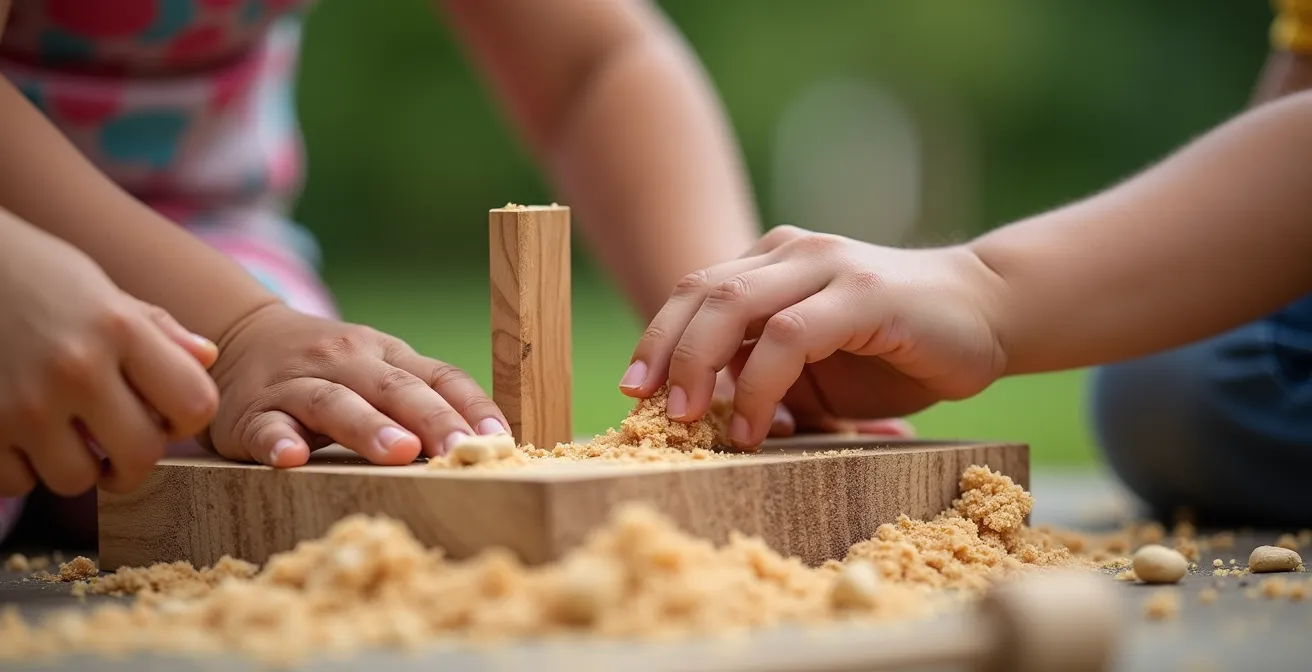
This isn’t just theory; it’s backed by research showing that shared, meaningful work is a powerful bonding agent. For example, one study showed that when siblings worked together on activities aligned with a family mission, their cooperation levels soared.
Mission-Driven Sibling Cooperation
Research involving over 800 high school students found a strong link between participation in family rituals and better sibling relationships. The study went further, discovering that when siblings were tasked with working together on mission-aligned family activities, such as organizing a food drive or planning a family event, their reported cooperation increased by 67% compared to when they were forced into activities that lacked a meaningful, shared purpose. The context of a shared mission transformed the nature of their interaction.
By engineering opportunities for required teamwork, you are not just keeping them busy; you are actively teaching them the skills and building the muscle memory of being on the same team.
Why Your Kids Roll Their Eyes at Family Meetings?
You announce it’s time for the “family meeting,” and a collective groan echoes through the house. The eye-rolling is almost audible. Why the resistance? Kids, especially teenagers, resist these meetings because they often feel like a top-down corporate lecture or a thinly veiled session to list their faults and assign chores. When a “meeting” is just another venue for parents to talk *at* them, it feels inauthentic, boring, and controlling. It lacks the critical ingredients of a true team huddle: shared ownership and genuine collaboration.
The resistance is a signal. It’s feedback that the current format isn’t working. Kids think family meetings are “corny” when they feel performative. The solution is to rebrand and restructure the entire concept. Ditch the corporate “meeting” language. Call it the “Family Huddle,” the “Team Game Plan,” or the “Sunday Summit.” More importantly, change the structure from a parental monologue to a collaborative forum. Start by celebrating wins from the past week. Give every family member, even the youngest, a chance to add items to the agenda. This immediately shifts the power dynamic and fosters a sense of agency.
The entire endeavor should be seen not as a one-time event to fix problems, but as an ongoing dialogue about what it means to be your family. As one expert on family culture puts it, this is a long-term investment in your shared identity.
The important thing is that you’re intentionally starting a conversation on what it means for your family to live the good life. This is a life-long, multi-generational discussion.
– Brett McKay, The Art of Manliness – Creating Family Culture
If participation is low, don’t force it. Make it an attractive, voluntary event. Pair it with a favorite snack, keep it short (20 minutes max), and focus initially only on positive things. Build positive associations first. Once the “summit” is seen as a place where everyone’s voice is heard and problems are solved *together*, the eye-rolling will slowly be replaced by engagement.
By transforming the meeting from a chore into a valued ritual, you turn it into one of the most powerful engines for building and maintaining your family culture.
Why “Family Fun Night” Is Torture for Your Teenager?
The mandatory “Family Fun Night” that was a hit with your 8-year-old is now met with deep sighs and excuses from your teenager. The reason is simple: a teenager’s primary developmental task is to build their own identity, separate from their parents. Forced, homogenous family fun can feel like a step backward—a childish activity that conflicts with their growing need for autonomy and peer connection. Pushing the same old board game night can feel like you’re not seeing them for who they are now, leading to resentment and disconnection, the exact opposite of your intention.
This doesn’t mean family connection is doomed. It means the approach must evolve. The key is to balance the family’s need for togetherness with the teenager’s need for independence. This is a delicate but crucial dance. Research validates this, as Psychology Today research indicates that families that adapt rituals to teen development maintain 73% stronger connections. The strategy must shift from mandatory attendance to offering a “menu of connection” that gives them a sense of choice and control.
Instead of one-size-fits-all events, create a variety of ways to connect, some of which are short, low-pressure, and teen-approved. This could include a quick 15-minute chat over a shared snack, watching one episode of a show they like together, or letting them take the lead on planning one family activity per month. The focus should shift from quantity of time to quality of interaction. A 10-minute authentic conversation where a teen feels heard is infinitely more valuable than a two-hour forced march through a board game they despise. Including “individuality” or “autonomy” as a stated value in your family mission statement can also validate their developmental stage.
The “Connection Menu” approach is a powerful tool. It respects their growing autonomy while keeping the door to family connection wide open. It might look something like this:
- Create a list of multiple connection options teens can choose from each week.
- Offer brief but meaningful 10-minute conversations as a valid option.
- Let the teen lead the activity choice once per month, giving them full control.
- Shift from mandatory attendance to an “opt-in” model for certain events.
- Focus on short, authentic interactions over long, forced events.
By offering choice and respecting their individuality, you show them that they are a valued member of the team, not just a subordinate who must comply.
Key Takeaways
- A family mission is a lived culture, not a written document. Start by fixing what’s broken, not by writing what’s ideal.
- Rituals are “identity anchors” that provide security and belonging, while a united parental front provides essential stability.
- True fairness means valuing each child’s unique contribution, not treating everyone the same. Shift from equality to equity.
The Sunday Summit: How to Run a Family Meeting That Isn’t Boring?
After addressing the fractures in cohesion and establishing the principles of a strong family culture, the “Sunday Summit” becomes the engine that keeps it all running. This is where the mission statement comes to life. A successful summit is not an agenda of chores and complaints; it is a mission-based ritual. It’s a weekly touchpoint to celebrate, problem-solve, and plan, all through the lens of your family’s core values. Its purpose is to reinforce your identity as a team.
The structure is what separates a vibrant summit from a boring meeting. Instead of a traditional corporate agenda, a mission-based meeting follows a more engaging flow. It should always start with a positive focus, like celebrating “wins” from the week where family members lived out a core value. When challenges are discussed, they are framed not as individual failings but as team problems to be solved using the family mission as a guide. This collaborative approach fosters psychological safety and encourages buy-in from everyone.
The DeYoung Family’s “Four-Word Mission” Framework
Proving that simplicity is key, the DeYoung family built their entire mission statement on just four words: “Inward, outward, upward, onward.” During their weekly meetings, this simple framework guides their entire discussion. They review how they are growing personally (inward), how they are serving others (outward), how they are choosing integrity (upward), and how they are learning and moving forward from challenges (onward). This elegant structure keeps their meetings focused, meaningful, and easy for everyone to remember and apply.
This shift in format fundamentally changes the energy and outcome of the gathering. It transforms it from a necessary evil into a valuable and even anticipated part of the week. The table below clearly contrasts the old, ineffective model with the new, mission-driven approach.
| Traditional Meeting | Mission-Based Meeting | Engagement Level |
|---|---|---|
| Review chores/tasks | Celebrate mission wins from the week | High – positive focus |
| Address problems | Problem-solve using family values | Medium-High – collaborative |
| Set schedules | Plan activities aligned with mission | High – purposeful |
| End with assignments | End with family motto/chant | High – unifying |
By running your Sunday Summit this way, you create a powerful, recurring ritual that actively builds the family you want to be, week after week.
Frequently Asked Questions about The Family Mission Statement
Why do kids think family meetings are ‘corny’?
Kids resist when meetings feel like corporate boardrooms or one-way lectures. Reframe them as ‘Team Huddles’ or ‘Family Game Plans’ and ensure everyone has equal voice and ownership of topics.
How can we make meetings less boring for teenagers?
Give teens ownership of one family value to lead discussion on, focus on solving their actual problems (not just parent agendas), and keep meetings short (20-30 minutes max).
What if family members won’t participate?
Start with voluntary participation, make it special with favorite snacks, and begin by celebrating wins rather than addressing problems. Build positive associations first.