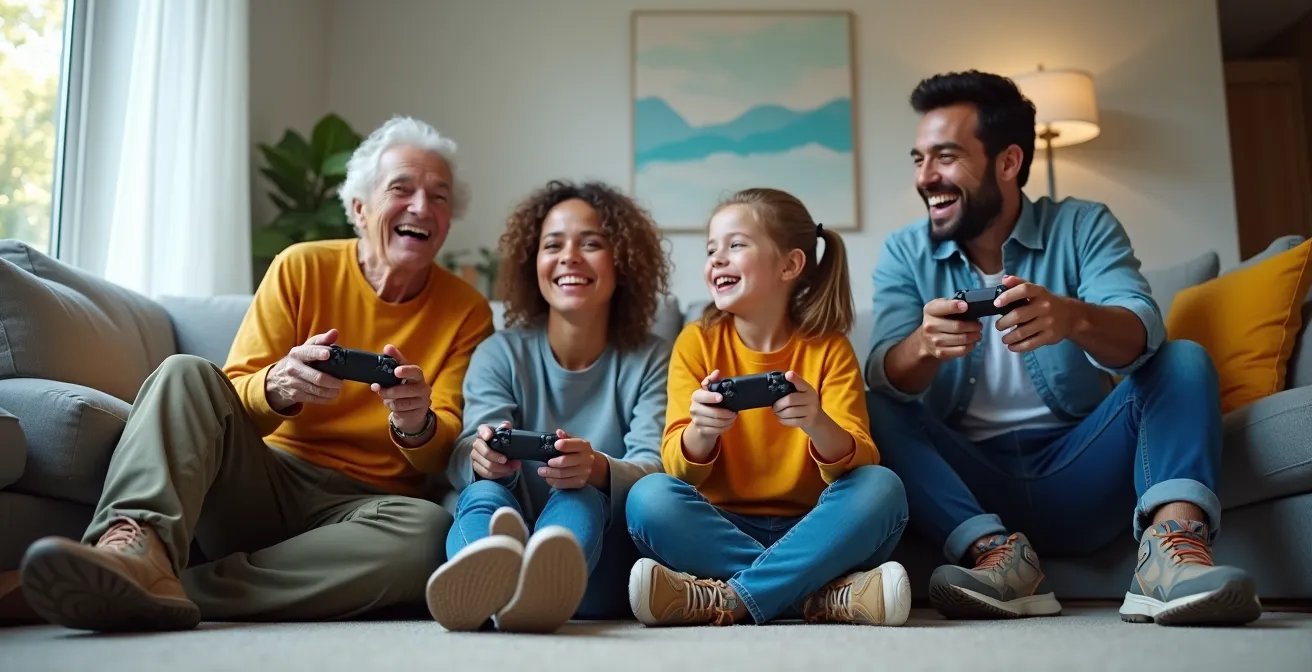
The secret to finding a hobby your whole family enjoys isn’t discovering one perfect activity—it’s designing a fair and flexible leisure system that works for everyone.
- Empower teenagers with real decision-making power and a veto to secure their buy-in.
- Use “handicap systems” or assign different roles to balance skill and age gaps in sports and games.
Recommendation: Start by defining your family’s core values in a shared “Adventure Manifesto” to guide your activity choices, ensuring they reflect who you are, not just what you do.
The scene is painfully familiar. You’ve declared it “Family Fun Night.” The board game is on the table, the snacks are out, but the enthusiasm is… selective. Your youngest is thrilled, your partner is trying their best to be supportive, and your teenager is broadcasting a signal of profound suffering that could be detected from space. The battle between hiking and gaming, between crafting and sports, feels like an unwinnable war for the family’s weekend. We’re told to “take turns choosing” or “find common ground,” but these platitudes often lead to one person’s enjoyment becoming another’s chore.
This cycle of forced fun and polite resentment stems from a fundamental misunderstanding. We treat family leisure like a hunt for a single, magical activity that will please everyone. But what if the solution isn’t about finding the perfect *what*, but engineering a better *how*? What if the key to genuine, multi-generational fun isn’t the activity itself, but the system you build around it?
This guide moves beyond generic suggestions. Instead, it offers a framework for you to act as your family’s own creative “Leisure Coordinator.” We will deconstruct the common points of failure—from teen apathy to skill imbalances—and provide you with concrete systems to build a more collaborative, engaging, and genuinely fun family culture. We’ll explore how to balance the playing field, manage costs for new ventures, and even turn sibling rivalry into a powerful engine for teamwork. It’s time to stop searching for a hobby and start designing your family’s unique blueprint for connection.
This article provides a structured approach to transforming your family’s shared time. The following sections break down the most common challenges and offer systematic solutions to create a leisure framework that everyone can get behind.
Summary: A Blueprint for Family Hobbies That Actually Work
- Why “Family Fun Night” Is Torture for Your Teenager?
- The Handicap System: How to Play Sports Together When Ages Vary?
- Rent vs. Buy: When to Commit to Expensive Gear for a New Hobby?
- The Sore Loser Parent: Are You Ruining the Game by Playing to Win?
- The Weekend Warrior: How to Fit Hobbies Between Soccer and Piano?
- Team Building for Siblings: Activities That Force Cooperation?
- Boredom Busters: How to Turn “I’m Bored” Into a Creative Project?
- The Family Mission Statement: How to Define “Who We Are”?
Why “Family Fun Night” Is Torture for Your Teenager?
The universal eye-roll from a teenager at the mention of “family fun” isn’t necessarily a rejection of the family itself; it’s a rejection of powerlessness. Adolescence is a developmental stage defined by the search for autonomy and identity. When activities are chosen and dictated by parents, they can feel less like a fun offering and more like a mandatory, patronizing chore. The pre-packaged fun night often fails because it lacks the one ingredient a teenager craves most: genuine agency.
To transform this dynamic, the role of the parent must shift from “organizer” to “facilitator.” Instead of presenting a finished plan, present a budget and a challenge. By giving them control over a portion of the family’s leisure planning, you’re not just asking for their opinion; you’re handing them real responsibility and demonstrating respect for their taste and judgment. This approach changes the activity from something they are forced to endure into something they own.
Establishing clear rules, like a “no-phones” zone during an activity *they* chose, reinforces that this respect is mutual. When a teen feels their choices are honored, they are far more likely to honor the boundaries set for the activity. The goal is to co-create experiences, turning a potential point of conflict into a training ground for negotiation, planning, and leadership.
Your Action Plan: Shifting from Parent-Organizer to Teen-Empowered Activities
- Give teens a real budget for planning one family activity per month.
- Allow veto power – teens can reject two parent-suggested activities monthly.
- Create a ‘consultant role’ where parents offer resources but teens lead the planning.
- Establish ‘no-phones’ zones during activities chosen by teens to show respect for their choice.
- Conduct after-activity reviews focusing on what worked and what they enjoyed, not what went wrong.
The Handicap System: How to Play Sports Together When Ages Vary?
A seven-year-old playing basketball against a forty-year-old is not a fair fight, and it’s not fun for either of them. The younger child feels defeated, and the parent feels guilty. This skill and age gap is where most active family hobbies fall apart. The solution, borrowed from sports like golf and bowling, is to build a Family Handicap System. This isn’t about making things “easy” for the younger player, but about creating equitable challenges so that everyone is playing to their own personal best.
This can be as simple as giving the adult a disadvantage (e.g., you can only shoot with your non-dominant hand) or giving the child an advantage (e.g., they start with 10 points). The key is to make these “rules” a fun and creative part of the game’s setup, not a condescending accommodation. By framing it as a strategic challenge, you turn the imbalance into part of the game itself.

Another powerful technique is assigning asymmetrical but equally important roles. In activities like hiking, one person can be the official “Navigator” with the map, another the “Snack Master” in charge of morale and energy, and a third the “Photographer” documenting the adventure. As documented in family activity studies, this method ensures every member contributes meaningfully, shifting the goal from individual competition to collective success. The measure of a good time is no longer “who won,” but “did our team accomplish its mission?”
Rent vs. Buy: When to Commit to Expensive Gear for a New Hobby?
The ghost of hobbies past haunts many a garage: dusty kayaks, barely used ski boots, and an expensive pottery wheel that now doubles as a plant stand. Enthusiasm for a new family hobby can be high, but the financial commitment is a major barrier—and a source of future guilt if the interest fades. Committing to a new hobby shouldn’t be a financial leap of faith; it should be a calculated, multi-stage process. The key is to create a structured hobby trial period before any significant purchase.
Think of it like a business pilot program. Before investing capital, you test the market. The first phase is renting. Can the family get through three rental sessions for paddleboarding or rock climbing and still be excited? If so, you graduate to the next phase: borrowing. This leverages social capital and community resources, giving you a feel for more regular use without the cost. Only after successfully navigating these low-investment stages should a family meeting be called to discuss a purchase.
This “business case” meeting is crucial. It’s not just about wanting the item, but about justifying it. By calculating the projected cost-per-use over a year, the family can make a rational, collective decision. If a $500 set of skis will be used 50 times, that’s $10 per use—a reasonable investment. If it’s likely to be used five times, renting remains the smarter choice. This framework removes emotion from the decision and teaches valuable financial literacy.
This structured approach to trying new hobbies is essential for managing family resources. The following framework, based on a popular model from an analysis of successful family hobby adoption, provides a clear path from initial curiosity to confident commitment.
| Stage | Action | Decision Point | Investment Level |
|---|---|---|---|
| Trial Phase (Month 1-2) | Rent equipment 3 times | Still interested after 3 uses? | $30-100 total rental |
| Validation Phase (Month 3) | Borrow from friends/community | Used 4+ times this month? | $0 + social capital |
| Commitment Phase (Month 4) | Family meeting with business case | Calculate cost-per-use over 1 year | Full purchase if <$10/use |
The Sore Loser Parent: Are You Ruining the Game by Playing to Win?
There’s a fine line between healthy competition and a parent whose intense desire to win sours the entire experience. The “sore loser parent”—or, just as destructively, the “gloating winner parent”—can inadvertently teach children that the only point of playing is to dominate. This pressure can crush the joy of participation and turn what should be a bonding experience into a stressful performance evaluation. If family members seem reluctant to play games with you, it might be time for some honest self-reflection.
Are you coaching from the sidelines? Making excuses when you lose to a child? Do you feel a genuine knot of tension when your team is behind in a low-stakes game of charades? Recognizing these behaviors is the first step. The goal isn’t to stop being competitive, but to channel that energy constructively. Your new objective isn’t to win the game, but to model good sportsmanship. This means celebrating a great play by your child more than your own victory, and analyzing a loss with curiosity rather than frustration.
To depersonalize post-game discussions and remove blame, families can adopt a powerful tool from an unexpected source: the military. As one research team highlights, this simple method shifts the focus from fault to facts. In the Journal of Family Dynamics Studies, they explain the value of a structured debrief:
The ‘After-Action Review’ technique borrowed from military practice focuses on three questions: What was supposed to happen? What actually happened? What accounts for the difference? This removes emotion and blame from post-game discussions.
– Family Psychology Research Team, Journal of Family Dynamics Studies
By implementing this technique, the conversation after a game of Monopoly changes from “You always buy all the properties!” to “Our strategy was to focus on the railroads, but we actually got blocked early. The difference was that the orange properties were bought first.” This analytical approach fosters strategic thinking and resilience, making every game—win or lose—a valuable learning experience.
The Weekend Warrior: How to Fit Hobbies Between Soccer and Piano?
In the whirlwind of school, sports practices, music lessons, and homework, the idea of adding a “family hobby” can feel like another exhausting item on an already impossible to-do list. The weekends are a frantic dance of obligations, and free time is a precious, scarce resource. However, the importance of these shared moments is growing; 61% of Americans now rate hobbies and recreational activities as extremely or very important to their lives, a significant increase from two decades ago. The solution isn’t to find a magical four-hour block of free time, but to redefine what a “hobby” can be.
Enter the Micro-Hobby Strategy. This approach focuses on integrating short, high-impact moments of shared activity into the existing cracks of your daily routine. It’s about quality over quantity. A five-minute collaborative activity done with full attention can be more bonding than a two-hour movie where everyone is on their phones. The goal is to sprinkle moments of connection throughout the week, rather than banking everything on a single, high-pressure weekend event.
These micro-hobbies can be woven into the fabric of your day. For example, you can build a collaborative family playlist during breakfast, solve a daily puzzle like Wordle together before homework, or practice a simple magic trick during a TV commercial break. These activities require minimal setup and time commitment but create consistent, positive touchpoints. They keep the spark of shared fun alive, even on the busiest of weeks, turning waiting time into connecting time.
- Daily Puzzle Solving: Work on the day’s Wordle, Connections, or a crossword puzzle together (5 minutes).
- Collaborative Playlist: Each family member adds one song to a shared playlist during a meal (10 minutes).
- Co-op Gaming Burst: Play one level of a cooperative video game like ‘Overcooked’ before homework (15 minutes).
- Story Building: While driving or waiting, one person starts a story with a sentence, and everyone takes turns adding the next one.
Team Building for Siblings: Activities That Force Cooperation?
Sibling relationships are often a mix of deep love and intense rivalry. While some competition is healthy, finding activities that shift the dynamic from rivalry to alliance can be transformative. The most effective team-building exercises are not those that simply ask for cooperation, but those where it is an absolute, non-negotiable requirement for success. The structure of the activity itself must do the teambuilding work.
This is where cooperative (co-op) games shine. Unlike competitive games where there is one winner, co-op games pit all players against the game itself. They must communicate, strategize, and divide labor effectively to win together—or lose together. This shared fate is a powerful bonding agent. The focus moves from “me vs. you” to “us vs. the challenge.” This creates a low-stakes training ground for real-world problem-solving and conflict resolution.
Case Study: Co-op Gaming as Conflict Resolution Training
A fascinating example of this in action is the Family Fun Pack YouTube channel. With millions of subscribers, the family documented how playing cooperative video games like ‘Overcooked’ and ‘It Takes Two’ fundamentally shifted their sibling dynamics. In these games, success is impossible without constant communication and task division. The parents noted that the skills learned under the fun, time-pressured environment of the game—like clear communication and dividing tasks based on strengths—began to transfer to real-world situations, improving how the siblings navigated chores and resolved disagreements. This approach, as detailed in reports on creator family dynamics, shows how a well-chosen hobby can be a powerful tool for social-emotional learning.
You don’t need video games to achieve this. A DIY “escape room” at home can be designed with puzzles that require different skill sets—one sibling might be strong with word puzzles, another with spatial reasoning. By creating challenges that physically require two people (e.g., holding down two buttons at opposite ends of a room), you engineer a situation where cooperation is the only path to the shared reward.
Boredom Busters: How to Turn “I’m Bored” Into a Creative Project?
The two most dreaded words for any parent are, “I’m bored.” Our modern instinct is to immediately solve this “problem” by suggesting an activity or handing over a screen. However, by rushing to fill the void, we rob our children—and ourselves—of a crucial catalyst for creativity. Boredom is not a problem to be solved; it is a space to be explored. It is the quiet, uncomfortable pause right before the mind makes a new connection or sparks an original idea.
As creativity researchers like Dr. Teresa Belton have pointed out, sitting with the discomfort of boredom is a necessary precursor to imaginative thought. The parental role, therefore, is not to be an entertainer but a guide. The challenge is to help your family learn to navigate this empty space and discover the creative impulse that lies on the other side. Instead of providing a solution, provide a prompt and a box of raw materials.
This is the principle behind the Invention Box Challenge. Designate a box and fill it with random, low-value materials: cardboard tubes, tape, string, fabric scraps, old (and safe) electronic parts, and bottle caps. When boredom strikes, the response is not a suggestion, but a mission: “Use the invention box to build something that solves a small family problem.” The problem could be anything from “a device to retrieve the remote without getting up” to “a better way to sort the mail.”
Setting a time limit (e.g., 45 minutes) prevents overthinking and encourages improvisation. At the end, each person presents their invention. The goal is not to judge functionality but to celebrate creativity. By creating a system for channeling the restless energy of boredom, you equip your family with a powerful tool for innovation and turn a moment of complaint into an opportunity for collaborative, imaginative play.
Key Takeaways
- Empower, Don’t Dictate: Give teens real control over planning and budgeting for activities to secure their buy-in and respect their need for autonomy.
- Engineer Fairness: Use “handicap systems” and assign asymmetrical roles to balance skill and age gaps, making activities challenging and fun for everyone.
- Start with Why: Before choosing an activity, define your family’s core values in an “Adventure Manifesto” to ensure your shared time reflects who you are.
The Family Mission Statement: How to Define “Who We Are”?
After exploring systems for making activities fairer, more inclusive, and more creative, we arrive at the most important question: Why are we doing this? Without a shared sense of purpose, even the most well-planned hobbies can feel hollow. A traditional, corporate-style “family mission statement” often feels stiff and uninspiring. A more dynamic and engaging approach is to create a visual Family Adventure Manifesto.
This isn’t about writing down words like “respect” and “kindness.” It’s about discovering the values that are already present in your family’s best moments. Start by having everyone list their top five favorite family memories. Was it the time you got lost on a hike and had to work together? The camping trip where it rained and you told stories in the tent? The afternoon you spontaneously decided to bake a ridiculously complex cake?
For each memory, identify the core feeling or value at its heart: was it adventure, teamwork, creativity, learning, or connection? These are your family’s true, lived values. Now, translate these values into a visual collage or mood board. Find images, symbols, and colors that represent “adventure” or “teamwork” to your family. This visual manifesto, created together and displayed in a high-traffic area, becomes a powerful and constant reminder of what truly matters to your family unit. As some Calgary families discovered, this visual approach is far more engaging for all ages than a simple text document.
This Adventure Manifesto becomes your North Star. When deciding on a new hobby or a weekend activity, you can hold it up against the manifesto. Does this align with our value of “curiosity”? Does it foster the “teamwork” we loved so much during that camping trip? This moves the decision away from individual preferences (“I don’t like hiking”) and toward a shared identity (“We are a family that values adventure and discovery”).
Your family’s next great adventure isn’t an activity to be found in a list, but a shared experience to be designed. Start by defining your family’s Adventure Manifesto, and you’ll have a compass to guide you toward hobbies that don’t just pass the time, but build a legacy of connection.