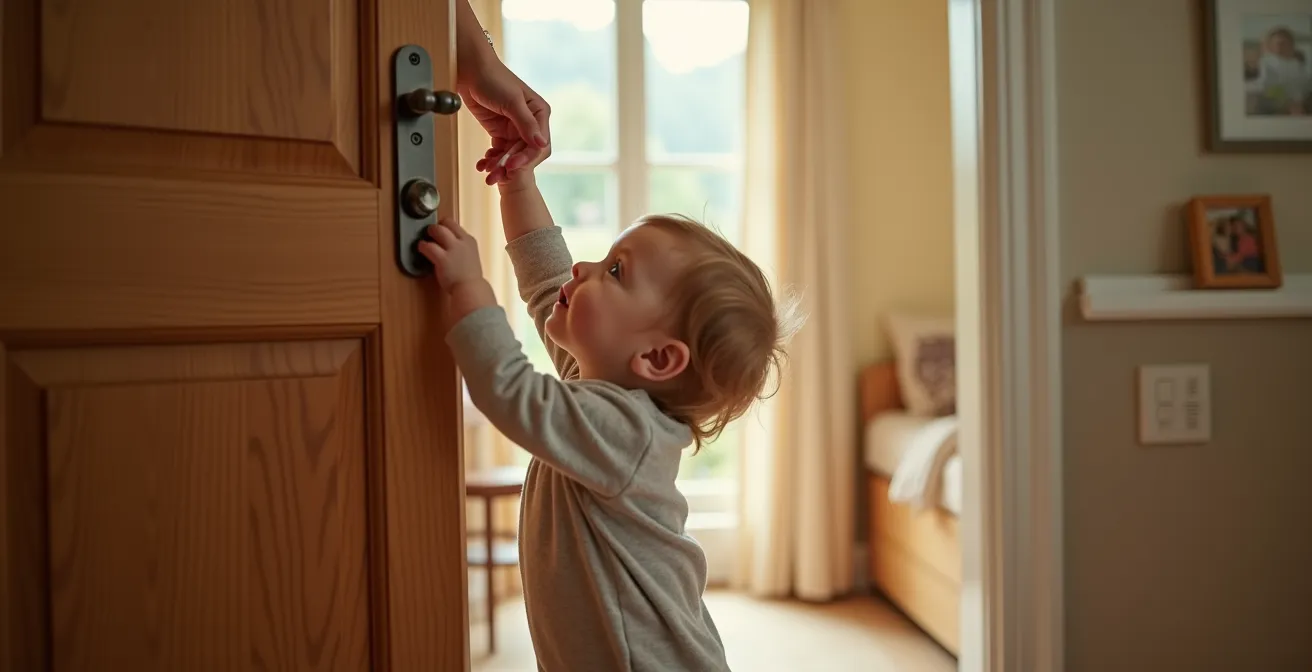
The goal isn’t just to get five minutes of peace in the bathroom. It’s to use that closed door as the first, most powerful lesson in a lifelong curriculum on boundaries, consent, and personal safety. This guide reframes your child’s ‘clinginess’ not as a problem to be solved, but as a sign of secure attachment—the very foundation from which their future independence will grow. It’s about teaching respect for space, not about exclusion.
That feeling is universal: you finally sit down on the toilet, seeking a rare moment of solitude, only to have small fingers appear under the door, followed by a questioning “Whatcha doin’?” For many parents, a child who follows them everywhere, especially into the bathroom, is a source of both amusement and deep exhaustion. The common advice is to simply lock the door or distract them with a toy, but these are temporary fixes for a much deeper opportunity. This isn’t just about your need for space; it’s your child’s first, most tangible lesson in the complex world of personal boundaries and bodily autonomy.
Treating this moment as a foundational teaching opportunity shifts the entire dynamic. Instead of seeing it as a frustrating interruption, you can frame it as the first chapter in a comprehensive Boundary Curriculum that will serve them their entire lives. This curriculum extends far beyond the bathroom, touching on physical consent with relatives, navigating shared spaces with siblings, and eventually, managing their digital footprint. The child who learns to knock on the bathroom door is the same child who will later understand not to read a friend’s diary or share someone’s private information online.
This guide moves beyond simple “how-to” tips. It provides a firm but respectful framework for establishing a family-wide culture of consent. We will explore the crucial difference between secrets and surprises, scripts for handling well-meaning but overbearing relatives, and the psychological reasons why your “clingy” child is actually building the secure base they need to become a confident, independent adult. The objective is not to shut your child out, but to equip them with the emotional scaffolding to understand and respect that some doors—both physical and emotional—should only be opened with permission.
This article will guide you through the essential components of this Boundary Curriculum. Each section builds upon the last, offering practical strategies to transform these everyday challenges into profound learning moments for your entire family.
Summary: Knocking First: Why Bathroom Privacy Is the First Chapter in Your Child’s Lifelong Boundary Curriculum
- Secrets vs. Surprises: The Safety Distinction Every Child Needs?
- The “My Body” Rule: How to Teach Grandparents Not to Force Hugs?
- Passwords and Diaries: When Does Safety Override Teen Privacy?
- The TMI Parent: Are You Burdening Your Child With Adult Problems?
- The Tape Line: Managing Boundaries When Siblings Share a Room?
- Why “Loving Kids” Is Not Enough: 5 Interview Questions for Potential Nannies
- Can You Be Too Attached? The Fine Line Between Connection and Enmeshment
- The Secure Base: Why Clingy Babies Become Independent Adults?
Secrets vs. Surprises: The Safety Distinction Every Child Needs?
The very first lesson in your family’s Boundary Curriculum must be about safety. Before you can teach the nuance of personal space, you must establish a clear line between what is kept quiet for joy and what is kept quiet out of fear. Children are often told not to “tattle,” which can easily be confused with a predator’s demand to “keep a secret.” Your job is to give them the language and emotional awareness to tell the difference, establishing a family rule of “no secrets.”
Explain that surprises are temporary, fun, and make everyone feel happy in the end, like planning a birthday party. Secrets, on the other hand, often feel heavy, uncomfortable, or make your tummy feel “weird.” This gut feeling is a critical internal alarm system. By validating this feeling, you empower your child to trust their instincts over an adult’s directive. Consistently reassure them that they will never get in trouble for sharing something that feels like a bad secret, no matter who asked them to keep it.
Case Study: The Chocolate Chip Secret
A parent, in an attempt to simplify potty training, gave their child a few chocolate chips after each success but told them, “Let’s keep this our little secret from your brother.” While well-intentioned, this created deep confusion. The child learned that some secrets with trusted adults are okay, accidentally blurring the lines. This simple act could have inadvertently made the child more vulnerable to keeping a harmful secret later, demonstrating how crucial it is for parents to be consistent with the “no secrets” rule.
This distinction is not a one-time conversation but an ongoing dialogue. Use everyday scenarios to practice. “Is hiding a gift for Grandma a secret or a surprise? How does it make you feel?” When a child understands that their safety and emotional comfort are paramount, they have the first and most important tool for navigating the world.
The “My Body” Rule: How to Teach Grandparents Not to Force Hugs?
Once safety is established, the next chapter in the curriculum is bodily autonomy. The bathroom door is one part of this, but the lesson truly solidifies during family gatherings. The well-meaning relative who swoops in for a mandatory hug or kiss puts a child in a difficult position: do they please the adult or honor their own feeling of not wanting to be touched? Your role as a boundary coach is to advocate for your child and teach relatives that connection does not require forced affection.
This requires you to be your child’s “Boundary Ambassador.” Before a family event, you can proactively tell relatives, “We’re teaching the kids about consent, so we’re letting them decide how to say hello and goodbye.” This isn’t confrontational; it’s educational. As one useful script from the Boundary Ambassador Framework suggests, you can model positive alternatives:
We’re teaching Alex about consent, so we’re letting him choose how he says hello. A high-five or a wave are great, too!
– Parenting Script Example, Boundary Ambassador Framework
This approach gives your child agency and provides the relative with a clear, alternative way to connect. You are not denying affection; you are expanding the menu of how affection can be shown. This teaches the child that their “no” is powerful and will be respected, and it teaches adults that a child’s comfort is more important than social expectations.
To make this practical, you can introduce a “Connection Menu.” This reframes the interaction from a single expected outcome (a hug) to a list of choices where the child is in control. This empowers them and removes the pressure from the situation.

The table below, inspired by a framework for teaching personal agency, offers concrete alternatives to replace traditional, often forced, interactions. It helps everyone understand that respect and love can be shown in many different ways.
| Traditional Expectation | Connection Menu Alternative | Child’s Autonomy Level |
|---|---|---|
| Mandatory hug for grandparents | High-five, fist bump, wave, or show a drawing | Full choice |
| Kiss goodbye | Blow a kiss, thumbs up, or verbal ‘love you’ | Full choice |
| Sit on relative’s lap | Sit beside, across, or stand nearby | Full choice |
Passwords and Diaries: When Does Safety Override Teen Privacy?
The Boundary Curriculum you begin at the bathroom door must evolve as your child grows. The toddler who learns about personal space becomes the teenager who expects a digital world of their own. For parents, this is often terrifying. The instinct is to monitor everything for safety, but constant surveillance can destroy the very trust you’ve worked to build. The key is to shift from a model of control to a model of trust-but-verify, where privacy is the default and safety check-ins are the agreed-upon exception.
This phase of the curriculum is about co-creating a framework for digital and personal privacy. It should be an explicit contract, not a set of unspoken rules. This contract should outline specific “red flag” behaviors (like talk of self-harm, extreme withdrawal, or signs of bullying) that would trigger a safety check-in, which should be done *with* the teen, not behind their back. The goal is to teach them how to manage their private world safely, not to spy on them.
This graduated approach to privacy should have clear timelines. Full access at age 13 might slowly transition to more independence at 15. This is a milestone that parenting experts recommend that by age 16, teens should have the freedom to create passwords their parents don’t know. Earning this freedom is part of their journey to adulthood. By establishing this path early, you show that privacy is a privilege that grows with responsibility, reinforcing the lessons of respect and trust started years ago.
The TMI Parent: Are You Burdening Your Child With Adult Problems?
Boundaries are a two-way street. While you are teaching your child to respect your space, you must also model respecting theirs—and that includes their emotional space. It is easy for a parent, especially a single parent or one feeling isolated, to turn their child into a confidante. This is often called being a “TMI (Too Much Information) Parent.” Sharing financial stress, marital problems, or deep anxieties with a child forces them into the role of an emotional caretaker, a burden they are not equipped to carry. This is a form of enmeshment, where the lines between parent and child blur.
As one child development expert notes, this has lasting consequences:
When a parent has no emotional boundaries, the child learns that love means enmeshment and a lack of personal space
– Child Development Expert, Teaching Privacy to Kids
To avoid this, you must create a “parental information filter.” Before you vent to your child, ask yourself a few critical questions. Is this information something they can act on? Am I sharing to teach them, or simply to relieve my own stress? Who is the appropriate adult I should be talking to instead? This self-regulation is a crucial part of modeling healthy boundaries. When your child sees you respecting their emotional capacity, they learn that love doesn’t mean carrying someone else’s problems. It teaches them that they are an individual, not just an extension of you.
To put this into practice, use this simple checklist as your filter before sharing adult-level information with your child:
- Is this information actionable for my child? (e.g., “We’re saving money, so we can’t buy that toy” is actionable; “I’m worried we can’t make rent” is not.)
- Does this help them understand their world, or add an unbearable burden?
- Am I sharing to vent, or to teach?
- Who is the appropriate adult I should be sharing this with instead? (A partner, a friend, a therapist.)
- Will this information make my child feel responsible for my happiness or our family’s problems?
The Tape Line: Managing Boundaries When Siblings Share a Room?
Perhaps the most intense real-world test of the Boundary Curriculum is a shared bedroom. The classic image of a tape line down the middle of the floor is a humorous but accurate depiction of the need for personal space. However, physical territory is only one type of boundary. In a shared room, children must also learn to navigate time, sensory, and social boundaries, skills that are a direct echo of what they will need to manage their future digital lives.
Instead of just focusing on whose side of the room is whose, introduce concepts like “Headphone Zones” or “Focus Time.” Designating a 30-minute block where one sibling can listen to music with headphones while the other reads quietly teaches them to respect sensory boundaries. It’s the physical-world equivalent of learning not to demand an instant reply to a text message. This is about managing availability and respecting that someone can be physically present without being socially available for interaction.
Another powerful concept is “Alone-Together Time,” where siblings can be in the same room doing their own separate activities without the requirement to engage. This skill is crucial for avoiding the pressure of being “always on” that pervades digital communication. By practicing these more nuanced boundaries in a shared physical space, siblings learn the foundational skills for healthy relationships, both online and off. They learn that respecting someone’s space is not just about staying on your side of the tape line, but also about honoring their need for quiet, focus, and solitude.
This table outlines how to translate physical room-sharing rules into crucial life skills, connecting them directly to the challenges of digital citizenship.
| Boundary Type | Implementation | Digital Life Connection |
|---|---|---|
| Headphone Zones | Designated quiet times with noise boundaries | Practice for managing notifications |
| Focus Time | 30-minute blocks of uninterrupted activity | Skills for avoiding constant availability |
| Alone-Together Time | Same room, no interaction required | Understanding digital presence vs engagement |
Why “Loving Kids” Is Not Enough: 5 Interview Questions for Potential Nannies
Your family’s Boundary Curriculum is only as strong as its weakest link. If you’ve worked hard to establish a culture of consent and respect, you must ensure that every caregiver in your child’s life upholds those same standards. When interviewing a potential nanny or babysitter, asking if they “love kids” is not enough. You need to test their understanding and commitment to your family’s rules on privacy and bodily autonomy.
This means moving beyond generic questions and using specific, scenario-based inquiries that reveal their true instincts. A candidate’s response to a hypothetical boundary challenge is far more telling than their stated philosophy. For example, how they would handle a toddler’s insistence on bathroom privacy or a 4-year-old’s refusal to hug a family friend will show you whether their default is to prioritize adult comfort or the child’s autonomy. Their answers are a direct window into whether they will reinforce or undermine your curriculum.
You are not just hiring help; you are hiring a co-teacher for some of life’s most important lessons. Ensuring they are aligned with your values on privacy, consent, and online photo sharing is non-negotiable. It protects your child and maintains the consistency that is crucial for these lessons to stick.
Your Action Plan: 5 Essential Boundary-Testing Interview Questions for Nannies
- What would you do if my 4-year-old said they needed private time in their room? (Tests their respect for a child’s need for solitude.)
- How do you handle a toddler who insists on following you into the bathroom? (Reveals their approach to teaching privacy vs. simple management.)
- A family friend wants to hug the kids, but they say no. What do you do? (Directly assesses their stance on bodily autonomy and consent.)
- What are your rules about posting photos of children online? (A critical question for digital privacy and safety.)
- How would you handle personal phone use during work hours with the children? (Tests their own boundaries and ability to be present.)
Can You Be Too Attached? The Fine Line Between Connection and Enmeshment
As you teach boundaries, a nagging fear may surface: “Am I pushing my child away? Can we be *too* attached?” It’s crucial to distinguish between healthy, secure attachment and unhealthy enmeshment. Secure attachment is a bond that makes a child feel safe enough to explore the world, knowing they have a secure base to return to. Enmeshment is a fusion where boundaries are so blurred that the parent and child’s emotions are indistinguishable. The parent feels the child’s disappointments as their own failures, and the child feels responsible for the parent’s happiness.
The child who follows you to the bathroom is not necessarily a sign of enmeshment; more often, it is a sign of a strong attachment. They see you as their safe harbor. The push for privacy is a natural and healthy part of their development, not a rejection of you. In fact, this push is a sign that the attachment is working. This aligns with developmental milestones, as research shows children understand privacy by age 6 and begin to develop a stronger sense of self as separate from their parents.
Your role is to honor this emerging independence without feeling rejected. This means celebrating when your child says, “I can do it myself,” or when they want to play alone in their room. It means finding your own emotional support system instead of relying on your child. The goal is differentiation: seeing your child as a separate, unique individual whom you love and guide, not as an extension of yourself. This is the fine line between connection and enmeshment, and walking it successfully is what allows your child to become a confident, whole person.
Key takeaways
- Distinguish “surprises” (joyful, temporary) from “secrets” (uncomfortable, unsafe) as the foundational safety rule.
- Model and enforce consent for physical affection, even with family. Offer alternatives like high-fives to respect bodily autonomy.
- A child’s need for space is a developmental milestone, not a rejection of you. A secure attachment is the base for independence.
The Secure Base: Why Clingy Babies Become Independent Adults?
We arrive at the most profound and perhaps counter-intuitive truth of the Boundary Curriculum: the child who follows you to the bathroom is not a “problem” to be fixed, but a child who is demonstrating a healthy, secure attachment. Their “clinginess” is not a sign of weakness or future dependence. It is the very foundation from which their independence will grow. In attachment theory, this is known as the secure base. The child who knows, without a doubt, that they have a safe, responsive caregiver to return to is the child who has the courage to explore the world.
As one expert on attachment theory clarifies, this bond isn’t about constant physical contact:
Secure attachment is not built on 24/7 physical proximity, but on consistent, predictable responsiveness.
– Attachment Theory Expert, First Five Years Australia
When you respond to your child’s need for closeness with reassurance, and then gently and respectfully set a boundary (“I need to use the potty by myself. I’ll be right out”), you are doing two things at once. You are confirming their secure base while also teaching them the first lesson in respecting another’s space. This “rupture and repair” cycle—the small separation and the predictable reunion—is how resilience is built. They learn that a closed door is not a sign of rejection or abandonment, but a temporary and normal boundary.
Case Study: Privacy on the Potty
A parent practicing elimination communication with their baby was frustrated with multiple, incomplete trips to the potty. On a whim, they tried giving the baby a moment of privacy, partially hiding behind the sink while the child sat on the small potty. The result was transformative. In that moment of solitude, the baby had one complete elimination. This powerful example from the world of diaper-free parenting shows that the need for privacy to “let go” can start even in infancy, and that honoring it directly supports a child’s bodily functions and independence.
So the next time those little fingers wiggle under the door, take a breath. See it not as an intrusion, but as a confirmation of your strong bond. You are their secure base. And from that base, with your firm and respectful guidance, they will build the confidence to not only let you close the door, but to walk out into the world on their own.
Start today by framing the next closed door not as a barrier, but as a respectful boundary. Your consistent, calm reinforcement is the most powerful tool you have to build a family culture of consent and mutual respect that will last a lifetime.