
Contrary to popular belief, holding your “clingy” baby isn’t creating a dependent child; it’s building the secure foundation they need to become a confident adult.
- The need for physical closeness is a biological drive for safety and survival, not a form of manipulation or a sign of weakness.
- Responding consistently to your child’s needs teaches them trust and co-regulation, the essential prerequisites for exploring the world on their own.
Recommendation: Shift your focus from preventing clinginess to consistently providing a secure base, and watch their independence naturally unfold.
The weight of a small child pressed against you can feel like both the greatest privilege and an overwhelming burden. For many parents, especially those with a “velcro baby” who fusses the moment they are put down, a persistent worry takes root. Well-meaning friends, family, and even outdated parenting books whisper the same fear: “You’re spoiling them,” “They’ll never be independent,” “You’re creating a clingy child.” This advice, born from a misunderstanding of child development, places parents in an impossible conflict between their instincts and their anxieties.
The common solutions offered—letting them “cry it out” to build resilience or distracting them from their distress—often feel wrong because they are. They treat a fundamental human need for connection as a behavioral problem to be extinguished. These approaches ignore the profound neurological and emotional processes at play. They ask you to fight against your child’s biology and your own.
But what if that “clinginess” isn’t a problem to be solved, but rather a vital sign of a healthy, developing attachment? What if the very act of providing that comfort and security is not a crutch, but the launchpad for true independence? This is the core principle of attachment theory: a child who feels unconditionally secure is a child who has the courage to explore. A securely attached child knows they have a safe harbor to return to, which frees them to sail out into the world. This article will deconstruct the myths around dependency and show how your responsiveness builds the very foundation of your child’s future autonomy.
This guide will walk you through the science of secure attachment, exploring the key moments and challenges that define the parent-child bond. From understanding separation panic to repairing connection after conflict, you will gain the confidence to trust your instincts and nurture your child’s journey toward confident independence.
Summary: How a Secure Base Cultivates True Independence
- The “Repair” Conversation: What to Say After You Yell at Your Child?
- Why Does Your Child Panic When You Leave the Room for 2 Minutes?
- The “I Don’t Care” Defense: Is Your Child Independent or Detached?
- Adoption and Bonding: How to Build Trust With an Older Child?
- Can You Be Too Attached? The Fine Line Between Connection and Enmeshment
- The Goodbye Protocol: How to Leave Your Toddler Without Tears in 10 Days
- The “Fix-It” Trap: Why Solutions Make Kids Stop Talking to You?
- Reliability Over Perfection: Why “Good Enough” Parenting Builds Better Bonds?
The “Repair” Conversation: What to Say After You Yell at Your Child?
No parent is perfect. In moments of exhaustion and frustration, voices get raised. The guilt that follows can be immense, coupled with the fear of having damaged the connection with your child. However, from an attachment perspective, these moments of “rupture” are not the end of the story. In fact, the “repair” that follows is one of the most powerful tools for strengthening a bond. It teaches your child a crucial lesson: that the relationship is resilient and can withstand conflict, and that mistakes can be mended.
Attempting to ignore the incident or pretending it didn’t happen leaves the child with a residue of fear and confusion. A sincere repair, on the other hand, models accountability, empathy, and emotional regulation. It communicates, “My anger was big, but our connection is bigger.” This process isn’t about groveling or relinquishing parental authority; it’s about acknowledging your own humanity and validating your child’s feelings. It shifts the focus from blame to reconnection, reinforcing the safety of the secure base you provide.
The goal is to show your child that you are a safe person to have big feelings around, even when those feelings are anger or disappointment. By taking responsibility for your actions, you give them a blueprint for doing the same. This act of vulnerability doesn’t make you a weak parent; it makes you a trustworthy one. It’s in these moments of reconnection that a child learns that love isn’t conditional on perfect behavior, a foundational belief for secure attachment.
Ultimately, modeling how to apologize and reconnect after a conflict is a far more valuable lesson than pretending you never make mistakes. It is this very process of rupture and repair that builds the emotional resilience needed for lasting independence.
Why Does Your Child Panic When You Leave the Room for 2 Minutes?
The sudden, full-throated panic that erupts when you step out of sight can be jarring for any parent. It’s often misinterpreted as manipulation or a sign of a “spoiled” child. In reality, this behavior is a normal, healthy, and predictable part of development known as separation anxiety. It’s a powerful sign that your child has formed a strong, primary attachment to you. They are not trying to control you; they are expressing a profound, biologically-driven fear that their source of safety and security—their secure base—has vanished.
This behavior is rooted in the development of “object permanence.” Before this cognitive leap, it’s “out of sight, out of mind.” But once a baby understands that people and objects exist even when they can’t be seen, they also realize you can leave. This developmental stage, where anxiety about separation peaks between 10 and 18 months, is a testament to their cognitive growth and their deep bond with you. Their distress is genuine. To them, your disappearance feels like a threat to their very survival. Responding with annoyance or by ignoring their cries only heightens their panic and reinforces the idea that the world is unsafe without you.
The most effective response is to provide reassurance. Your calm return, even after a two-minute absence, teaches a critical lesson: “You were scared, but I came back. You are safe.” This is not rewarding “bad” behavior; it is responding to a legitimate need. Each time you respond with comfort, you deposit another coin in their “trust bank,” building the inner security that will eventually allow them to tolerate separations with confidence.
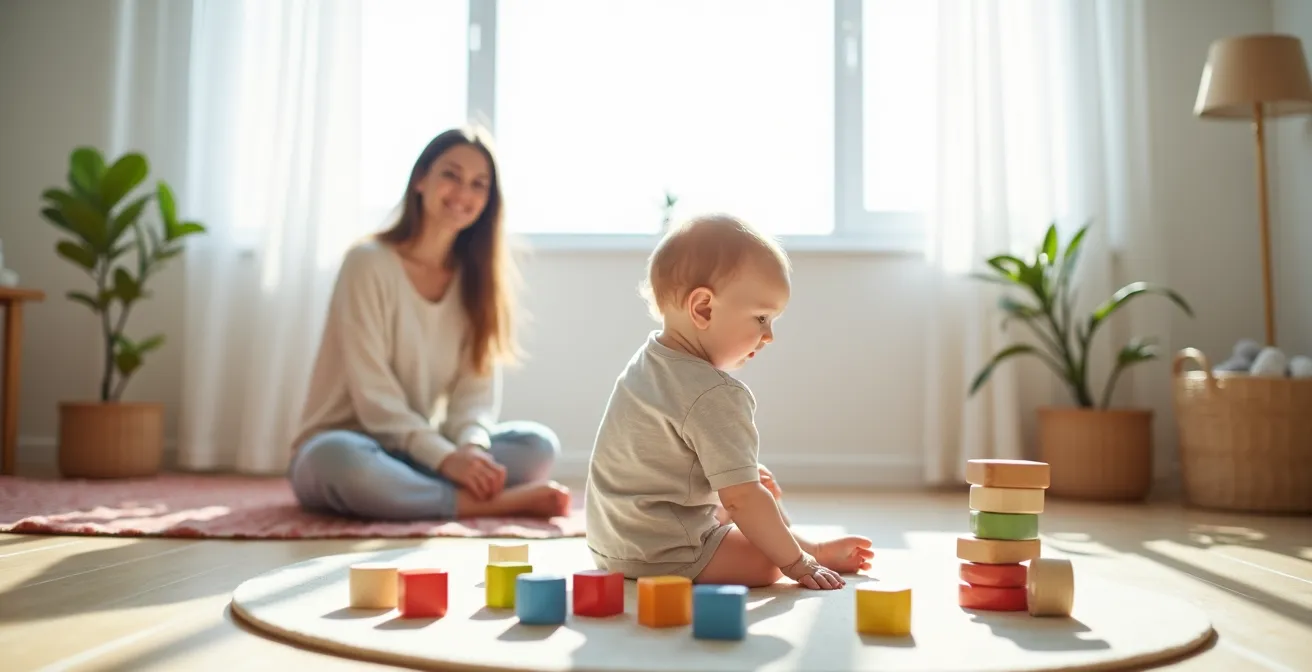
As you can see in this depiction of a secure base, the child feels free to explore precisely because they can check back and confirm your presence. This act of “emotional refueling” is the engine of independence. They are not clinging out of weakness; they are connecting to find the strength to venture forth.
Instead of viewing this panic as a problem, reframe it as proof of your successful bonding. You have become your child’s world, and their protest at your departure is a testament to your importance. This is the foundation upon which their future confidence will be built.
The “I Don’t Care” Defense: Is Your Child Independent or Detached?
As children grow, some develop a seemingly independent streak, shrugging off offers of comfort with a stoic “I’m fine” or “I don’t care.” While this might look like the self-reliance parents hope for, it’s crucial to distinguish between true, secure independence and a defensive detachment. Secure independence is born from confidence; the child knows they can handle challenges but also that they can seek comfort if needed. Defensive detachment, or an avoidant attachment style, is born from disappointment; the child has learned that signaling their needs is pointless or even risky, so they stop trying.
The attachment bond is the core of this distinction. As attachment specialists note, it is a deep, non-verbal connection that forms the basis of a child’s sense of safety and value. As Jeanne Segal, Ph.D., and Marti Glenn, Ph.D., explain for HelpGuide.org:
The attachment bond is the emotional connection formed by wordless communication between an infant and you, their parent or primary caretaker.
– Jeanne Segal, Ph.D., Marti Glenn, Ph.D., HelpGuide.org – What is Secure Attachment and Bonding
A child who appears overly independent may actually be investing significant mental energy into suppressing their natural attachment needs. They don’t seek comfort not because they don’t need it, but because they have concluded it won’t be provided in a way that feels safe. This can happen in homes where emotions are dismissed or where parents are emotionally unavailable. The child’s “I don’t care” is a protective shield against the pain of their needs being ignored. They are not independent; they are alone.
Distinguishing between these two states is critical for fostering genuine emotional health. The following table, based on attachment research, highlights key differences in behavior, which a comparative analysis of attachment behaviors can help clarify.
| Behavior | Secure Explorer | Avoidant Defender |
|---|---|---|
| Exploration Pattern | Ventures out but ‘checks back’ with caregiver | Explores without seeking connection |
| Response to Stress | Returns to caregiver for comfort | Self-soothes, doesn’t signal needs |
| Emotional Expression | Shows full range of emotions openly | Suppresses emotional needs |
| Energy Usage | Natural, relaxed exploration | High mental energy suppressing attachment needs |
True independence is not the absence of need; it is the confidence that our needs will be met. The goal is not a child who never asks for help, but one who knows, without a doubt, that help is always there if they do.
Adoption and Bonding: How to Build Trust With an Older Child?
Building a secure attachment with an adopted older child presents a unique and profound journey. Unlike an infant, an older child often comes with a history that may include neglect, trauma, or broken attachments. Their internal “blueprint” for relationships may be one of mistrust and self-preservation. Their clinginess—or, conversely, their defensive detachment—is not just a developmental phase but a survival strategy honed by experience. Building a bond in this context requires more than just love; it requires a conscious, therapeutic approach centered on earning trust through radical predictability.
Many children who have experienced trauma operate in a heightened state of stress, with overactive fight-or-flight responses. Their brains are wired to expect danger and abandonment. Verbal declarations of love or promises of a “forever home” can feel meaningless or even threatening in the face of this wiring. Trust is not built with words, but with thousands of tiny, consistent, and predictable actions over time. This approach, often called therapeutic parenting, is about creating an environment of such profound safety that the child’s nervous system can finally begin to relax and recalibrate.
Case Study: The Power of Therapeutic Parenting
Therapeutic parenting involves creating a highly structured and predictable environment with an unwavering focus on attachment. A child who has experienced early life trauma often has elevated cortisol levels, keeping them in a constant state of alert. Their behaviors are often survival responses, not defiance. For these children, trust must be practiced and earned through radical predictability. The parent’s role is to become the external regulator of the child’s emotions, consistently responding with calm and empathy, which, over time, helps the child’s brain and body learn that they are finally safe, allowing a secure bond to form.
The foundation of this process is showing up, consistently and reliably, in the small moments of everyday life. It’s about the predictable morning routine, the calm response to an outburst, and the quiet interest shown in their day. These repeated, reliable interactions slowly rewrite the child’s internal script from “I am alone and must protect myself” to “I am safe and my needs will be met.”
Your Action Plan: Auditing Daily Connection Points
- Points of contact: List all the small, daily routines where you interact with your child (e.g., waking up, meal times, bedtime, car rides). Are these moments calm and connecting or rushed and stressful?
- Collecte: For one week, inventory the emotional “bids” your child makes for connection (e.g., asking a question, showing you something, a sigh). How are you currently responding?
- Cohérence: Compare your responses to your core parenting value of building trust. Are your actions (e.g., being on your phone during a conversation) aligned with your goal of being present?
- Mémorabilité/émotion: Identify one routine that feels transactional. How could you inject a unique, memorable moment of connection into it (e.g., a special handshake at school drop-off)?
- Plan d’intégration: Choose one point of contact to focus on. Commit to replacing a distracted or rushed interaction with a fully present, empathetic one for the next two weeks.
For the adopted older child, the parent becomes a “secure base” in retrospect. You are providing the safety and reliability they never had, allowing them to finally do the emotional work of childhood and, from that place of security, step into a future of confident independence.
Can You Be Too Attached? The Fine Line Between Connection and Enmeshment
In the pursuit of secure attachment, a valid question often arises: is it possible to go too far? Can a parent be *too* responsive, creating a bond that is not secure, but suffocating? The answer is yes. There is a critical distinction between a healthy, secure attachment and an unhealthy, enmeshed relationship. Understanding this line is key to fostering true independence rather than anxious dependency. A secure attachment is a relationship of mutual respect that provides a safe base for the child’s exploration. Enmeshment, on the other hand, is when the parent’s emotional needs bleed into the relationship, overriding the child’s developmental need for autonomy.
As renowned attachment researcher L. Alan Sroufe succinctly puts it, the quality of the bond is what matters, not just its intensity. A connection can feel close but be fundamentally insecure.
There’s a difference between a ‘tight’ connection and a secure attachment.
– L. Alan Sroufe, Developmental Science – What is a Secure Attachment
An enmeshed parent may struggle to see their child as a separate individual. They might feel personally rejected when their toddler wants to play alone, or they might project their own anxieties onto the child, preventing them from taking age-appropriate risks. In this dynamic, the parent’s need for closeness dictates the child’s behavior. The child may learn to suppress their own desires for independence to please the parent and maintain relational harmony. They remain physically and emotionally close not out of a sense of security, but out of a sense of obligation or anxiety about the parent’s reaction if they pull away.
The hallmark of a secure attachment is its flexibility. It provides comfort when the child is distressed or afraid, but it also celebrates and encourages their drive for exploration and independence when they feel confident. It’s a dance of connection and separation, led by the child’s needs, not the parent’s. A securely attached child feels the freedom to say “no,” to have their own preferences, and to venture away from the parent, all while knowing the secure base is there waiting for their return. Enmeshment clips the child’s wings; secure attachment gives them the confidence to fly.
The goal is not to create a child who never leaves your side, but one who knows they can always come back. This requires a parent who is secure enough in their own worth to celebrate their child’s journey away from them.
The Goodbye Protocol: How to Leave Your Toddler Without Tears in 10 Days
The daily ritual of daycare drop-off or leaving a toddler with a babysitter can become a source of dread for parents and children alike. The tears, the clinging, the heart-wrenching cries of “Don’t go!” can make any parent question their decision. The temptation is to either sneak away to avoid the scene or to engage in a long, drawn-out goodbye, hoping to soothe the child into compliance. Attachment science shows us that both approaches are counterproductive. Sneaking away erodes trust, while lingering reinforces the child’s anxiety. The key is a clear, consistent, and confident goodbye protocol.
A successful goodbye ritual is not about eliminating the child’s feelings—sadness at a parent’s departure is normal and healthy. Instead, it’s about acknowledging their feelings while providing a predictable structure that communicates safety and confidence. The goal is to be both emotionally present and resolute. You give your full, loving attention, state clearly that you are leaving and when you will return, and then you leave. This consistency is what builds trust and helps the child’s nervous system learn that separation is temporary and survivable.
This process takes practice and commitment. It’s important for parents to manage their own anxiety, as children are highly attuned to our emotional state. If we are hesitant or guilty, they will interpret our departure as something to be feared. A calm, confident, and loving exit tells them, “This is safe. You will be okay. I will be back.” Over time, this predictability creates security. While there may be an initial period of protest, most children adapt. It’s reassuring for parents to know that according to research, most children show decreased separation anxiety by age 3, especially when caregivers are consistent.
Implementing a structured goodbye routine can transform this daily challenge. The following steps, based on evidence from child development experts, provide a clear roadmap:
- Keep goodbyes short and sweet. Even with special rituals like a secret handshake or a window wave, do not linger.
- Follow the same drop-off ritual at the same time each day to maximize predictability.
- Give your child your full attention and affection, then leave quickly and confidently, even if they are protesting.
- Provide specifics about your return in terms they can understand, such as “I’ll be back after your nap and before your afternoon snack.”
- Never sneak back for “one more hug” after you’ve left. This restarts the entire separation process and undermines their trust.
- Practice short, gradual separations with other trusted caregivers before major transitions like starting daycare.
Ultimately, a good goodbye is not about avoiding tears. It’s about building the deep-seated trust that allows a child to hold onto the knowledge of your return long after you’ve walked out the door.
The “Fix-It” Trap: Why Solutions Make Kids Stop Talking to You?
When a child comes to us with a problem—a conflict with a friend, a struggle at school, a disappointment—our instinct as parents is to jump in and fix it. We offer advice, brainstorm solutions, or even intervene on their behalf. We do this out of love, wanting to alleviate their pain. The paradox, however, is that this “fix-it” response often has the opposite effect. Instead of bringing us closer, it can make a child shut down and stop sharing their problems with us altogether. Why? Because what they are often seeking is not a solution, but a connection.
When a child is upset, their primary need is emotional regulation. They need a calm, empathetic presence to help them manage their big feelings. This process, known as co-regulation, is a biological necessity. By simply listening, validating their feelings (“That sounds really frustrating,” “I can see why you’re so upset”), and offering a caring presence, we help their nervous system calm down. When we rush to solutions, we inadvertently send a message that their feelings are a problem to be solved quickly, rather than an experience to be shared and understood.
Case Study: The Neuroscience of Listening
Research on parent response styles reveals a powerful neurological truth: when a parent stays calm and acknowledges a child’s feelings instead of immediately jumping to solve the problem, the child’s stress hormone levels (cortisol) actually decrease. An adult’s caring, non-judgmental presence physically changes how a child’s brain and body respond to stress. This process of co-regulation is not just a nice idea; it’s a biological mechanism that builds a child’s own capacity for self-regulation over time, all through the foundation of a safe and trusting relationship.
Resisting the urge to fix things requires a significant shift in our parental role—from manager and problem-solver to emotional anchor. It means becoming comfortable with our child’s discomfort and trusting that they can, with our support, find their own way. By holding space for their emotions without trying to change them, we communicate profound trust in their competence and resilience. We are telling them, “I’m here with you in this difficult feeling. You are not alone. And I trust you to handle this.”

This act of quiet, active listening—where our goal is to understand, not to respond—is one of the most powerful ways to strengthen an attachment bond, especially as children enter adolescence. It is in these moments of shared vulnerability that a child learns their parent is not just a provider, but a true secure base they can turn to with any problem, knowing they will be met with empathy, not an action plan.
The next time your child comes to you with a problem, try taking a breath and offering a simple, “Tell me more about it.” You might be surprised to find that your listening ear is the only solution they ever really needed.
Key Takeaways
- A child’s “clinginess” is a healthy form of communication, signaling their biological need for safety and connection, not a sign of manipulation or future dependency.
- The primary goal of responsive parenting is not to prevent separation but to consistently provide a “secure base,” which gives a child the confidence to explore and become independent.
- Building a strong bond is not about parental perfection. The process of “rupture and repair”—mending the connection after conflicts—is what truly teaches children emotional resilience and trust.
Reliability Over Perfection: Why “Good Enough” Parenting Builds Better Bonds?
The modern parenting landscape can feel like a pressure cooker of impossible expectations. We are bombarded with images of “perfect” parents who are endlessly patient, creative, and attuned to their child’s every need. This pursuit of perfection is not only exhausting, it’s also counterproductive to building a secure attachment. The foundational concept of the “good enough” parent, first introduced by psychoanalyst D.W. Winnicott, is more relevant than ever. It suggests that children do not need perfect parents; they need parents who are reliable, consistent, and, crucially, human.
A “good enough” parent is one who is attuned to their child’s needs but doesn’t meet them perfectly every single time. They make mistakes, they get frustrated, they miss cues—and then they repair the connection. It is in this cycle of mismatch and repair that a child learns some of life’s most important lessons: that relationships can withstand imperfection, that people can make mistakes and still love each other, and that they themselves don’t have to be perfect to be worthy of love. A constantly “perfect” parent, by contrast, creates an impossible standard and may leave a child feeling that any misstep on their part could shatter the relationship.
This idea is strongly supported by modern attachment research. The “serve and return” interactions that build a child’s brain architecture don’t have to be flawless. In fact, studies on caregiver responsiveness show a surprising and reassuring reality. Research shows that for a secure attachment to form, caregivers need to be responsive only about 50% of the time. It’s not the perfect attunement that builds the bond, but the overall pattern of reliability and the commitment to repair when things go wrong.
Begin today by embracing your role as a reliable, consistent, and “good enough” secure base. Trust that your responsiveness, even when imperfect, is the most powerful gift you can give for your child’s future independence and well-being.
Frequently Asked Questions about Secure Attachment
What’s the difference between secure attachment and enmeshment?
Secure attachment provides comfort when needed AND freedom to explore when desired. Enmeshment occurs when the parent’s needs for closeness override the child’s need for independence.
How can I tell if I’m being overprotective?
If you’re preventing exploration due to your own anxiety rather than real danger, or if your child shows difficulty with age-appropriate independence, you may be overprotective.
Is it possible to be too responsive to my child?
Research shows parents in secure attachments are only attuned about 30% of the time. What matters is consistent repair when mismatches occur, not perfect responsiveness.